[I got back to Kathmandu yesterday – this is the first of 2 posts about the last 20 days in the Everest region. The second will appear tomorrow]
After spending two days rattling around in the small Sherpa town of Namche Bazaar, I was eager to get going, and to get some real altitude.
From Namche, five glacial valleys spread out like the thumb and fingers of a hand, separated by towering snow-clad peaks. Most people tramp up to Everest Base Camp along the Khumbu valley which stretches like the ring finger to the North-East; given my lack of time constraints (and my relative fitness following Sikkim), my intention was to visit them all over 20 days, travelling West to East across high passes where possible.
A barren landscape (in more ways than one)
The small village of Thame was my first stop, to allow for nosing around the less-explored valleys in the West and starting the slow process of acclimatisation.
As an introduction to just how ingrained climbing is in this region, you can’t beat Thame – it is hard to find a villager who hasn’t summitted Everest. The owner of the small lodge I stayed in, Ang Phurba Sherpa, had summitted a couple of times; Ang Rita Sherpa, who as summitted 10 times without Oxygen, is also from this tiny village.
I shared the lodge with a team of four Japanese climbers who were planning an assault on Kawande, a notoriously difficult peak. Climbing/walking days here tend to start at dawn, and finish by early afternoon, leaving plenty of time for reading, thinking and chatting, so I was glad to have a chunky Dickens novel (Martin Chuzzlewit) to while away the hours. Time somehow also passed more swiftly when my new-found Japanese friends and I discovered a shared taste for the local homebrew “Chang“, which had the added benefit of lowering the language barrier significantly.
I left Thame to walk up the second valley, heading North towards the Nangpa La pass to Tibet, This is truly bleak, barren wilderness – you can get to the Tibetan border in two long days with a tent, but not many pass this way. I walked as far North as I could without a tent, rewarded with spectacular views of the massive Cho Oyo on the Nepalese border. This is also a great place to see the raw grittiness of Sherpa life, and to sense the strength of the Buddhist influence here. You can walk for miles without seeing much sign of cultivation, and then suddenly come across a glacial boulder intricately carved with Mani inscriptions, or a water-powered prayer wheel whirring away.
I stopped in the last hut before Tibet, spending two nights with Pemba Nuru Sherpa. His Chang, brewed in December, was exceptional, and as we chatted in stilted English, it became clear that he had been on Everest 6 times too, with Alpine Ascents International. It became clear that the risks of a life on Everest also had obvious benefits – he had four children at boarding school in Kathmandu.
One evening, when Pemba realised I was eventually heading to Everest Base Camp, he became quite animated. His eldest son, 19, was at Base Camp. Would I carry a letter to him? I said I would be delighted to.
By now I was well-acclimatised; with the letter in my pocket, I headed East over the spectacular 5400m Renjo La pass, a tough six-hour day, dropping down to Gokyo, a village set by one of a series of 6 glacial lakes. Gokyo is relatively popular as a trekking destination due to stunning views of Everest from a 5400m peak nearby.
After 3 days of wonderful solitude, the relative bustle of Gokyo took a little mental adjustment. I started chatting to some of the others in the lodge, and was reminded that the economic landscape away from Nepal was just as bleak as some of the areas I had been walking through. In one hut of twelve people, there were two Spanish girls, a British couple, one American and even one Chinese all made redundant in the last 6 months. In a telling and amusing role reversal, the British couple (both in their fifties) had shocked their children by announcing to their children at Christmas that they were off travelling for half a year.
 I spent three fun nights in Gokyo, getting up early to see the sun rise over Everest, and exploring some of the higher lakes. (Everest is, funnily enough, the big one in the photo).
Down and Out in Dzongla and Gorak Shep
I teamed up with four others to cross the glaciered 5450m Tsho La pass over into the Khumbu Valley. We were across the hard stuff by mid-morning and had started to drop down the other side when it started.
Rumble. Rumble. Rumble. Thankfully this was the start of an intestinal avalanche rather than the more dangerous snow-laden type; I made for the first hut I could find in the small summer Yak herding station Dzongla, and hunkered down in a sleeping bag, feeling truly rotten, sickness being accentuated by the altitude of 4800 metres.
In an inevitable twist of fate, this was one of the huts with only an outside toilet. For two nights, I pulled my boots on and off with monotonous regularity to make the 50 yard dash to the rough shed with a hole in the ground that passed for a toilet, the only compensation being the most incredible views of Ama Dablam by moonlight.  I even managed to remain compos mentis enough to take a snap in my reduced state.
On the third day I struggled for four hours up to the highest hut in the Khumbu valley, the last village before Base Camp, Gorak Shep at 5140m. This proved to be somewhat premature, and I spent another day laid low and miserable.
With time now marching on, and Base Camp tantalisingly out of reach, I got busy reminding myself that, in the best Buddhist fashion, pain is temporary. Then suddenly two pretty Brazilian girls came to my aid. Apart from lighting up the lodge, they also pushed some of the drug Diamox (for reducing the effects of altitude) my way, which gave my body time to recover from what had been a gut-wrenching bug.
I was slowly returning to some sort of form… as I fell into a drug-induced sleep on my second night at over 5000m, I resolved to get to Base Camp the following day come what may. After all, I had a letter to deliver…
[Click for follow up post: “Base Camp, Bad booze, and Bad news“]
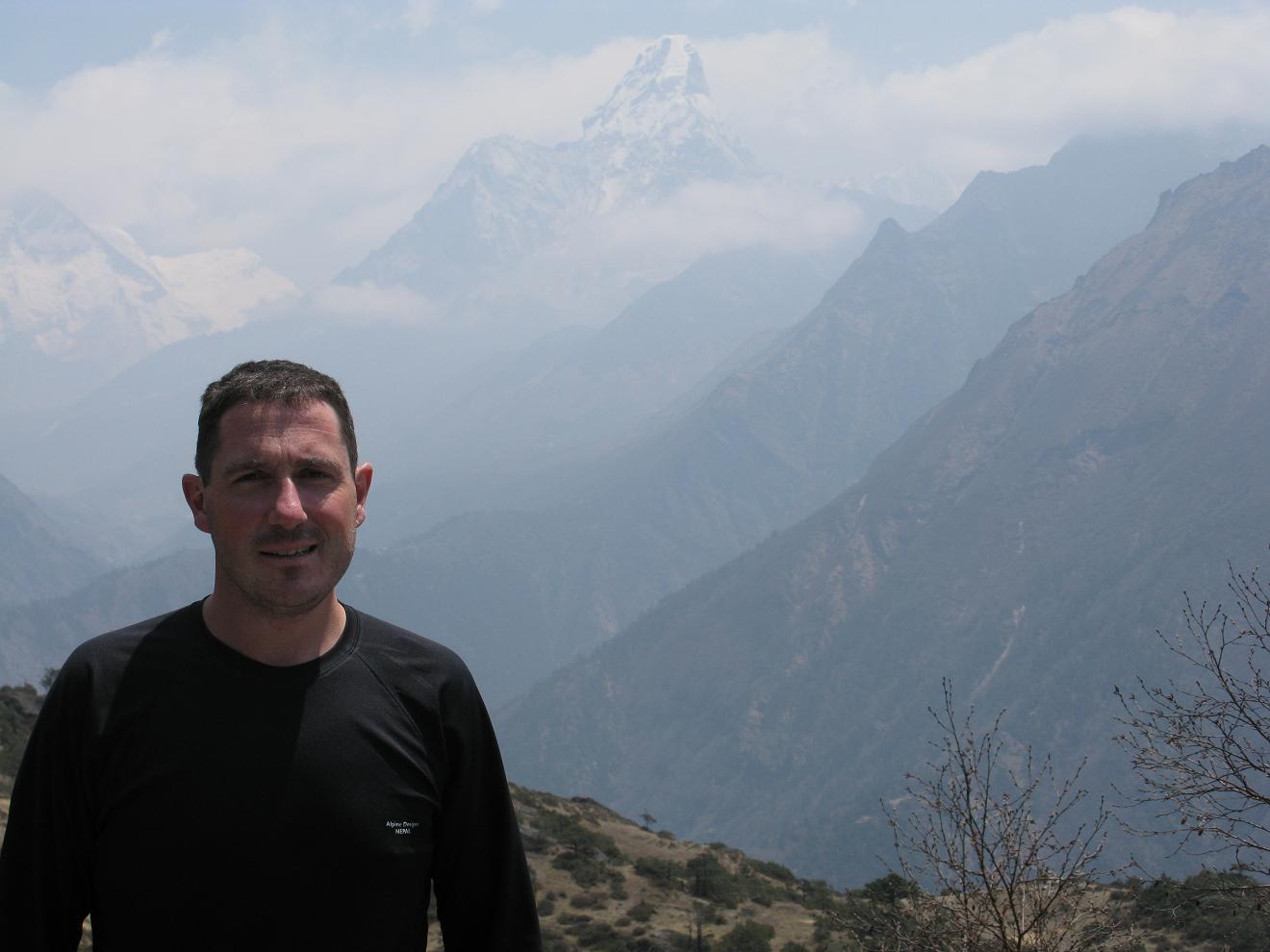


 Andrew Duff