
After the Belly Blitzkrieg last week, I was sorely tempted to get up and leave Rajasthan immediately. The Desert Festival had been close to a tourist-hell, and I was somewhat nervous that the Stomach Stormtroopers had only granted me a temporary reprieve.
The advantage of having time on my side in this trip, however, is that I can always give a place a second chance. I am glad I did.
I spent an extra four days in Jaisalmer. This gave me time to get under the skin of the fort and its history, and to wander through the warren of back-streets sucking up the atmosphere in this quintessential desert-town.
One of the most remarkable sights from the roof terrace of the guest-house was the number of huge farms of wind Turbines punctuating the endless scrub and dunes. I spent a few days thinking how wonderfully progressive this all was – until I was told that they powered the floodlights on the border with Pakistan (only a matter of 50-odd kilometers away) rather than being for the benefit of the people.
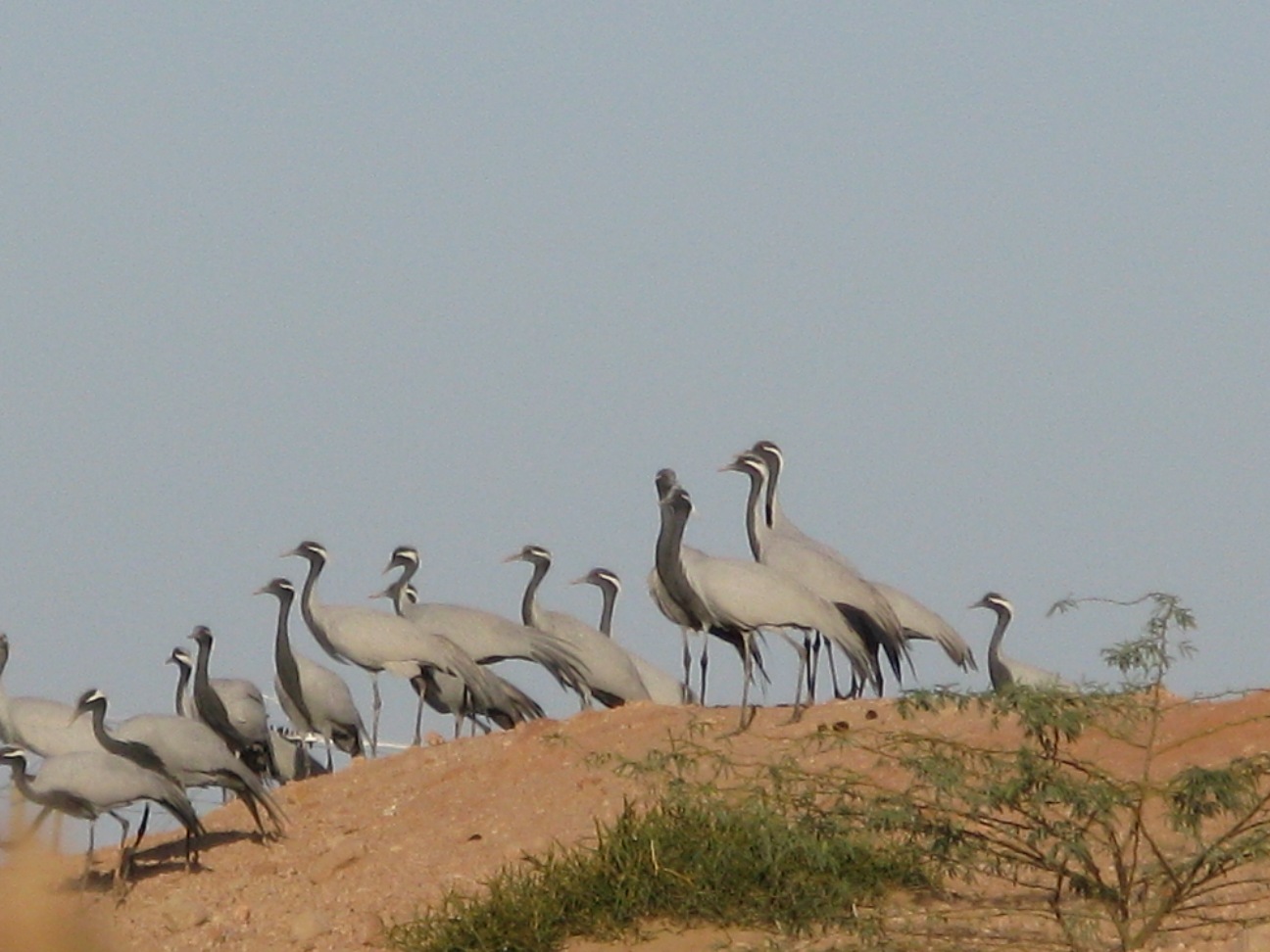 And then I followed a whim. A tiny paragraph in the Rough Guide told of a small village called Keechen, where 4000 Demoiselles Cranes supposedly migrated each year. I hired a jeep and a driver, and headed into the desert.
Whims are wonderful things. I was rewarded with the amazing sight 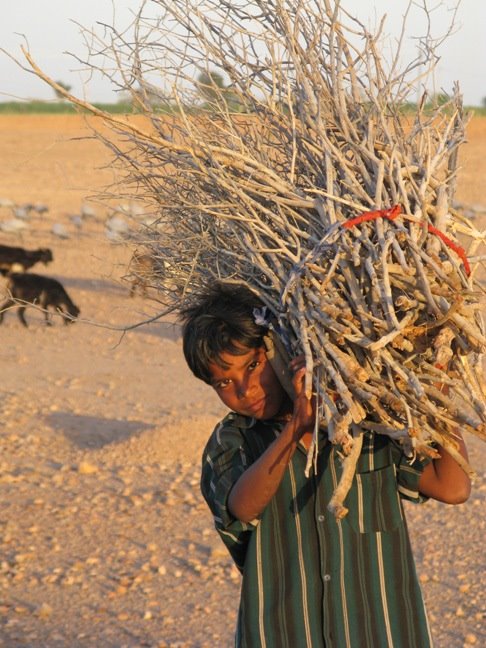 of 4000 of these beautiful birds feeding by a small pool and then taking off back to their resting place as the sun slowly went down over my shoulders. It was a moment of real beauty which I was incredibly privileged to see – with only a local cowherd as company.
We set off for Jodhpur the next morning in a thick pea-souper. (http://en.wikipedia.org/wiki/Pea_soup). We were a good 10 kilometres down the road when I realised that my flat-cap (donned to protect against the surprisingly bitter cold) must have dropped out of my pocket and out of the jeep. In a deep state of anxiety, I got the driver to return slowly, allowing me to scour the side of the road. This was no easy task, given that said flat-cap bears a more than passing resemblance to a cow-pat.
Just as I was giving up hope, two stray-dogs loomed up out of the mist. They were fighting. How disgusting I thought – over a cow-pat. Wait a minute…! I leapt out like Daniel Craig, beat off the mangy curs with my bare fists, and rescued my beloved. Panic over. (The morning got increasingly more bizarre, but that’s a tale for another day).
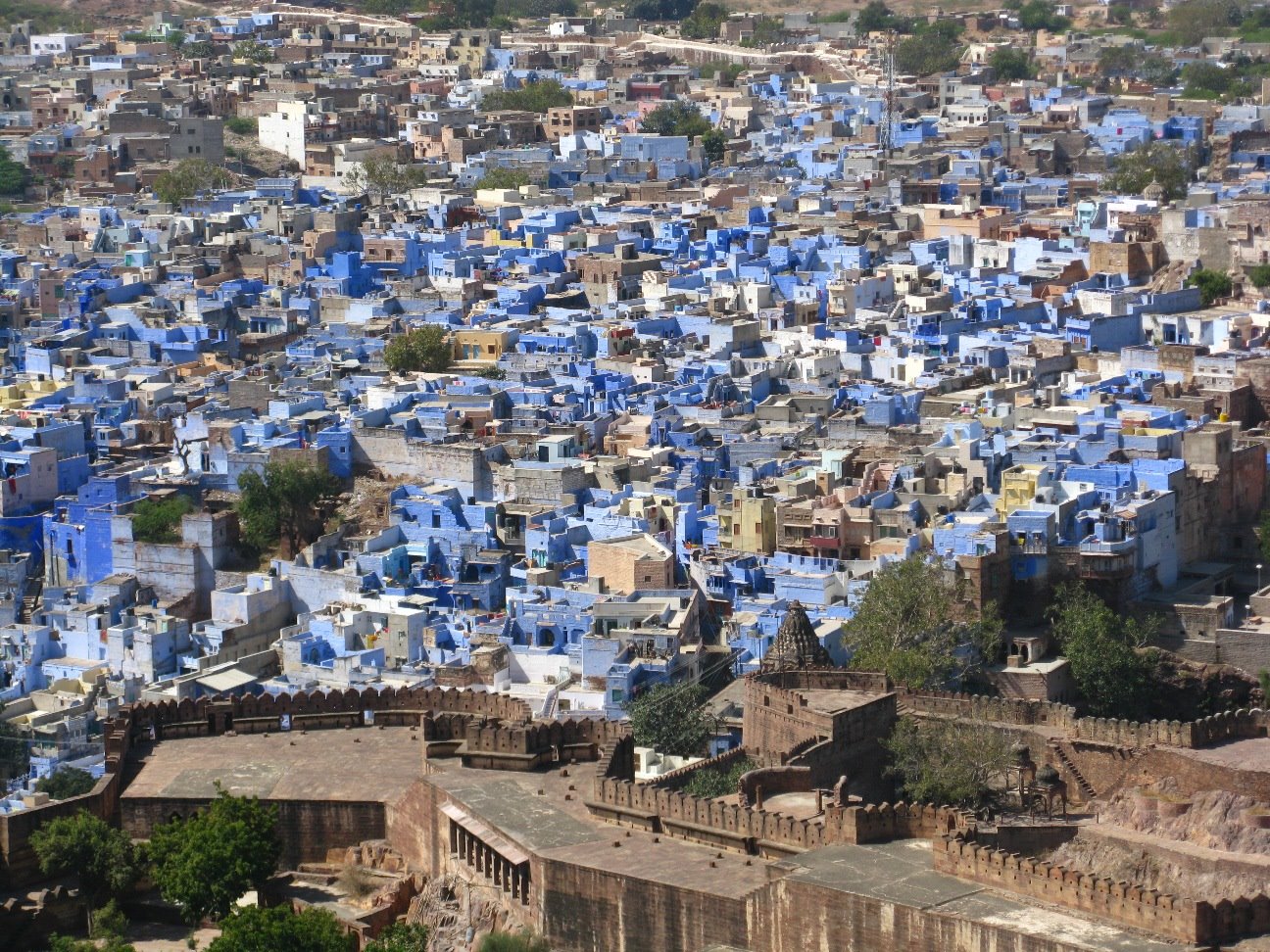 My mono-syllabic driver (suited me) Salim drove me on to Jodhpur. If Jaisalmer was a grower, Jodhpur struck me from Day One., the city, dominated by a fort which has to be seen to be believed, is nicknamed the “Blue City” after the Indigo that was mixed in with the whitewash by upper-caste Brahmins to keep their houses cool, keep away the insects, and (presumably) to mark them out from lower castes.
While visiting the fort (beautifully maintained by the current Maharaja), I noticed that the really blue houses seemed to be to the North, an area near the well-preserved outer city wall, and not mentioned in the Rough Guide.
So the following morning I hopped a couple of fences, got up to the city walls, and walked round to this area. It was a timely reminder to get off-piste whenever possible – the walk was stunning, and I was correct in surmising that this was the real Brahmin area. For a blessed couple of hours I escaped the constant street-hawkers in the main part of town as I wandered through the narrow hilly alleyways, getting a sense of the immense history and tradition in this city.
Later, I overheard someone mentioning Shakespeare being done at the Fort. I followed my nose, and that evening found myself watching a staging of Measure for Measure, performed by five English actors and actresses and directed by an ex-Czech Ballerina. It was so good that I returned the following night to watch it again, surrounded by half the guides and guards from the Fort. As this is the Shakespeare play that saw my one and only triumph on the stage (at school) I felt justified in giving the cast a few tips at the end.
I visited the remarkable Art Deco Umaid Bhawan Palace (the Maharaja’s current home and a 5-star hotel to boot) yesterday, and left this morning to come to Udaipur, where the bizarreness continues – the Bond film Octopussy (which has a sequence which was filmed here in the amazing Lake Palace Hotel) is shown in every guesthouse nightly at 7pm. I am in room 007.
It is easy to see how you could get drawn into this state by straying off the beaten path as author/journalist William Dalrymple did – (for insights into Rajasthan’s – and all India’s – complex caste and cultural heritage, read his excellent book “The Age of Kali”). But there’s also no doubt that Rajasthan is the part of India that is most set up for the mass tourism. Its proximity to Delhi and Agra and the Taj, its accessible and relatively simple to understand dynastic history, and its romantic desert light all make it ideal for that.
I will probably spend another week or so in and around Rajasthan before heading East.


 Andrew Duff