Category Archives: India ’08-’09

Indian Student politics (via a wild goose chase)

Given the forthcoming elections in India, politics are front of mind here. A couple of days ago, I had a brief insight into the student version, via a circuitous route.

I had decided to try and get in contact with an Indian family that had looked after friends, Patrick and Mary Harrison, when they were here 15 years ago. Patrick (now retired) was Secretary of the RIBA and had been visiting an architect in Cochin. The architect had asked his secretary (Katherine Alencherry) to give them a tour of the Cochin backwaters.

The ensuing brief trip (with father Sebastien who worked for Indian Railways, plus two children) was one that I was told all had always remembered fondly. Christmas cards had been exchanged since, but no further contact than that.

To make the connection, I had been given a sparse architect’s scrawl – “ALENCHERRY, Railway Quarters 132/G (or 4?), Beat No.9, Ernaculam South, Cochin”. This drew blanks from the owner of my hotel, as well as from his friends rapidly assembled to help. More enquiries in town were met with similar puzzled looks. I feared a wild goose chase.

A couple of vague directions from random friendly looking people on the streets of Cochin didn’t feel particularly helpful at the time, but after a couple of hours I found myself on the first floor of a small building in a tight back street by the Ernakulam Railway Junction. I knocked on the non-descript door more in hope than expectation. (I recalled a discussion with my father before leaving where we had agreed that “the best thing about being a pessimist is that you’re never disappointed with the outcome”).

I didn’t have time to be disappointed. Instead I was taken aback by the welcome I got from Sebastien and Katherine Alencherry. It was pure chance that Sebastien had a days leave, and that Katherine had returned home for lunch. They had no warning that a random man would be turning up at their door saying he knew someone that they last spoke to 15 years ago.

Tea was conjured up; rapid telephone calls were made; in no time 3 turned into 6 as their law-student son Karol turned up with two of his college friends; plans were made without any consultation of me; and within minutes I found myself in a cramped Suzuki Maruti 800 heading for Cherai Beach with Karol and his friends.

Slightly stunned, I told them that while I was delighted with the rapid turn of events, I was concerned that I might be keeping them from their studies?

“Oh, don’t worry, there’s a strike at the college. There was an attempted murder there yesterday”. Gulp. “Oh yes, one of the BJP [Hindu Nationalists] student representatives tried to stab one of the SFI [Communist] reps in the neck with a sharpened screwdriver.”

Another gulp. I tentatively asked if they were involved in student politics. “Oh yes,” Karol responded cheerfully, “We have started our own party. Very important demands. We want that the college bus stops at the female college BEFORE they get here rather than after. This is very critical indeed – we need to meet girls!”

After a lengthy walk and plentiful conversation, I returned to Cochin for dinner, and an unexpected dip (fully-clothed) in the pool of the pricey Malabar House Hotel. (It’s a long story, not quite as loutish as it sounds, and not making it onto the blog).

I am now in the tea plantations of the Kanan Devan hills. Another amazing bus-ride to get here, and now traveling for a few days with the afore-mentioned Justin, who rode here on his Royal Enfield Bullet. We are staying with legendary Joseph Iype, made famous by Dervla Murphy’s book “On a shoestring to Coorg”.

Given the out-of-town location of Joseph’s home, moving anywhere involves riding pillion down potholed roads on Justin’s Royal Enfield Bullet motorbike. Which is just as fun as it sounds.
Leave a comment

Filed under 'mind the gap' journey 08-09, All posts, India '08-'09, South India

Cochin, Backwaters, and Mel’s 5-legged elephant

Another week in Paradise.

The week started in style with a great connection with Polly Gough, who is the Medical Co-ordinator for the Volvo Round-the-world ocean race which is visiting Cochin. Over a magnificent dinner at the Malabar House restaurant (thanks George, Race Commercial Director), the conversation was filled with stories of the frustrations and challenges of getting things done here. I was left quite breathless by the story of… getting the Race Doctor in London to get the rep from a knee-brace manufacturer to get one of their employees to fly to Cochin stopping off at the Embassy for an emergency visa and getting here just in time to allow one of the sailors on the Green Dragon (Irish boat turned Chinese-Irish after the money ran dry) to continue to Singapore. Phew. The stories of dealing with DHL in Bangalore were equally draining.

The speed and organization required to run an event like this is immense, and it will be interesting to see if the race returns here. The security was so appalling that Mel (a friend who flew in from Delhi) and I easily slipped through into the dockside for the race start – me flashing my pass (which gave me no rights to be there) and Mel peering importantly through her Chanel glasses at her Apple i-Phone. Frustrating as it may be though, it is hard for any sport to ignore the numbers here – the crews were made to feel more like rockstars than ever with the crowd pressing madly up against the hastily erected fences.

I met the afore-mentioned (Australian) Mel traveling in Vietnam in 1996. After a 2-year stint at the Beijing Olympics, she and her husband are now in Delhi prepping the Commonwealth Games. Naturally, Delhi is proving a challenge, and Mel flew down to spend a few days in Cochin to escape the anarchy and noise of the capital, which couldn’t be more of a contrast with the control of Beijing.

Like any sensible girl (given she had no idea what to expect), she packed high heels and two pairs of sunglasses. This definitely increased my streetcred. Her Marc Jacobs bag, and Chloe and Chanel sunglasses attracted judgemental (read: jealous) glances from dreadlock-clad travelers in search of something more akin to the mystical magic that the Beatles wanted everyone to believe was India.

Curiously, one group that have challenged this hackneyed view of an Indian nirvana-in-waiting are Justin (who I had met on his motorbike in Kannur in the previous post) and his friends Kiwi and Aurosan. Kiwi and Aurosan are both residents of the Auroville experiment in Tamil Nadu (Aurosan was in fact the first child born of Auroville residents in the commune). They are, I suspect, very far from what the combination of the words “commune” and “India” are conjuring up in your mind – these guys are well-dressed, well-educated, well-traveled. Auroville is creeping onto my path I think.

I definitely get the sense that attitudes, not just economics, are changing facts here. Over dinner with Justin and the Indian owner of a recently-opened luxury hotel, Mel turned the conversation to the frustrations she had with India, and with Delhi. She railed against the corruption, the dirt and the noise, the water situation (where the poor have to buy water from the mafia) and the general inefficiency. Justin leapt to the defence of this India, making an equally strong and impassioned argument for the strange honesty of baksheesh, the reality implicit in the dirt and the noise, and the contrast between camera-laden streets of London and the freedom of the Indian streets.

I was intrigued to know the views of the hotel-owner, the only Indian at the table, who sat quietly until the argument subsided. Too polite to take sides, he simply gave the facts – 6 months, and 100,000 rupees in bribes had failed to get electricity to his hotel for the opening. That is the reality of the system of doing business here. But you get the feeling that it is under pressure as burgeoning economic success starts to reveal the cracks in a system that lives off corruption.

(On a related tack, ordinary Indians know what they want too – an Indian asked me yesterday what I thought of the trains in India. I replied, rather too gushingly, that I loved them. His reply: “That is so funny – you want Indian trains, and all we want is bullet trains!” I felt deeply colonial).

A lighter note. Mel and I took a trip to the beautiful backwaters of Kerala after the boats left. This stunning area of natural beauty took our breath away. We avoided the tourist traps by traveling first by ferry into Kumarkorum in the heart of the area, before hiring a houseboat over night. One of the strangest things was visiting one of the Syrian Orthodox churches, and meeting Father Cyriac, who kicked off the conversation with the usual “Where are you from?” A simple reply is often the limit of the conversation with Indians who have merely been demonstrating the four words of nglish they know. In this case however, the reply of “Scotland” was greeted with “Oh, Edinburgh, I love Edinburgh, we have many Keralan nurses in Edinburgh, and I visited Edinburgh many times.” Nice conversation ensured.

Finally, Mel’s enduring memory of the backwaters will be our encounter with an elephant by the side of the road, which she was convinced had five legs. In some ways, the poor girl was even more shocked when the fifth leg started gushing like a hosepipe, and she recalled her fifth-grade biology lessons, relegating the elephant back to the reality of the quadrapedic world.

Heaing into the hills tomorrow, and over to Tamil Nadu.

Leave a comment

Filed under 'mind the gap' journey 08-09, All posts, India '08-'09, South India

Of bees, buses, and boats

Neither the Coorg region nor Kannur in Northern Kerala were on my (admittedly vague) pre-departure itinerary. As a result of my visits to both in the last eight days, I now have a passing knowledge of the world of the apiculturist, and experience of the incredible ancient spirit possession ritual, Theyyam.

Chance is a great mentor while on the road. A fleeting encounter with a crazy American girl Alissa a couple of weeks ago led Swiss Hanna and me first to the Honey Valley “Homestay” in the Coorg region. Coorg nestles in the Western Ghats, the mountain range stretching from near Mumbai down to India’s southern coast. (Apparently it was referred to as the “Scotland of India” by homesick colonials, although as my host Suresh pointed out, there’s not much coffee growing in Scotland).

From his idyllic home (accessible only by jeep), Suresh and his family built a business from scratch as the largest honey producer in Asia. At their height, they produced 7 tonnes of honey, until an imported disease struck Asian bee-keeping in 1991. Since then he has built a business from coffee, cardamom and pepper farming, the homestay business for travelers during the week, and most importantly a regular gaggle of loud Bangaloriloos (splendid new term for Bangalore residents, coined by one of the workers at Honey Valley) who travel for seven hours to escape here from the city at the weekends.

I could have listened to Suresh talking about bees for hours. His encyclopaedic knowledge of the apicultural world, combined with a guru-like ability to draw philosophical analogies from the world of bees, were legendary. I learnt about the wiggle maps that scout bees dance to communicate directions to colonies before migration; the remarkable ability of Asian bees to surround predatory hornets, closing in so tightly that the hornet suffocates; and the sad stories of imported bees from Europe bringing disease, ruin, and hardship in the name of so-called agricultural economics. (“The problem with Agricultural Economists”, he said quietly, “is that they think like a laserbeam. I understand them and know they are needed. But they don’t understand me and my land.”)

In between more fantastic South Indian meals, and my starry-eyed sessions at the feet of the Suresh-guru, we trekked through the beautiful Ghats, swimming in the river, passing over an ancient salt route, and generally getting lost in the beauty of this amazing region. And all this for under a tenner a day.

Apparently everyone stays longer than they intended at Honey Valley, and we were no exception staying 6 nights.

The next adventure started with a fun six-hour jeep-bus-jeep-bus trip which brought us to the virginal Malabar coast of Kerala, peppered with unspoilt beaches, white sand and palm trees.

We stayed in another Homestay (Costa Malabari), with the usual assortment of interesting fellow travelers. This time they included an independent film producer making a series of Channel 4 “Three Minute Wonder” programmes on monkeys, an amateur photographer doing a project on tourists in context in India, a biker traveling to hippy colony Auroville from Goa, a painfully try-hard 50-year-old who we christened “Trendy Dad”, and a cast of other minor characters.

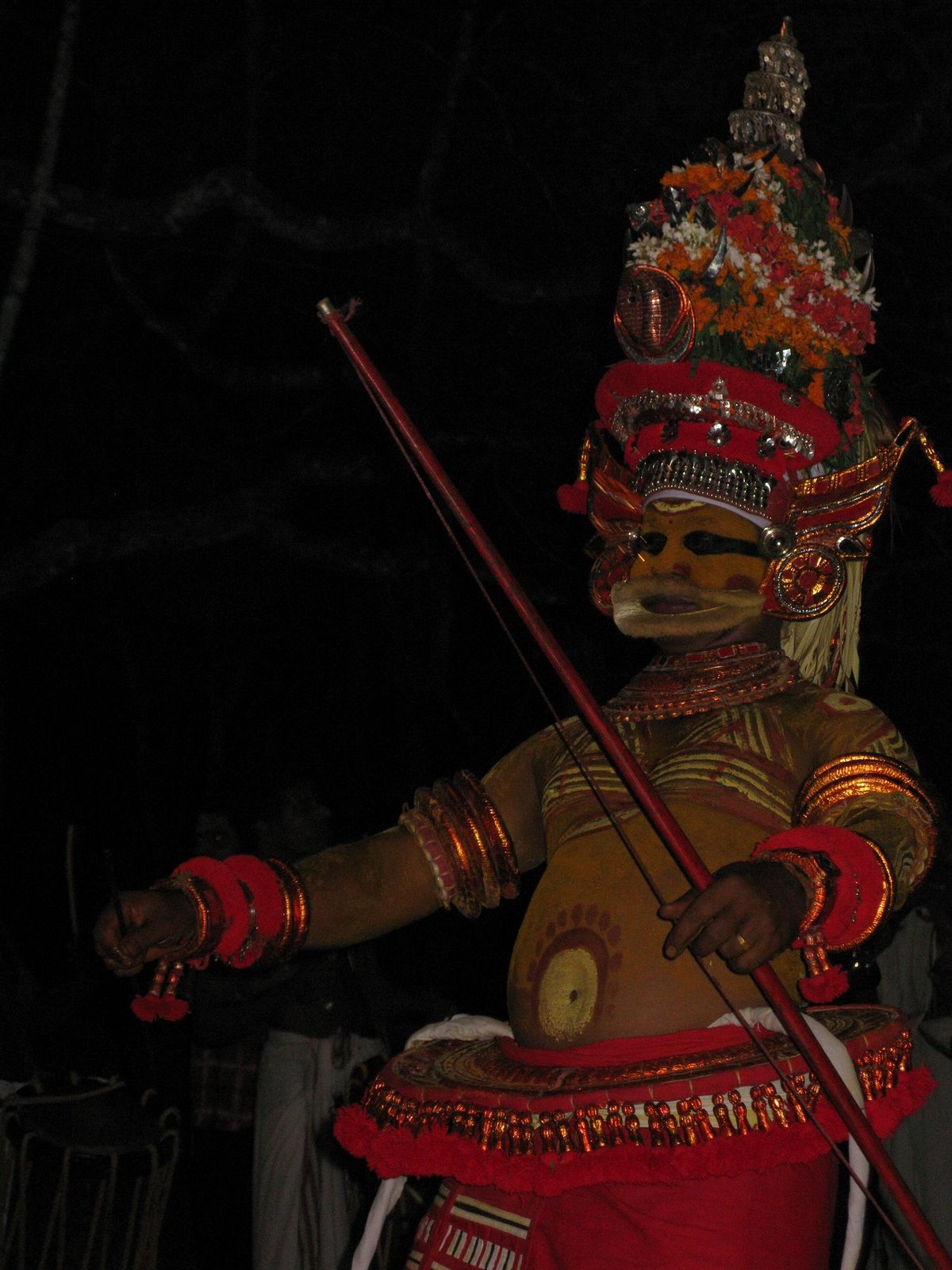
I had read about the spirit possession ritual Theyyam, and it was one of the reasons for heading to Kannur. Kurian, the host of Costa Malabari, is an expert on this little known religious ceremony where villagers are body-painted and don extraoadinary costumes to assume the roles of Gods, pass advice to fellow villagers, and enact ancient stories. If you want to know more about it, click here – I won’t bore you with the details. Kurian arranged for us to visit a remote village where it was to take place that night. It was remarkable, and fantastic to observe a real ceremony rather than see some sort of show put on for tourists.

The return journey by minibus was more than a little eventful. Granted we were literally in the middle of nowhere, and so inevitably got lost as the clock crept towards midnight. The driver, with one hand on the wheel and the other glued to his mobile, tore along palm-tree lined one way roads, often in reverse, like Ayrton Senna at his most daring. On more than one occasion it looked like we all might be joining Senna in the Great Big Car Lot in the Sky.

We made it out alive, and I am now in Cochin, where the Volvo Round-the-world Yacht Race boats are in harbour. Given the remarkable longevity of the Phoney War, I think I might spike their food and see if I can get on the next leg to Singapore.

Leave a comment

Filed under 'mind the gap' journey 08-09, All posts, India '08-'09, South India