
Category Archives: India ’08-’09

Getting lost in the Delhi Triangle

I have been staying with ex-pat friends in Delhi’s “Defence Colony”, the plush suburb that marks the break between the heritage of both Old and New Delhi in the North, and the sprawling middle class housing projects expanding ever further south.

To misquote Obama, change is coming to Delhi. Things are on the move here – the Commonwealth Games will take place in Delhi in 2010; a massive underground metro is being built (work will continue until 2021); and a Municipal government (led by the unfortunately-named Sheila Dikshit) has just been elected for a third four-year term.

With eight (some say fifteen) different cities built over the centuries, it would take more than the dozen or so days that I am spending here to understand the complexities of Delhi.

Nevertheless, I have had three very distinct impressions of this rapidly evolving city that is destined to play a major role in the 21st century.

A sense of the suburbs

After my slightly bizarre cinema experience in Jaipur, I headed out last night into the deep suburbs to South Delhi to catch Slumdog Millionaire. As my auto-rickshaw jostled for position in the road amid the Toyota, Audi and Suzuki saloons, it was clear that I was entering true aspirant middle-class Delhi.

The Saket PVR cinema complex could be anywhere in the world. The multiplex cinema, surrounded by a McDonalds, a Pizza Hut, a Subway sandwich bar and a few emerging drinking holes; young couples strolling around, while families struggled with errant children, and groups of teenagers congregated on concrete benches; Popcorn, Pepsi and pre-fab Hot Dogs on sale by the box office.

I wandered into the McDonalds before the film. Despite the odd subtle change (the “Big Mac” became the “Chicken Maharaja” – even Ronnie M has worked out that beef don’t sell in India), the similarities were more evident than the differences. The same fixed grin on the servers faces, the obligatory “Have a nice day” with your meal, the tall stainless steel dispensing units shielding the frenetic fast food preparation activity from prying eyes. As I took my Maharaja Meal upstairs, I realised that the only discernible difference was the people –you get a better class of customer in a Delhi Maccy Ds.

If it hadn’t been for the much higher standard of behavior (probably due to the lack of alcohol), the whole thing could have been transplanted into Surbiton. This very average scene is an essential part of the whole Delhi picture.

The film itself seemed to leave a few people uneasy. Moral agonising (in the way that we love in the West) still isn’t the norm in films over here. Bollywood has a tendency to keep things simpler. While the reaction that I had heard in Jaipur was probably at the extreme end, I got the feeling that there were bits of the film that did touch nerves. Which is probably no bad thing.

Remains of the Raj

In the 1930s, the British laid down New Delhi with (as William Dalrymple points out in “City of Djinns” ) more than a whiff of the arrogance and hubris of Nuremberg. The resulting “imperial mass of masonry” still holds the political centre of India, as well as wide boulevards and green spaces which recall the European cities it was built to ape.

For four weeks each year in February and March, the Mughal Gardens (actually created in the 1930s as well) of the Presidential Palace (formerly the Viceroy’s House) are opened to the public. A journalist told me that visiting these is something of a rite of passage for a Delhi-ite, so Mel and I set off on Friday to see what all the fuss is about.

As we passed the laborious security checks and entered the gardens, we both suspected that we were in for another disappointment. A slightly tatty herb garden and a Path-From-Which-You-Must-Not-Stray did not augur well.

Then, as we turned the corner into the Rectangular Garden, we were confronted by a riot of colour that was almost overpowering. The formal layout of the garden is offset by blooming flowers in hues of red, blue, yellow, pink, orange and greens of all kinds. With over 100 types of rose, all beautifully labeled, there were some great names: the “Kiss of Fire”, “Rhapsodie in Blue”, “Doris Trysterman”, “Dr B.P.Lal” (who he? Ed), and my favourite name “Just Joey”. With cameras banned from the Gardens, it was refreshing to be able to simply suck up the atmosphere without the very 21st century obsession with capturing everything digitally (more often than not only to be deleted later).

As we left the Gardens and drove along “Church Lane” past the Cathedral Church of Redemption, I felt privileged to have seen at least one fine legacy of the pre-Independence era.

Making a mess of the Mughals

Walking through the streets of “Old Delhi” (the 17th century Mughal bit) is a bit like being on one of the streets in the futuristic film Bladerunner, only without the cars flying about: the confused jumble of signage, some of it illuminated; the bundles of electrical wires hanging and occasionally crackling and fizzing; the mix of Eurasian and Asian facial types all competing for attention; the occasional hint of a glorious past in patches of architecture peeping out from down a back alley.

In many ways this part of the city is the biggest challenge for the city planners and administrators in Delhi. Even if it feels disorientating and out-of-control for many westerners, the narrow streets and alleys are packed with life, commerce, and people’s livelihoods. Change will not be easy.

At the apex of the Old city is the Red Fort, which was a stronghold for the Mughals, the British and the young Independent India.

Six years ago, the fort was granted UNESCO status on the condition that it got rid of its military garrison. As a result, things have started to look up for what could be an interesting monument with a bit of TLC, though clearly it will take time.

Our guide told us that restoration work on some of the delicate wall-paintings has been halted for 5 years, after an (Indian) NGO sued the Archaeological Survey of India, alleging that the restoration was not faithful to the original and that cleaning practices were damaging the original materials. The case is still being heard in the courts.

—–

Delhi is fascinating. An article in today’s Hindu Times noted (admittedly with a touch of melodrama) that India is now facing potential failed states on three of its six land borders (Pakistan, Nepal and Bangladesh were what they had in mind – the others being Bhutan, Burma and China). Delhi is at the heart of that particular triangle. And the religious mix here certainly continues to hold a degree of repressed tension.

With such a diverse and rich historical background and such a potentially important future role, this is a city to watch.

I leave on Tuesday heading for the Gangetic Plains.
Leave a comment

Filed under 'mind the gap' journey 08-09, All posts, India '08-'09, North India

Bikaner Boozers

Bikaner is one of those towns that doesn’t cut much ice with the Rough Guide: “The smoggy city of BIKANER has little of the aesthetic magic of neighbouring Jaisalmer, Jodhpur and Jaipur…

But what it lacks in tourist-friendly “aesthetic magic” (somewhat questionable in two of the three Js anyway), Bikaner makes up for with a cowboy-style attitude that makes it feel more of a genuine dusty desert city than other cities in Rajasthan.

I arrived here fresh from the Rat Temple. As I knew I was spending a single night here, I checked into the cheapest place in town. This is always something done more in hope than expectation – however much the room looks clean, quiet and comfortable at first site, at that price it is a racing certainty that

a. the toilet won’t flush (check)
b. the bed will have all the flexibility of concrete (check)
c. someone in a next door room will listen to a Bollywood classic at 2am at full volume (check)
d. random heavy goods vans will go past at 3am tooting their horns for no reason (check)
e. roaches will gently nibble at your ear at 4am to wake you up (check)

That was all still to come though, and I set about taking in what sights Bikaner had to offer.

Which didn’t take long. The highlight was the audio-guide for the fort, narrated in a wonderfully proud cut-glass Indian-English accent. We were to be treated to a “plet-HORA of artefacts, some wonderful paraphern-EE-lia from the Raaajpoooot era”. As the tour ended, his final words were so splendid that I wrote them down:

“We have MEANDERED through Junagarh fort together… and STRODE through pages of its history. I hope you have IMBIBED the essence of our customs and traditions, a RARE LEGACY. Before we take leave of each other… [etcetera etcetera]”

By the evening, I was ready for a drink.

In most of Rajasthan, beer is readily available in restaurants. It quickly became apparent that this wasn’t the case in Bikaner. Sensing my thirst, a friendly restaurant owner pointed me in the direction of a small alleyway where he assured me I would find the answer to my prayers.

The bar in question turned out to be a small dimly-lit 20 foot by 20 foot smoke-filled room, with a few tables surrounded by chairs. There was one seat free. I hesitated. The room fell silent. 30 pairs of eyes looked forlornly at me from under vacant drooping eyelids, an all too familiar look perfected in run-down pubs across semi-rural Scotland.

Given my earlier brush with the rats however, I was feeling pretty confident of my ability to handle all-comers, so I settled down in the free chair with a Kingfisher.

As conversation slowly resumed, I took a look around. The similarities with a Scottish boozer were pretty strong. The photocopied sheet of A4 announced “Free peg [shot] of McDowells [whisky] with 2 beer”; the TV high up in the corner of the room flickered silently (although I’m not sure they play Bollywood films in Cowdenbeath bars); the smell of stale alcohol that felt like it hadn’t left the room for months.

As I watched pegs of McDowells disappear with alarming regularity, I realised that this was a bit like an Indian tourist sitting in said bar in Cowdenbeath. One beer was enough. I suddenly felt deeply conspicuous, and left.

I returned to my hotel with the night’s pleasures still to come, reflecting on the fact that booze is one language that is truly (and sometimes sadly) international.

Back to Delhi tomorrow.

Leave a comment

Filed under 'mind the gap' journey 08-09, All posts, India '08-'09, North India

Slumdog attitude, “Holi” Colours, and Reincarnating Rats

Slumdog attitude

I arrived in Jaipur yesterday, fresh from an extraordinary experience at Deshnok’s “Rat Temple” (story below).

On discovering that Danny Boyle’s film on Bombay “Slumdog Millionaire” had swept the Oscars, I decided to take advantage of being in a relatively big city for once, and catch the film in a local cinema. I enquired of the hotel’s owner as to where it might be showing.

“Very boring film sir,” came the barbed response. “We did all that slum stuff in Bollywood 30 years ago. And very silly film too. No Indian actors – they used Chicago back street boys – PAH! You English think you know India but you get it all wrong! You insult India! Why don’t you make films about your own problems – like your 13-year-old pregnant girls?”

I pointed out that we do actually make films about pregnant 13-year-old girls (in fact rather too many of them), and suggested he explore the collected oeuvre of Ken Loach if he was interested in that kind of stuff.

He gave me a vague and reluctant wave towards an out-of-town cinema, but the conversation was rapidly going nowhere. It became clear that my best option was to venture out on a solo exploration.

The Raj Mandir was the nearest cinema. Built in 1976, this faux-Art-Deco pile in muted pinks and magnolia provides a fantastic location to escape the hustle and bustle of Jaipur’s streets, with a dose of Bollywood. The choice of film was fairly simple. With only a single screen (albeit capable of showing to at least 1000 people I calculated), the new release “Delhi-6”suddenly seemed like an excellent idea. Slumdog would have to wait.

Having previously taken in a Bollywood film in Mumbai, I knew vaguely what to expect. Bollywood story lines are always straightforward and this was no exception: Indian Boy living in New York returns to Delhi… realises Mother India is wonderful… meets a girl… sings a song or two… and falls in love. It’s actually got a little more to it than that, but the simple story-lines (combined with the fact that English tends to be used in various key moments) help to remove the Hindi language barrier. And if you lose the plot, there are plenty of students in nearby seats willing to whisper you back on track.

I settled back in the comfort of a large velour sliding seat.

I had a sense that we were in for a rowdy night when one of the pre-film ads was drowned out by wolf-whistles and cat-calls. In the ad in question, a sultry woman moved seductively around a smart penthouse flat in close proximity with her dashing consort. Every time she passed the light switch, she managed to turn off the light (with her hand, her toes, her elbow) and bring her man closer. Every moment of darkness was greeted with an ear-splitting rise in volume from the Indian boys in the cinema. The ad was for…? Yes, you guessed it. “Elley Light Switches”.

Sexual content is frowned upon in Indian cinema. As a result, Bollywood films are famous for their sudden cut-aways to sequences of birds or animals mating as a substitute when things get too steamy on screen. The occasional bare foot or lower leg is fine, but that’s it. But as with any prohibition, the heart just grows fonder…

In an amusing take on the familiar routine, the sex scene in Delhi-6 did indeed cut away to a pair of courting doves on a TV screen at the end of the bed – but then showed four intertwined feet clumsily hitting the “Channel up/down” button in the throes of passion. Cue a TV re-run of the Indian space-rocket getting ready to take off; back to the birds; and back to an explosive shot as the rocket disappears into the sky. The cheers around me were deafening.

As the film reached its own climax, we even had an appearance from the legendary Amitabh Bachchan. In India he seems to appear in virtually every ad on TV (apart from the ones with cricketers Tendulkar or MS Dhoni in them), and pops up in most films. In Delhi-6, the lead was played by his son, Abishek, giving the film-makers the excuse to bring him in for all of 30 seconds, as a heavenly spirit providing guidance to the young pretender.

Returning to the hotel in good spirits, I was greeted by the glaring owner. “How was the film?” he asked with some venom, still under the impression that I had slummed it with the dogs.

When I told him that I had switched to “Delhi-6” he visibly softened; and his mood changed completely when he heard that Bachchan had made an appearance.

“Ah… Amitabh…! I have a list of things I want to do in life – meeting him was on the list! He came to Jaipur and I saw him! I love his BARITONE voice and his DOWN-TO-EARTH attitude… But his son – PAH! He has a long way to go… I mean Amitabh is such as COLLOSALUS… isn’t that what you say?” I thought it best to let this small grammatical error gently pass.

“Holi” Colours

While Bollywood is developing into something of a religion of its own for the urbanizing youth, Hindu culture continues to provide a strong backdrop for the lives of millions of ordinary Indians. I have been lucky enough to experience this twice in recent days.

First, in Udaipur I had wandered into the small Jagdish Temple for a quick look en route somewhere else. When I realized that some form of celebration was taking place, I took a seat on the floor in the crowded main area intending to stay for 10 minutes.

I had chanced upon a preparatory celebration of “Holi” or Festival of Colours. Over the next 90 minutes, I became involved in the famous ritual, as a chorus of seventy or so women slowly built up the volume of their rhythmic chanting (to Rama, Krishna, and Jagganath – all incarnations of Vishnu).

As they reached a crescendo to a backdrop of clanging bells and burning lamps, a priest appeared and threw coconut water over us all. I found it hard to feel quite as enraptured as the women next to me, and when the priest reappeared with bags of green and red powder, I got nervous. Rightly so, as it turned out. The women knew what was coming, and pulled their ghunghat veils over their heads in preparation for the onslaught. Clouds of coloured powder descended from the heavens over us. I tried to relax, remembering that laundry’s cheap in India.

It was a strange experience, and one that probably has changed little over 500 years. The devotion in the worship, and the time that is dedicated to ritual, are not unique to India; but they are embedded in society here in a way that creates a sense of communal purpose above and beyond most other cultures.

Reincarnated Rats

After Udaipur, I decided to take an overnight bus to a place called Bikaner, close to Deshnok which is the site of one of India’s more bizarre temples – the Karni Mata “Rat” Temple.

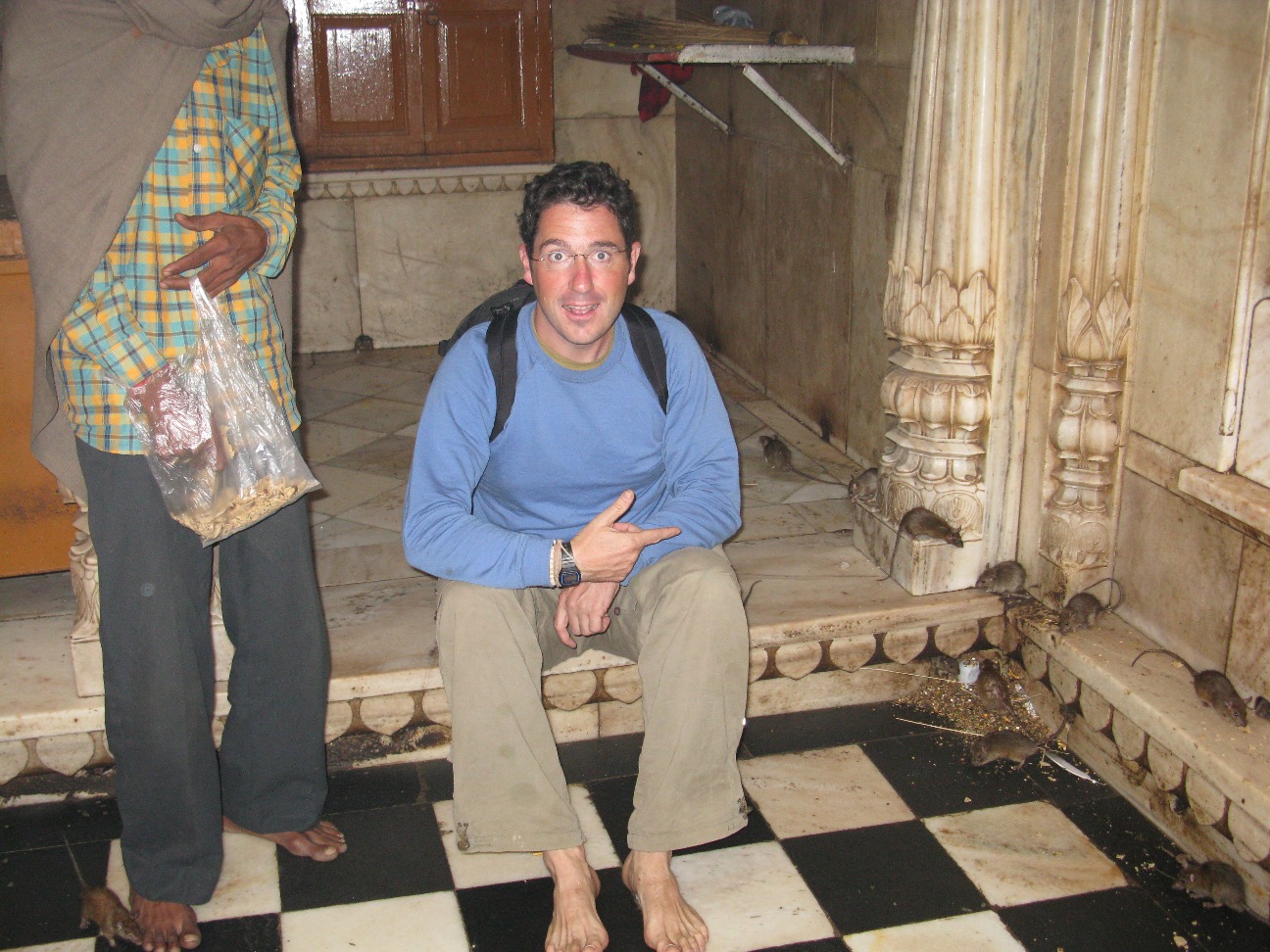
Members of the Charan Caste believe (for reasons that I won’t go into – but you can read about here) that they are reincarnated as rats. As a result, rats in the temple are fed daily and allowed to roam free everywhere.

I had taken a ropey overnight bus to get to Deshnok, so I arrived at 7.30am in a bit of a daze. This probably helped. Given the thin patina of rat droppings evident through the marble entrance, I decided that “sans socks” was the way ahead. I gingerly edged through the doorway.

Although I was prepared for the onslaught, this has to rank as one of the more bizarre experiences of my life. The rats scurried back and forth, less intimidating than you might think, and making up in speed what they lacked in size. I forced myself to feel blessed as a mangy rodent scuttled across my toes 1-2-3-4-5 – it is considered good luck to have one of these reincarnated souls run over your foot.

Being the only Westerner in the building at such an ungodly (no pun intended) hour, I got some special attention from the temple attendant.

As he pulled me over to a corner, he started muttering excitedly “White… white…” I admit that I got a little excited. I had read that a glimpse of the Temple’s venerated “White Rat” is considered very auspicious, something that many people spend hours waiting for. I had been there for less than 15 minutes.

Suddenly a pair of white whiskers appeared, poking through a small hole in the temple wall. A group of worshippers rushed over to be beside me, chanting incantations and telling me how lucky I was. The whitie made another appearance, before wisely retiring, probably for the rest of the day.

I left the temple and moved on, having seen something that few get a chance to see.

Bollywood. Temples, Rats. India is nothing if not diverse.

More tomorrow.

Leave a comment

Filed under 'mind the gap' journey 08-09, All posts, India '08-'09, North India