Category Archives: ‘mind the gap’ journey 08-09

Base Camp, Bad Booze, and Bad News

[Continued from the previous post]

It is a short 90-minute saunter up the side of the glacier to get to Everest Base Camp, the jumble of tents at the bottom of the infamous Khumbu Icefall apparent from some distance.

Given the uncertain nature of glacial terrain, the path doubles back and forth past crevasses before suddenly entering the compact area of tents. This year, it is home for over 600 climbers, supporting sherpas and porters, their tents perched improbably on the ice on stone-built platforms.

The risks are ever-present. A couple of days before my visit, an avalanche had swept down the Khumbu Icefall, killing one Sherpa climber and injuring two others, the snow-dust cloud reaching well into Base Camp itself. The Icefall, which moves about a metre down the hill each day, is always dangerous – and particularly unpredictable this year. The snow piled up on the forbidding slopes to North have made it more treacherous than usual – to the extent that at least one expedition leader has put a time limit on climbers getting through. If you can’t make it in time, tough – you’re back down, no climb.

But I had work to do – 8 days earlier, across a couple of mountain ranges ot the West, I had been given a letter to deliver from a Sherpa whose son was at Base Camp. I started asking around to locate his expedition. “Alpine Ascents?” I enquired. The familiar answer – “Go straight” with a vague wave of the arm in the direction of the main camp – wasn’t particularly helpful.

In fact, somewhat predictably, Alpine Ascents was the furthest possible set of expedition tents right at the top of the temporary village by the foot of the icefall. Knowing that expeditions were not always that keen on the distraction of visitors, I entered gingerly.

“Errrr… I’m the postman – anyone know Nima Nuru Sherpa?” A few shouts and grunts later, and the 19-year-old Nima wandered out, toothbrush in hand.

It was a great moment – in an age of instantaneous communication across continents, there’s something deeply satisfying about delivering a letter by hand over 30 miles and eight days. After he had devoured the letter, I sat quietly drinking tea with Nima for half an hour. He must have offered me more tea about very 30 seconds. I will stay in touch with him.
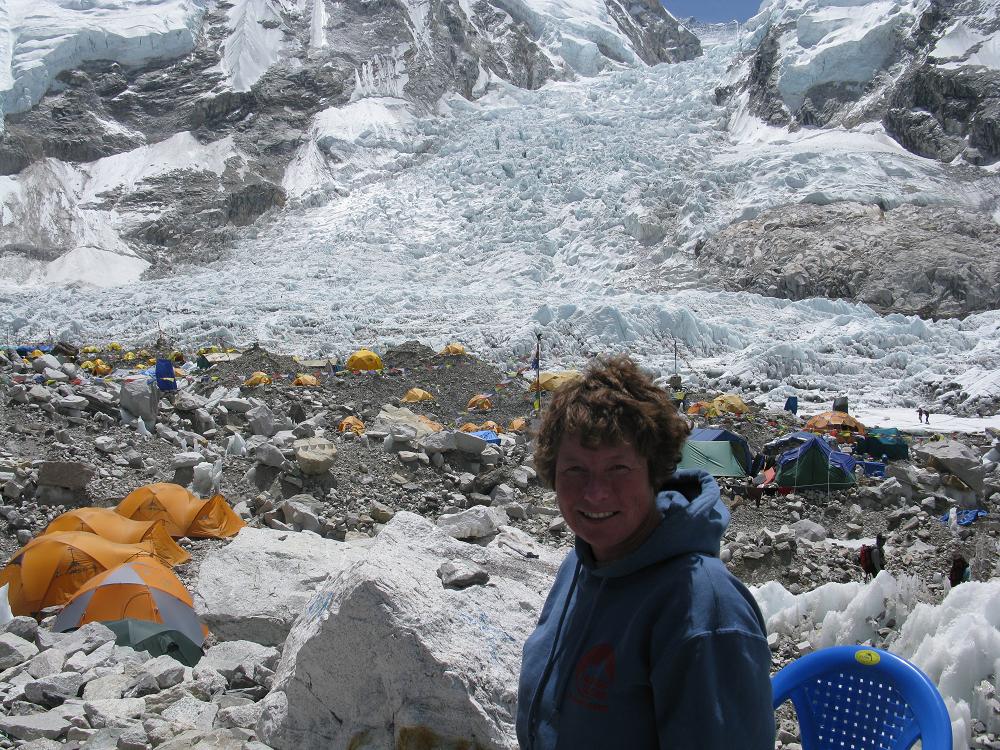
I spent a further couple of hours at Base camp, chatting with the leader of the Jagged Globe expedition (Adele, pictured in front of the Icefall, with the ominous hanging ice on the slopes to the left/North) and one of the climbers, Doug (Everest will complete the “Seven Summits” for him). I did a climbing course with Jagged Globe in the Alps in 2006. Adele was, amusingly, recovering from a massive party put on my the Kazakhstani Expedition the night before.

I also managed to enjoy the incredible apple pie in the Base Camp Bakery (set up by a climber-Sherpa Steven Dawa Sherpa – all the profits go towards an initiative to remove plastic waste from Base Camp) before eventually dragging myself away from this fascinating human drama.

The challenges of Everest 2009…

As I returned to Gorak Shep, heavy snow started to close in. It would snow for the next three days. Summit attempts this year have already been postponed once (orignally May 10th), and the snows are threatening to do so again. As I write, many expeditions have set off with the aim of summitting on or around the 20th. You can read about their progress here. With so many expeditions, the chances of queues for the top along the final stages is high.

After a quick wander up the 5600m peak Kala Pittar, I reluctantly started heading back down the Khumbu valley. 4 days of sickness (plus the deteriorating weather) put paid to my plans to walk over a third pass to the fifth valley.

As I descended, a series of strange incidences occurred which only made sense later. A Sherpa complaining of severe kidney pain in Gorak Shep; an expedition leader passed me running down from Base Camp to the medical camp at Pheriche and back (2 hours round trip); a higher-than-usual number of helicopters buzzing up and down the valley.

The full story is quite remarkable, and very sad. Essentially a bad batch of moonshine booze from Kathmandu (methanol masquerading as whisky) killed one Sherpa cook and severely injured another. The activity I had witnessed was an amazing (successful) 48-hour battle to save the second Sherpa. It is recorded, by the climber whose cook he was, in a compelling blog here. The doctors had to innovate above and beyond normal practice, eventually (bizarrely) putting him on an alcohol drip, to combat the methanol. Incredible.

Return to Namche and beyond

Within two hard days of walking through the snow, I was back in Namche Bazaar. I returned to the hut that I had started from. I was happily explaining my route to the owner and casually mentioned the Japanese climbers that I had bonded with over the local rice-beer Chang 15 days earlier. I was shocked to hear that 2 of them had been killed in their attempt to climb Kawande, their rope being cut by a falling rock as they ascended a ridge. It was a final reminder of how dangerous proper climbing in this region can be.

I returned, bearded, to Kathmandu for the inevitable night out in Thamel, and reflected on a rewarding, fascinating and sobering 20 days. Taking the path less trodden across the passes) had given me a broader sense of the region and it’s culture than I could have hoped for; and travelling without a guide or a porter (I carried all my own gear) increased the physical challenge, and gave me a very liberating sense of freedom.
Finally, the trek served as Phase 2 of my unintentional weight loss programme (Phase 1 being qualifying as a Yoga Teacher). Getting ill at altitude is a fine way to shed the pounds (though probably not medically recommended). While not quite a rake yet, I definitely am erring on the slender side for the first time in a few years.

I leave for Tibet, overland, on Tuesday; with only a 15-day one-man “group” visa for Tibet, I then have the challenge of entering China via the Lhasa-Qinghai railway, and trying to extend my visa – apparently not as easy as it sounds.

Leave a comment

Filed under 'mind the gap' journey 08-09, All posts, Nepal and Tibet '09

Getting to Everest Base Camp – the long way round

[I got back to Kathmandu yesterday – this is the first of 2 posts about the last 20 days in the Everest region. The second will appear tomorrow]

After spending two days rattling around in the small Sherpa town of Namche Bazaar, I was eager to get going, and to get some real altitude.

From Namche, five glacial valleys spread out like the thumb and fingers of a hand, separated by towering snow-clad peaks. Most people tramp up to Everest Base Camp along the Khumbu valley which stretches like the ring finger to the North-East; given my lack of time constraints (and my relative fitness following Sikkim), my intention was to visit them all over 20 days, travelling West to East across high passes where possible.

A barren landscape (in more ways than one)

The small village of Thame was my first stop, to allow for nosing around the less-explored valleys in the West and starting the slow process of acclimatisation.

As an introduction to just how ingrained climbing is in this region, you can’t beat Thame – it is hard to find a villager who hasn’t summitted Everest. The owner of the small lodge I stayed in, Ang Phurba Sherpa, had summitted a couple of times; Ang Rita Sherpa, who as summitted 10 times without Oxygen, is also from this tiny village.

I shared the lodge with a team of four Japanese climbers who were planning an assault on Kawande, a notoriously difficult peak. Climbing/walking days here tend to start at dawn, and finish by early afternoon, leaving plenty of time for reading, thinking and chatting, so I was glad to have a chunky Dickens novel (Martin Chuzzlewit) to while away the hours. Time somehow also passed more swiftly when my new-found Japanese friends and I discovered a shared taste for the local homebrew “Chang“, which had the added benefit of lowering the language barrier significantly.

I left Thame to walk up the second valley, heading North towards the Nangpa La pass to Tibet, This is truly bleak, barren wilderness – you can get to the Tibetan border in two long days with a tent, but not many pass this way. I walked as far North as I could without a tent, rewarded with spectacular views of the massive Cho Oyo on the Nepalese border. This is also a great place to see the raw grittiness of Sherpa life, and to sense the strength of the Buddhist influence here. You can walk for miles without seeing much sign of cultivation, and then suddenly come across a glacial boulder intricately carved with Mani inscriptions, or a water-powered prayer wheel whirring away.

I stopped in the last hut before Tibet, spending two nights with Pemba Nuru Sherpa. His Chang, brewed in December, was exceptional, and as we chatted in stilted English, it became clear that he had been on Everest 6 times too, with Alpine Ascents International. It became clear that the risks of a life on Everest also had obvious benefits – he had four children at boarding school in Kathmandu.

One evening, when Pemba realised I was eventually heading to Everest Base Camp, he became quite animated. His eldest son, 19, was at Base Camp. Would I carry a letter to him? I said I would be delighted to.

By now I was well-acclimatised; with the letter in my pocket, I headed East over the spectacular 5400m Renjo La pass, a tough six-hour day, dropping down to Gokyo, a village set by one of a series of 6 glacial lakes. Gokyo is relatively popular as a trekking destination due to stunning views of Everest from a 5400m peak nearby.

After 3 days of wonderful solitude, the relative bustle of Gokyo took a little mental adjustment. I started chatting to some of the others in the lodge, and was reminded that the economic landscape away from Nepal was just as bleak as some of the areas I had been walking through. In one hut of twelve people, there were two Spanish girls, a British couple, one American and even one Chinese all made redundant in the last 6 months. In a telling and amusing role reversal, the British couple (both in their fifties) had shocked their children by announcing to their children at Christmas that they were off travelling for half a year.

I spent three fun nights in Gokyo, getting up early to see the sun rise over Everest, and exploring some of the higher lakes. (Everest is, funnily enough, the big one in the photo).


Down and Out in Dzongla and Gorak Shep

I teamed up with four others to cross the glaciered 5450m Tsho La pass over into the Khumbu Valley. We were across the hard stuff by mid-morning and had started to drop down the other side when it started.

Rumble. Rumble. Rumble. Thankfully this was the start of an intestinal avalanche rather than the more dangerous snow-laden type; I made for the first hut I could find in the small summer Yak herding station Dzongla, and hunkered down in a sleeping bag, feeling truly rotten, sickness being accentuated by the altitude of 4800 metres.

In an inevitable twist of fate, this was one of the huts with only an outside toilet. For two nights, I pulled my boots on and off with monotonous regularity to make the 50 yard dash to the rough shed with a hole in the ground that passed for a toilet, the only compensation being the most incredible views of Ama Dablam by moonlight. I even managed to remain compos mentis enough to take a snap in my reduced state.

On the third day I struggled for four hours up to the highest hut in the Khumbu valley, the last village before Base Camp, Gorak Shep at 5140m. This proved to be somewhat premature, and I spent another day laid low and miserable.

With time now marching on, and Base Camp tantalisingly out of reach, I got busy reminding myself that, in the best Buddhist fashion, pain is temporary. Then suddenly two pretty Brazilian girls came to my aid. Apart from lighting up the lodge, they also pushed some of the drug Diamox (for reducing the effects of altitude) my way, which gave my body time to recover from what had been a gut-wrenching bug.

I was slowly returning to some sort of form… as I fell into a drug-induced sleep on my second night at over 5000m, I resolved to get to Base Camp the following day come what may. After all, I had a letter to deliver…

[Click for follow up post: “Base Camp, Bad booze, and Bad news“]

2 Comments

Filed under 'mind the gap' journey 08-09, All posts, Nepal and Tibet '09

On Porters, being Present and route Planning

It’s not often that you get the chance to connect to the Internet at 3500m. I am in Namche Bazaar, the stepping-off point for Everest Base Camp Trek. Most people spend a couple of nights here for acclimatization, hence the rather smart internet facilities I am now sitting in.

I flew into Lukla’s aptly named STOL (Short Take Off and Landing) airstrip on Saturday, the first plane to arrive at 7am.

The benefits of an early start were immediately apparent, as I set off immediately on the two-day trek to Namche. From Lukla, the path snakes up through villages and tea-houses, past pine trees and plentiful rhododendrons, and crossing the occasional steel suspension bridge over rushing green glacial water.

It wasn’t long before I met the first group of porters coming down with improbably large and precariously balanced loads. The way they carry these is extraordinary – rather than using rucksack style shoulder straps, the entire weight is carried on a single band looped across the forehead, with a forward-leaning stance presumably ensuring that the entire spine is used/damaged rather than just a few vertebrae. It is an amazing sight. They are frequently carrying 2-3 100 litre kit bags, fully loaded, and strapped together. Others carry bundles of thick planks of wood or large boulders for construction work, held in specially designed carrying contraptions.

But you don’t want to stand amazed for too long – there is no chance of the porters giving way, and at the pace they are moving, flattening yourself against the shrubs on the inside of the path is the wisest policy. The load-carrying Yaks (called Dzubjoks or Dzongios) are equally impervious to the weak-kneed wobbles of terrified trekkers.

Today, on visiting the remarkable Hillary Foundation hospital at Khunde (3800m), I was amused to read No.11 in the list of injuries that they typically see, which emphasized the risk if a Yak gets out of the wrong side of the cattle-shed:

11. FALLS OFF STEEP TRACKS. Always keep to the inside of the tracks and out of the way when passing load-carrying dzubjoks who might be in a bad mood

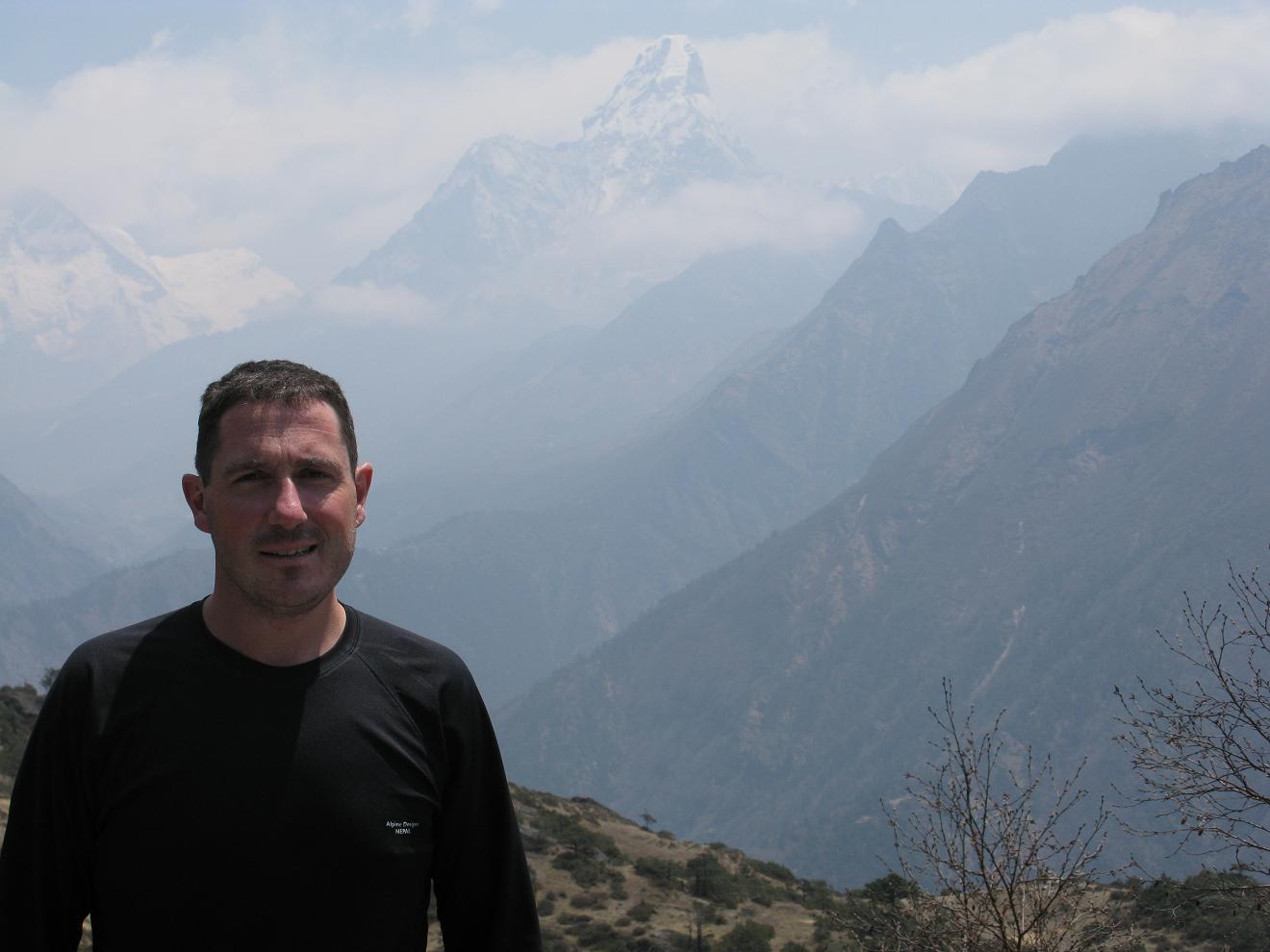
Yesterday I got my first glimpse of the highest point on the planet. I had to stop myself for a moment to remind myself that I was actually here, and savour the extraordinary sight of Everest, flanked by the equally impressive Lhotse and Nuptse. This morning Everest itself was in cloud for the first time in a few days – hence in the picture, it is the aggressive peak of Ama Dablam to the South that is in the background.

There is a wide variety of trekkers here, from the late middle-aged Japanese trekking not much further than Namche for a glimpse of Everest to one group of school-children having the time of their lives. And the occasional runner. Yes, runner.

Some are slightly clueless – yesterday, I was very surprised to see again a French Swiss guy who I had met on the India-Nepal border last week. He was on his way down at a rapid pace. It didn’t make any sense… he looked fit, but with acclimatization there was no way he could have been all the way to Base Camp and back. I quizzed him on why he was descending. When he told me he had got to Namche and was surprised that he couldn’t use his debit card, all my sympathy evaporated. The rapid pace was due to the speed of his (understandably furious) unpaid porter-guide.

The vast majority of people here are on the standard route to Everest Base Camp, which you can see on this map – the route goes North East from Namche before turning North to finally getting to Gorak Shep.

A couple of friendly Nepalis guiding other parties have helped me to establish a longer, more esoteric and exciting (but perfectly safe) route which goes West, in the opposite direction. For the map-minded among you, I will be going across to and up the Bhote valley, across the Rhenjo La pass (La means “pass”) to the Gyoko Valley, across the Tsho La to Gorak Shep, and finally down to Chukkung, before returning to Namche. The highest point on the passes will be about 5450m or 18,000 feet.

I will be back in Namche in about a fortnight’s time and will post again then.

Leave a comment

Filed under 'mind the gap' journey 08-09, All posts, Nepal and Tibet '09