Category Archives: ‘mind the gap’ journey 08-09

Banter at the Border – and a new Lingua India?

In the last week, my travels have taken me to two of the great mosques in India (Agra and Fatehpur Sikri), to “play” in the Hindu festival Holi, to the Sikh Golden Temple, and finally to Dharamsala, home to the Tibetan Buddhist leader Dalai Lama and his government-in-exile. It’s enough to confuse even the most committed agnostic.
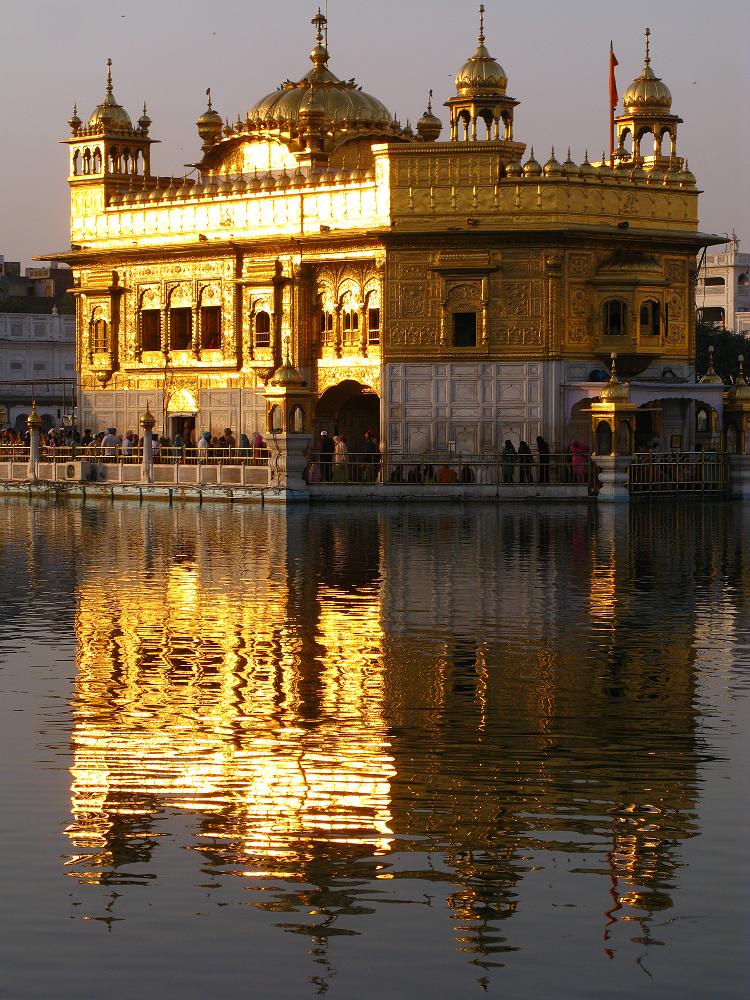
The Golden Temple was particularly stunning, meriting three separate visits, including one at 4am. The sight of thousands of circumambulating pilgrims combined with the sound of the recitation of the Sikh holy book the Adi Granth (read continuously 24/7/365) was unforgettable.

Amidst this spiritual sensory overload, I took a trip over to the India-Pakistan border on Sunday, for a bizarre display that highlights the contrasting fortunes of these two countries. On this most arbitrary of borderlines (drawn on the map in 1947), the “lowering of the flags” at Wagah has become something of an attraction for patriotic Indians and intrigued foreigners alike.

Driving out through the super-organised Punjabi fields (this area is the breadbasket for the country and has a prosperous feel to match) I noticed an advert painted on a building wall – “BHATIA GUN HOUSE Licensed for pistols and Gun Cartridges”. I wondered briefly if Wagah might have a touch of the Waco about it. In the event, it was all pretty good-natured.

I arrived at the border at 5.30, walking the last kilometre with thousands of others for the prequel to the sunset ceremony.
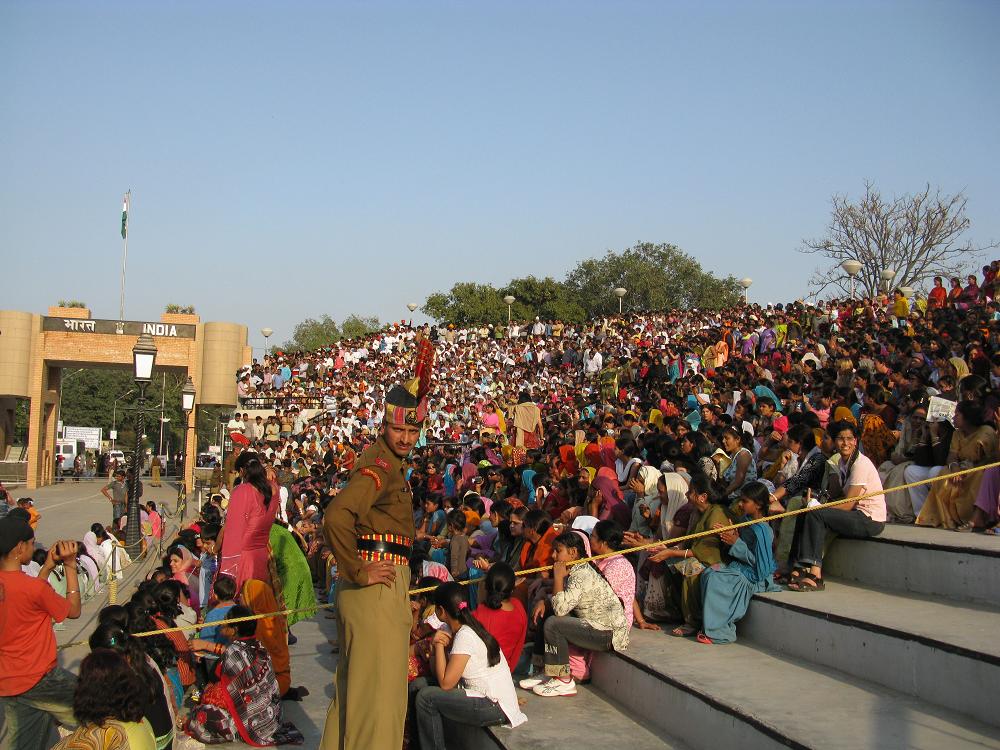
On the Indian side, in a large, incongruous stadium-style hemisphere of concrete seating, a few thousand colourful over-excited spectators were being whipped into a frenzy by a scary-looking ringleader in dark glasses. The screams – of “HIN-DU-STAN!” and “VAN-DE MA-TA-RAM!” (Hail to the Motherland) – were deafening. One of my neighbours was quick to assure me that everyone loves everyone really.
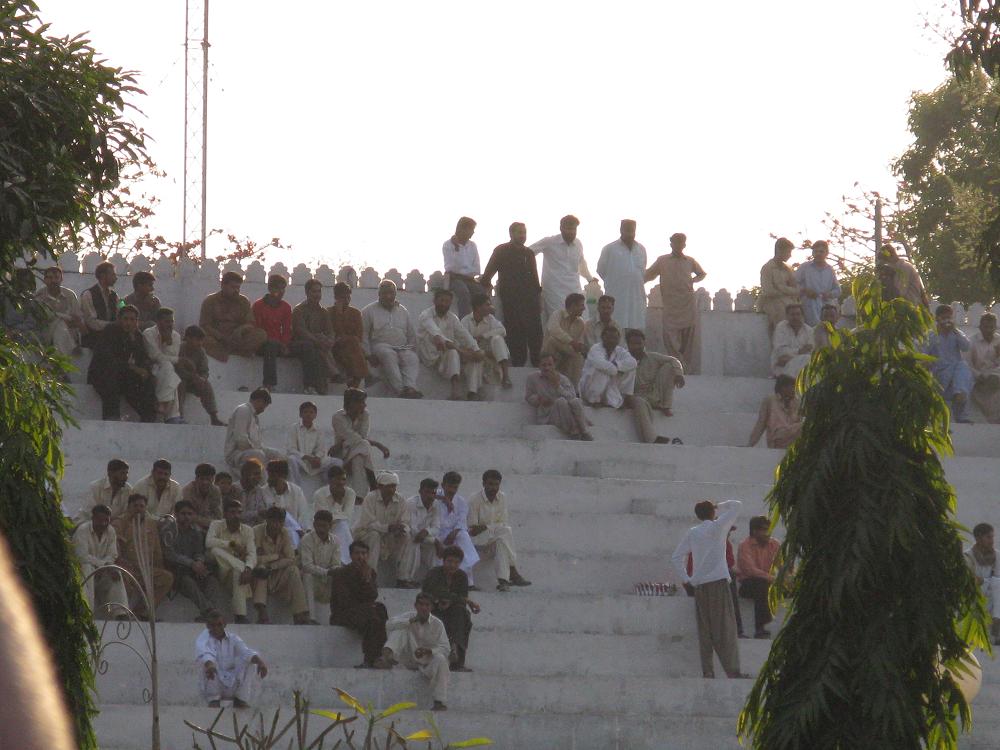
The view on the Pakistan side might be a bit different. The contrast with the happy-go-lucky growing-at-5%-a-year Indians was stark. The Pakistani side looked dismal. A paltry couple of hundred sat in a similar sized amphitheatre. This lot looked dour, sad, dressed in bland greys and blacks, the women in burkhas against tatty white-washed seating. It was all a bit sad.

The ceremony itself – choreographed in advance by both sides and involving copious chest-puffing and goose-stepping – was greeted with whoops, cheers, and more flag-waving and foot-stomping than a crucial Celtic-Rangers head-to-head.

It was a vivid reminder of the continued blurring of the lines between politics, the military, warfare and sport – and of the strange relationship between two countries created out of the back-end of a failing imperial adventure in 1947.

A new Lingua India?

There’s something interesting going on within India itself too. Despite apparent frequent displays of pan-national pride like the one above, regionalism is definitely rearing its head for the April/May elections. I noted the huge diversity of languages across India in an earlier post, that diversity is now being reflected by a rise in the power of locally attractive politicians. You might even see one of them – Mayawati, a powerful Dalit women who looks like she could pack a punch – becoming a critical power-broker when the time comes to appoint a PM…

A common language is, in many ways, the glue that keeps a country together. So it is interesting to note that English is giving Hindi a run for its money. Consider these facts:

1. If a North Indian from Delhi wants to communicate with a South Indian from Kerala or Tamil Nadu, he will most likely do so in English. (If he tries Hindi, he will probably get a blank look from the Southerners, whose own languages of Malayalam and Tamil are worn as a badge of honour)

2. The huge adverts for private schools everywhere always say “English medium” or “Hindi medium”. If the relative number of each is a reflection of market demand, India wants its children speaking English first and foremost. .

3. At the showing of Smile Pinki that I attended in Varanasi, everything (except the film) was conducted in… English. And that despite the fact that the audience was (with the exception of me and one other) entirely Indian.

It’s all rather interesting. After a long period after partition where English was lingua non grata (while Hindi was being pushed forward), market forces may be shifting things. Most people here are also clear that English gives India something of a business advantage over its arch-rival China.

Meanwhile the way English is used by Indians continues to be as flowery as ever. Reading the cricket reports in the Times of India or the Indian Express (both English language) is sometimes like reading McGonagall at his worst. This from the Times of India after they lost a couple of games in New Zealand (the emphasis is mine):

“The Indian cricket team is like a sleeping ocean, or a dormant volcano, if you please: One just doesn’t know when it will wake up and take the shape of an all-consuming storm or erupt into a flame-throwing monster. New Zealand heard the first roll of thunder, saw flashes of lightening too, on Tuesday afternoon; they also felt the earth growl from deep within as India’s batting all but exploded in unison. They are clearly worried, if not scared.”

The article goes on to talk of fighting “ripple-to-ripple, wave-to-wave”, of “follow-up Tsunamis”, of “getting past other brooks, creeks, and even seas”. There’s nothing like taking an analogy too far. Read the whole, wonderful, article here.

—–

Despite the attractions of feeling cold rain on my face for the first time in 4 months (Mcleod Ganj a.k.a Dharamsala is at 2827m), I am moving southwards from Dharamsala tonight so that I can get East before my visa runs out.

Toodle pip!
Leave a comment

Filed under 'mind the gap' journey 08-09, All posts, India '08-'09, North India

Holi Taj! Beauty in perfection – and chaos

Beauty in Perfection – The Taj

The Taj Mahal is such a cliché these days that everyone worries that it won’t live up to the hype.

I and two friends arrived in Agra determined to avoid this. We employed two tactics – first, we crept up on it, visiting the Red Fort to get a the view down the river Yamuna on the first day. Secondly, we arrived during the full moon phase, getting the opportunity to view it by near-full moonlight the night before we visited. Both hinted at what was to come.

The day of the main visit arrived. We arrived at the gates at the recommended ungodly hour.

We immediately found ourselves under fire from a series of would-be guides. Rather than prolong the agony, we selected one partly on the basis that he bore more than a passing resemblance to an Indian version of Oddjob. But when his first sentence in English turned out to be utterly incomprehensible, I had to cut him short. He waddled off, clearly crestfallen, but returned in double-quick time with another man.

I looked our replacement up and down. If you can judge a man by the crease in his trousers, then this guy was top-notch. He was 70, a former schoolteacher with excellent English and a proud, upright bearing. We agreed terms. As he set off at a crisp pace into the main area, I thought it polite to enquire as to his name. Without breaking step he responded “Master!” It was clear who was in charge on this tour.

“Master” and the other guides are convinced (often rightly) that people only really come to the Taj for the photos. They therefore make it their business to know every spot for a “classic shot” on the walk through the garden to the main Mausoleum. Every 50 yards or so, Master would pause, and issue the stern command “Come! Camera! Please!” We were expected to drop everything, give him our cameras, assume the position, and get snapped, while he issued firm commands such as “Back!”, “Please! Come this side!” and “Smile!”

Unfortunately the speed with which he dispatched each photo meant that many of these rendered the Taj’s beautiful symmetry at rather Dutch angles. They are rather wonderful.

As we walked on, his impeccable explanations of the history and the 22-year construction came into their own. His love for this astonishing building came shining through. The beauty of the Taj lies in the minutest detail of an inlaid piece of jade or agate just as much as in the whole building seen from afar. It is a truly gestalt experience.

Three hours with Master at the helm passed in no time at all as he hustled us through back doors and shared his tales gleefully with us.

As we finished the tour, he finally let his guard down, revealing his true name – Shamsad Uddin. Shamsad sheepishly produced a couple of crumpled photos. The first was of him guiding India’s most senior general, the second of him guiding Lalu Prasad Yadav (see previous post).

We had clearly drawn the long straw – it had been our lucky day.

Beauty in Chaos – “very too much Holi!”

I had a taster of the Holi Festival while in Udaipur. As it turned out, that was not even worthy of being called a taster.

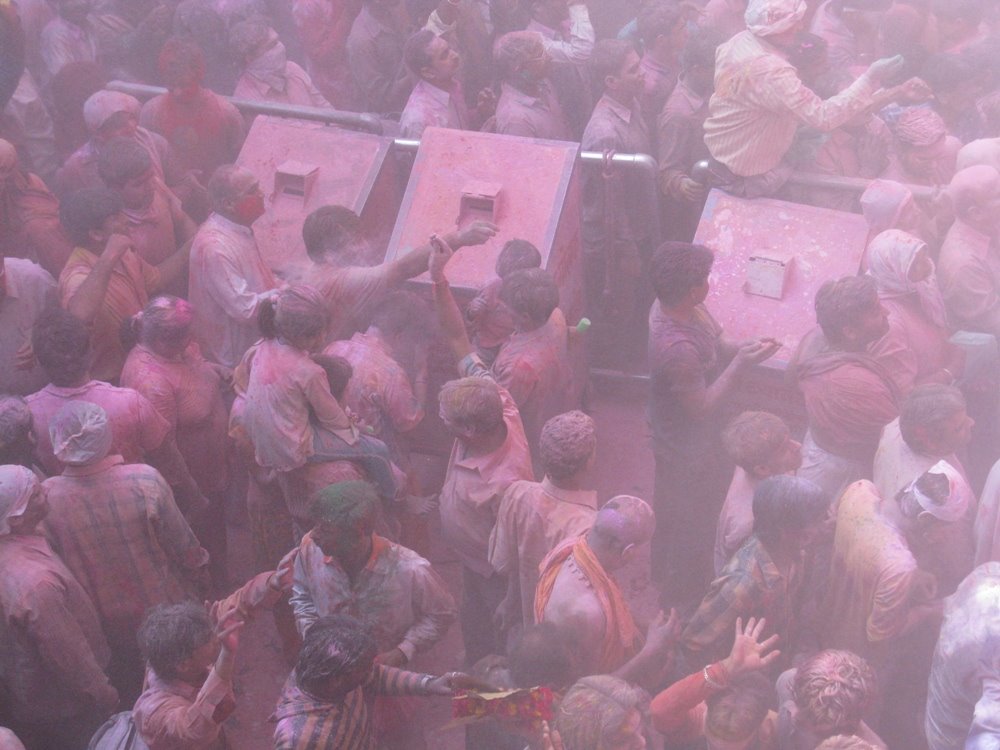
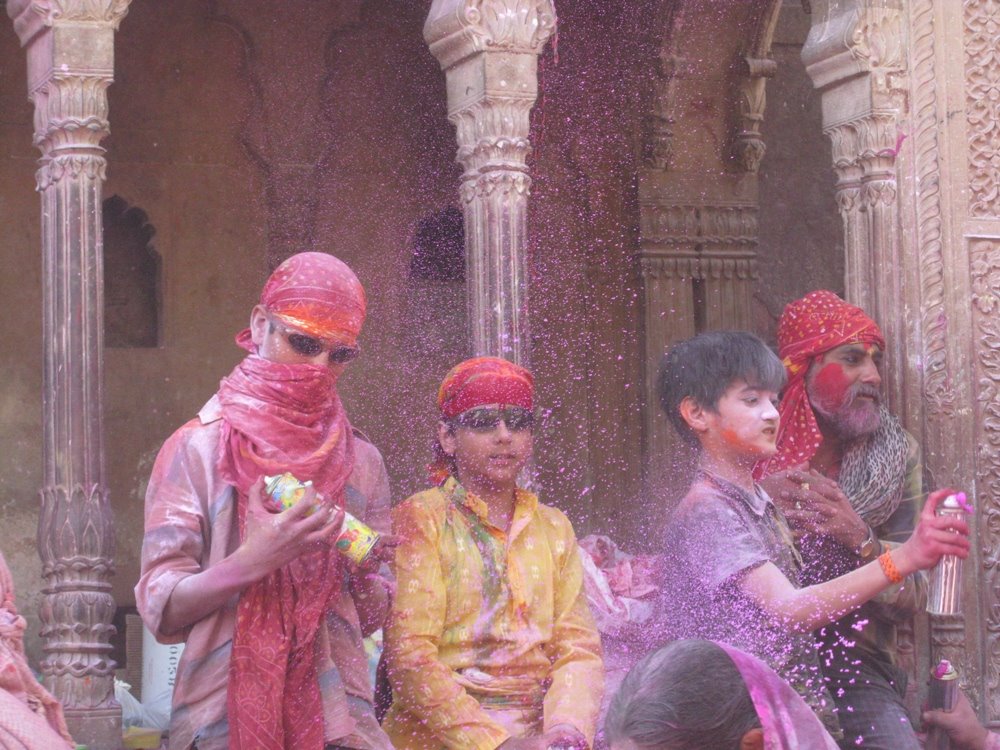
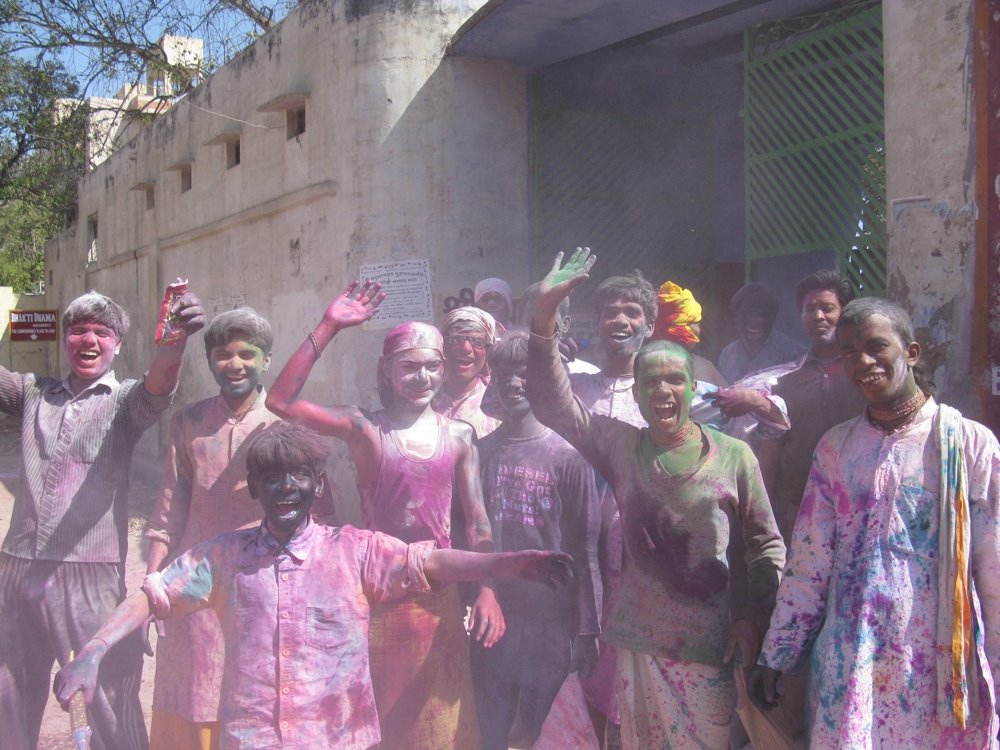
Minor celebrations go on for a month, but everything culminates in the main event held on the night of the Full Moon and the following day, when vaste swathes of India become madness personified and throw coloured dye, powder, and sometimes even paints at each other.

As the festival is associated strongly with the Hindu deity Krishna, we decided to head to Vrindavan (near Agra) where he supposedly grew up for the main event. Our rickshaw driver was clear – “Vrindavan is very too much Holi!”

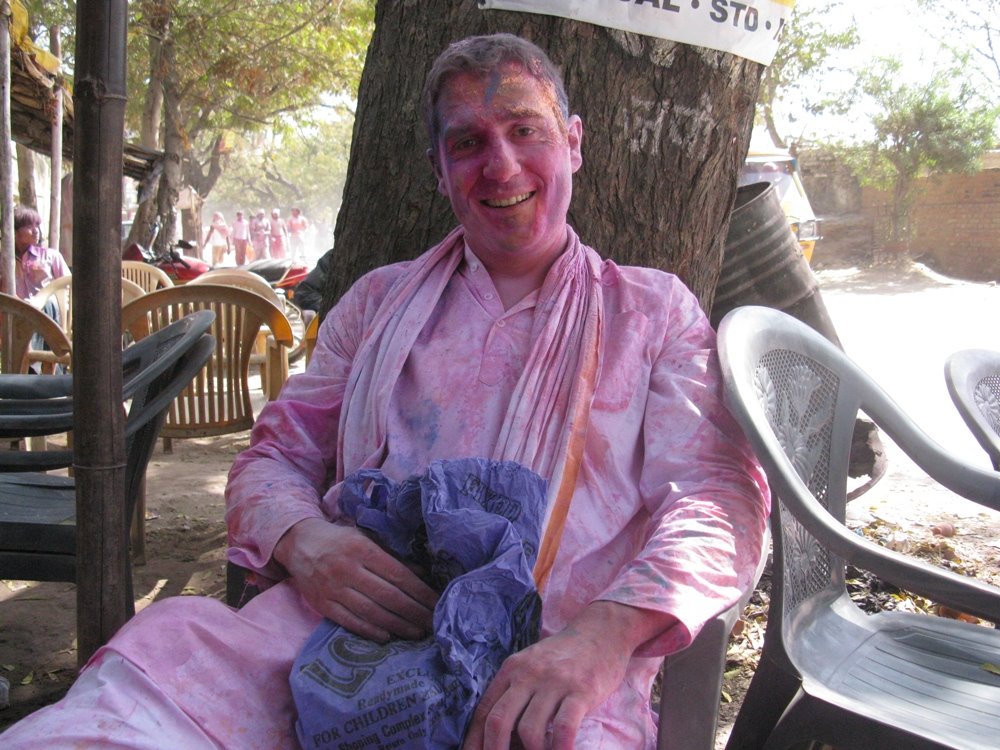
We prepared to leave Agra. Our friendly Punjabi hotel owner warned ominously of ruined cloths and less pleasant substances being flung with abandon in impoverished Vrindavan. I therefore decided to try and blend in, buying a white Kurta Pyjama. Which did nothing of the sort.

Remarkably, my new attire stayed near spotless as we hurtled precariously in a rickshaw up towards our destination, huge bonfires on the roads illuminating our path.

Morning came, and I headed for the Pujah (morning worship) in the Krishna temple to get a sense as to what this was all about. For us Brits, the “Hare Krishna mob” tends to mean the shaven-headed tambourine-banging crowd on Oxford Street or Princes Street. There were a few of those in the temple, but they were vastly outnumbered by Indians demonstrating a level of devotion and love in worship that is amazing to observe and hard to describe.

By 7.30am, it was time to head onto the streets. The madness began. After half an hour we were all covered and had been well and truly “holi’d”. Unfortunately, wandering hands were sadly in abundance and the girls had to head back. I continued to explore alone – for which pictures speak louder than words.


We returned to Agra by train, feeling not the least out of place in dye-spattered clothing. It had been an amazing 24 hours, encompassing two spectacular experiences – one of architectural perfection, one of colourful chaos.

An overnight train last night, and I’m now in Amritsar on the edge of Punjab province by the Pakistani border. More in due course.

[P.S. They say it is good luck when a bird defecates on you. Certainly, since the first incident on my first day in India (Bombay street corner), things have gone pretty well.

The second incident happened exactly 120 days later, in slightly more pleasant surroundings, while gazing at the Taj Mahal. Perhaps the Gods felt I needed an update. Or a reminder.]

1 Comment

Filed under 'mind the gap' journey 08-09, All posts, India '08-'09, North India

Indian Railways: getting on the right side of the tracks

“Indian Railways” is, by any account, a remarkable organization. Various sources claim that:

a) it is either the largest or second largest (after the Chinese Army) employer in the world
b) the network carries the equivalent of the population of Australia every day
c) it has one of the most complex revenue collection systems in the world

The daily reality is equally astonishing.


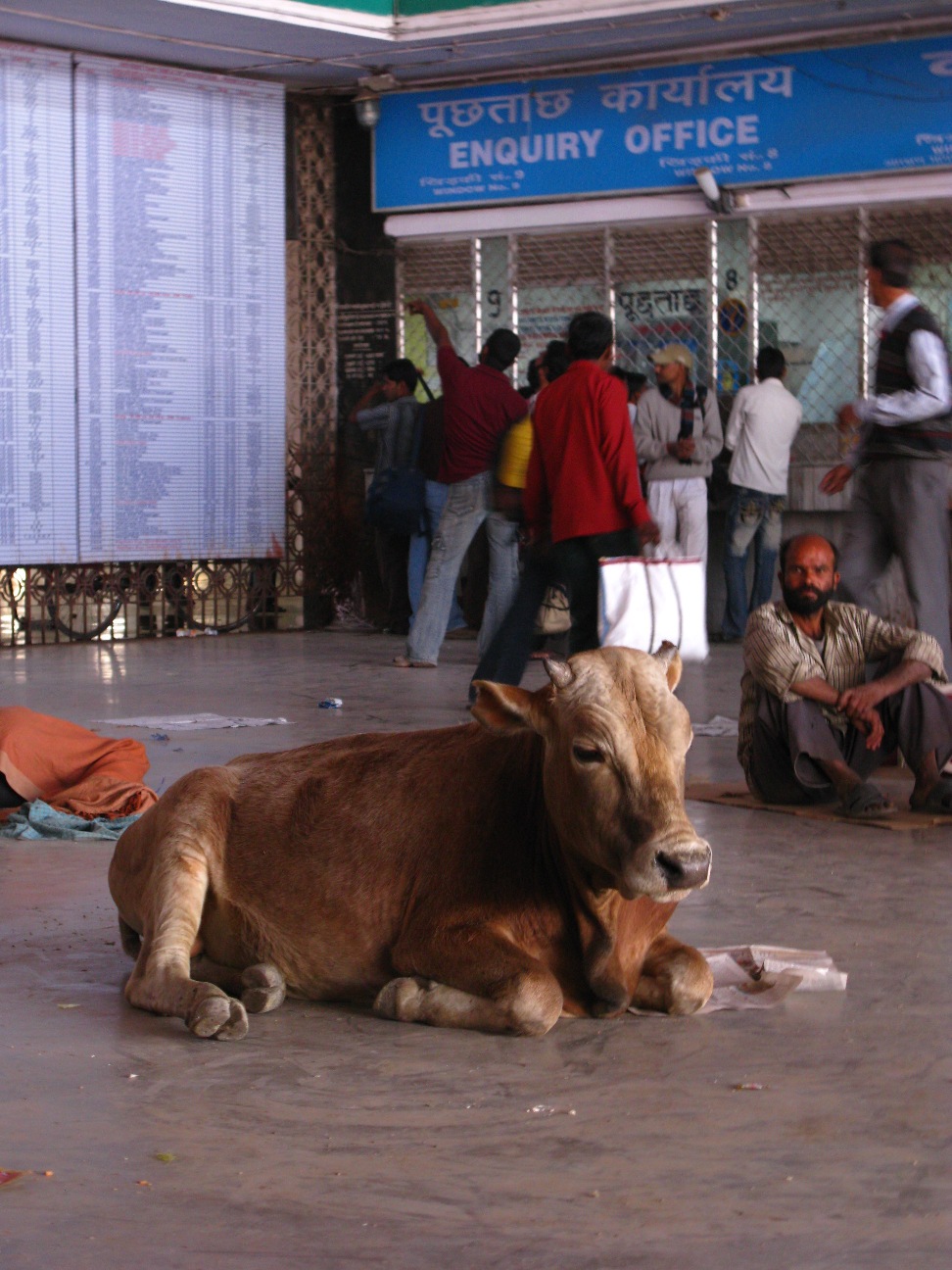
We arrived at Mughal Sarai station (just outside Varanasi) at 8.30am, greeted by a cow who had clearly got bored of queueing up for the ever-chaotic Enquiry Office. Although it would be unfair to say this is a frequent sight, you get so used to randomness here that it took a second to register just what a strange picture this was.

Leaving Ermentrude behind, we walked through the upright scanner that most Indian stations now have for these security-conscious times. The operation of these is just as random as the queue for enquiries however – the sound of the beeper alarm is no guarantee that you will be stopped, and if your bag is too big to squeeze through these flimsy structures, doing a quick side-step round the side is usually tolerated by generally bored looking officials.

The train was delayed. I was quite happy to draw on my ever-increasing well of patience. I decided to have a look around.

A couple of young official-looking boys with flimsy fluorescent yellow waistcoats (so loved by officials the world over) walked past. They came over. The usual pleasantries were exchanged, involving interrogation as to our country of origin (more on that in another post). It turned out that they were riding on the trains in a joint WHO/Rotary International programme, administering polio drops to children under five. Given the Australia statistic above, this seemed like a deeply practical initiative.

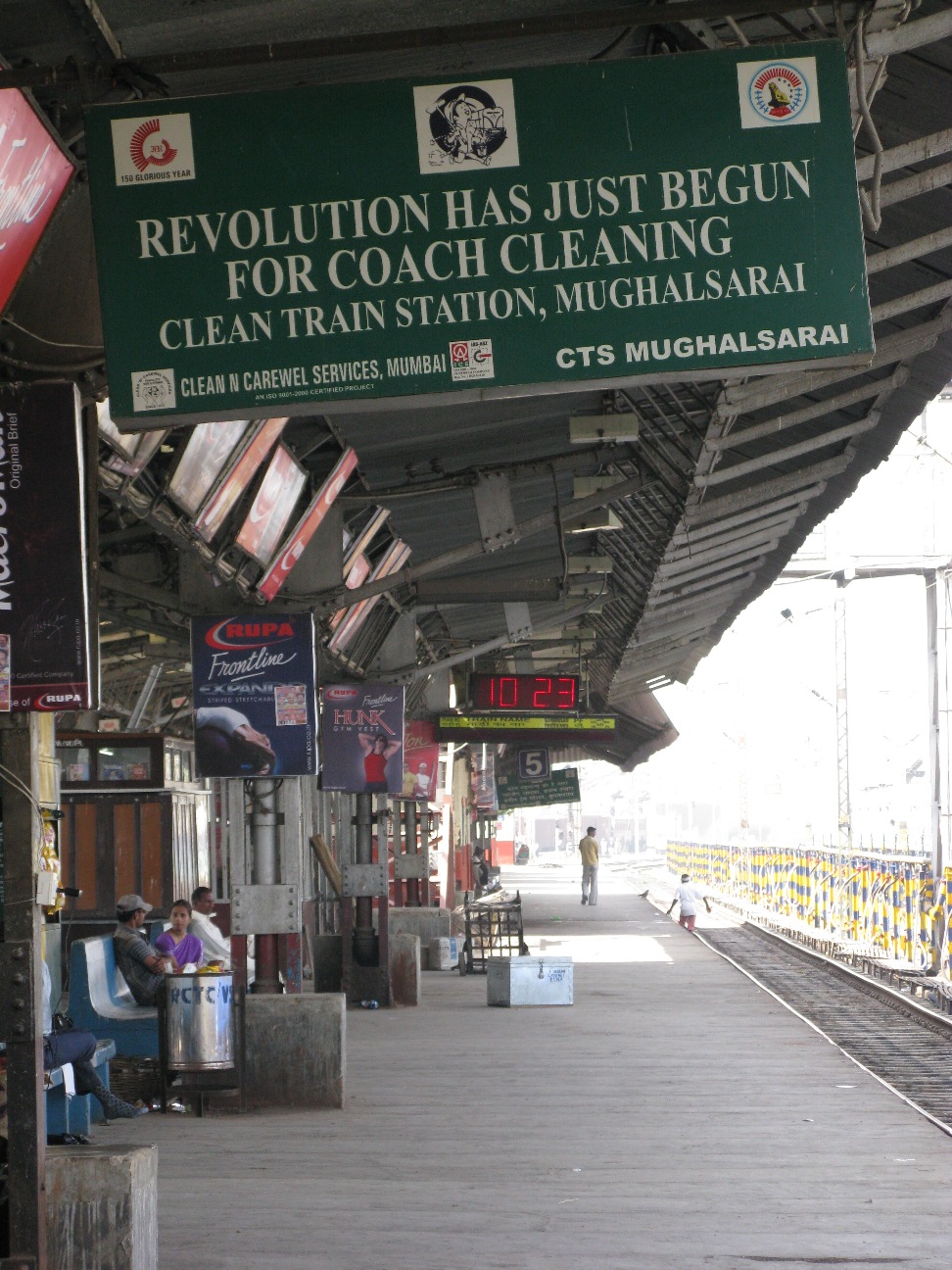
As the boys walked off to continue their walk, I looked up the platform. There was something wrong. The platform was not just clean, it was close to spotless. I looked up to see a sign:

“REVOLUTION HAS JUST BEGUN FOR COACH CLEANING
Clean n Carewel Services CTS MUGHAL SARAI”

It seemed remarkable. As the Western world privatizes its banking system, could private contracts for railway station maintenance really be establishing a foothold in India?

The train arrived, a mere 90 minutes late, which is actually not bad for a train that had been on the tracks for 10 hours and had at least another 12 to go. (We were joining the Sealdah-Jaipur Express, which cuts a swathe through the Gangetic Plain from Bengal to Rajasthan – click here for route).

Within a few kilometres we were headed into the interminable expanses of countryside, so uniform across the entire country that, as John Keay points out in his History of India, “the traveller – even the Indian traveller – may have difficulty in identifying his whereabouts”.

Despite this uniformity, there is always endless fascination and plenty of food for thought. Within a single minute you pass seemingly random piles of concrete pillars (actually railway sleepers); village settlements with haystacks and flimsy homes with roofs made from plastic sacks; railway crossings with a surprisingly large number of assorted cars, cycles, rickshaws, pigs, cows, monkeys, and foot passengers waiting patiently to cross; a concrete town settlement looking strangely cubist with it’s concrete box housing; school children immaculately dressed on their way to their lessons.

But these are interruptions to the hours spent staring out of the windows at vast tracts of cultivated land as the train trundles on. (It was in Karnataka when the full scale of what these tracts mean first dawned on me – with little to no mechanization in many parts of the country, the crops still have to be harvested. By hand).

We pulled into Allahabad station, where the Ganges and the Yamuna rivers converge. Two men in smart green jump-suits climbed on – one walked purposely through the carriage spraying pungent air freshener everywhere, while another brought on what looked like a steam vacuum cleaner and started cleaning the floors. Someone, somewhere, had spotted the opportunity of these private cleaning contracts. “Clean n Carewel” were clearly a successful outfit.

The opportunity to chat to fellow passengers is one that I rarely turn down (even at the risk of occasionally being sucked into a vortex of interminable conversation). On this journey, my favourite was the Sikh who sniffily picked up the history I was reading, turned straight to the Index and announced loudly that it couldn’t be any good because it only had a dozen pages or so worth of references to Sikhs. I tried to point out that a) the book was 500 pages, b) it endeavoured to cover 5000 years, and c) Sikhism (though an essential part of the mix) hasn’t exactly dominated Indian society since its founding in the late 15th century. But he was not convinced.

We finally pulled into Agra Fort station in the evening, emerging back into the chaos of the streets from the relative tranquility of the journey.

There is a whiff of change in the Indian Railway system. It almost feels like things have even improved while I have been here (although admittedly the sample is rather low and restricted to passenger trains – 70% of Indian Railways revenue comes from shifting freight).

Lalu Prasad Yadav is the man in charge, a bruiser of a politician from the wrong side of the tracks, with a background that is colourful even by Indian political standards. It is he that is credited by some with making the difference, and in a tactic employed the world over in the run-up to elections, he is also promising massive investment.

He is a toughie, from the toughest of the tough lands in India, Bihar. But then as one of my fellow passengers said, the Biharis may be the only ones tough enough to keep up with the pace of change here.

I am in Agra and the surrounding area for a few days.

Leave a comment

Filed under 'mind the gap' journey 08-09, All posts, India '08-'09, North India