
Slumdog attitude
I arrived in Jaipur yesterday, fresh from an extraordinary experience at Deshnok’s “Rat Temple” (story below).
On discovering that Danny Boyle’s film on Bombay “Slumdog Millionaire” had swept the Oscars, I decided to take advantage of being in a relatively big city for once, and catch the film in a local cinema. I enquired of the hotel’s owner as to where it might be showing.
“Very boring film sir,” came the barbed response. “We did all that slum stuff in Bollywood 30 years ago. And very silly film too. No Indian actors – they used Chicago back street boys – PAH! You English think you know India but you get it all wrong! You insult India! Why don’t you make films about your own problems – like your 13-year-old pregnant girls?”
I pointed out that we do actually make films about pregnant 13-year-old girls (in fact rather too many of them), and suggested he explore the collected oeuvre of Ken Loach if he was interested in that kind of stuff.
He gave me a vague and reluctant wave towards an out-of-town cinema, but the conversation was rapidly going nowhere. It became clear that my best option was to venture out on a solo exploration.
The Raj Mandir was the nearest cinema. Built in 1976, this faux-Art-Deco pile in muted pinks and magnolia provides a fantastic location to escape the hustle and bustle of Jaipur’s streets, with a dose of Bollywood. The choice of film was fairly simple. With only a single screen (albeit capable of showing to at least 1000 people I calculated), the new release “Delhi-6”suddenly seemed like an excellent idea. Slumdog would have to wait.
Having previously taken in a Bollywood film in Mumbai, I knew vaguely what to expect. Bollywood story lines are always straightforward and this was no exception: Indian Boy living in New York returns to Delhi… realises Mother India is wonderful… meets a girl… sings a song or two… and falls in love. It’s actually got a little more to it than that, but the simple story-lines (combined with the fact that English tends to be used in various key moments) help to remove the Hindi language barrier. And if you lose the plot, there are plenty of students in nearby seats willing to whisper you back on track.
I settled back in the comfort of a large velour sliding seat.
I had a sense that we were in for a rowdy night when one of the pre-film ads was drowned out by wolf-whistles and cat-calls. In the ad in question, a sultry woman moved seductively around a smart penthouse flat in close proximity with her dashing consort. Every time she passed the light switch, she managed to turn off the light (with her hand, her toes, her elbow) and bring her man closer. Every moment of darkness was greeted with an ear-splitting rise in volume from the Indian boys in the cinema. The ad was for…? Yes, you guessed it. “Elley Light Switches”.
Sexual content is frowned upon in Indian cinema. As a result, Bollywood films are famous for their sudden cut-aways to sequences of birds or animals mating as a substitute when things get too steamy on screen. The occasional bare foot or lower leg is fine, but that’s it. But as with any prohibition, the heart just grows fonder…
In an amusing take on the familiar routine, the sex scene in Delhi-6 did indeed cut away to a pair of courting doves on a TV screen at the end of the bed – but then showed four intertwined feet clumsily hitting the “Channel up/down” button in the throes of passion. Cue a TV re-run of the Indian space-rocket getting ready to take off; back to the birds; and back to an explosive shot as the rocket disappears into the sky. The cheers around me were deafening.
As the film reached its own climax, we even had an appearance from the legendary Amitabh Bachchan. In India he seems to appear in virtually every ad on TV (apart from the ones with cricketers Tendulkar or MS Dhoni in them), and pops up in most films. In Delhi-6, the lead was played by his son, Abishek, giving the film-makers the excuse to bring him in for all of 30 seconds, as a heavenly spirit providing guidance to the young pretender.
Returning to the hotel in good spirits, I was greeted by the glaring owner. “How was the film?” he asked with some venom, still under the impression that I had slummed it with the dogs.
When I told him that I had switched to “Delhi-6” he visibly softened; and his mood changed completely when he heard that Bachchan had made an appearance.
“Ah… Amitabh…! I have a list of things I want to do in life – meeting him was on the list! He came to Jaipur and I saw him! I love his BARITONE voice and his DOWN-TO-EARTH attitude… But his son – PAH! He has a long way to go… I mean Amitabh is such as COLLOSALUS… isn’t that what you say?” I thought it best to let this small grammatical error gently pass.
“Holi” Colours
While Bollywood is developing into something of a religion of its own for the urbanizing youth, Hindu culture continues to provide a strong backdrop for the lives of millions of ordinary Indians. I have been lucky enough to experience this twice in recent days.
First, in Udaipur I had wandered into the small Jagdish Temple for a quick look en route somewhere else. When I realized that some form of celebration was taking place, I took a seat on the floor in the crowded main area intending to stay for 10 minutes.
I had chanced upon a preparatory celebration of “Holi” or Festival of Colours. Over the next 90 minutes, I became involved in the famous ritual, as a chorus of seventy or so women slowly built up the volume of their rhythmic chanting (to Rama, Krishna, and Jagganath – all incarnations of Vishnu).
As they reached a crescendo to a backdrop of clanging bells and burning lamps, a priest appeared and threw coconut water over us all. I found it hard to feel quite as enraptured as the women next to me, and when the priest reappeared with bags of green and red powder, I got nervous. Rightly so, as it turned out. The women knew what was coming, and pulled their ghunghat veils over their heads in preparation for the onslaught. Clouds of coloured powder descended from the heavens over us. I tried to relax, remembering that laundry’s cheap in India.
It was a strange experience, and one that probably has changed little over 500 years. The devotion in the worship, and the time that is dedicated to ritual, are not unique to India; but they are embedded in society here in a way that creates a sense of communal purpose above and beyond most other cultures.
Reincarnated Rats
After Udaipur, I decided to take an overnight bus to a place called Bikaner, close to Deshnok which is the site of one of India’s more bizarre temples – the Karni Mata “Rat” Temple.
Members of the Charan Caste believe (for reasons that I won’t go into – but you can read about here) that they are reincarnated as rats. As a result, rats in the temple are fed daily and allowed to roam free everywhere.
I had taken a ropey overnight bus to get to Deshnok, so I arrived at 7.30am in a bit of a daze. This probably helped. Given the thin patina of rat droppings evident through the marble entrance, I decided that “sans socks” was the way ahead. I gingerly edged through the doorway.
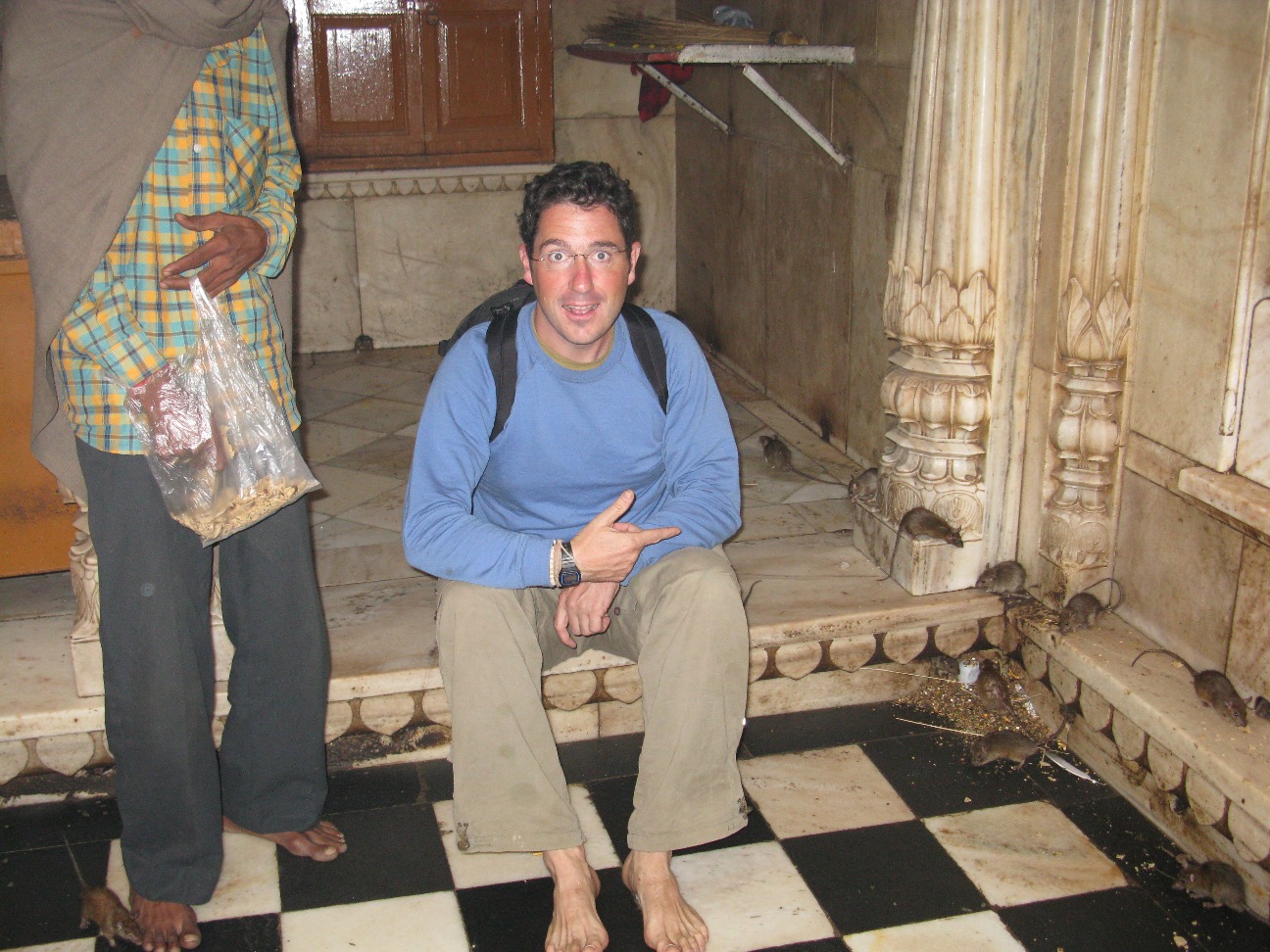 Although I was prepared for the onslaught, this has to rank as one of the more bizarre experiences of my life. The rats scurried back and forth, less intimidating than you might think, and making up in speed what they lacked in size. I forced myself to feel blessed as a mangy rodent scuttled across my toes 1-2-3-4-5 – it is considered good luck to have one of these reincarnated souls run over your foot.
Being the only Westerner in the building at such an ungodly (no pun intended) hour, I got some special attention from the temple attendant.
As he pulled me over to a corner, he started muttering excitedly “White… white…” I admit that I got a little excited. I had read that a glimpse of the Temple’s venerated “White Rat” is considered very auspicious, something that many people spend hours waiting for. I had been there for less than 15 minutes.
Suddenly a pair of white whiskers appeared, poking through a small hole in the temple wall. A group of worshippers rushed over to be beside me, chanting incantations and telling me how lucky I was. The whitie made another appearance, before wisely retiring, probably for the rest of the day.
I left the temple and moved on, having seen something that few get a chance to see.
Bollywood. Temples, Rats. India is nothing if not diverse.
More tomorrow.



 Andrew Duff
