“Literary lessons” – a meeting with Professor Puroshottama Lal

There is one more encounter that I want to write about before I leave South Asia. It took place in Calcutta in late March.

One of the things that I have been enjoying while travelling is making fresh, interesting connections. One of these led me to an email correspondence with John Keay, the author of many books including a highly-acclaimed History of India.

John noticed from my blog that I was interested in the prevalence of the English language in India, and suggested that I might like to look up a publisher in Calcutta, Professor Puroshottama Lal. For more than 50 years, Lal has run a publishing house from his home – The Writers Workshop – championing Indian writers in the English language, helping many aspiring writers, including Vikram Seth, get into print.

The professor and a new perspective on Indian English

A round of phone-calls, some fancy footwork and frantic flattery helped to secure an appointment. Despite a warning from Lal’s son of the frailty of his father as he approaches his 80th birthday in August of this year, Lal agreed to see me. Lal still gets a solid stream of aspiring writers contacting him to arrange a meeting – Michael Buckley [author of the recently published ‘An Indian Odyssey‘] had visited the previous day – so I felt relatively privileged to be granted an audience.

Lal is a frail man, tall and gaunt, but with a presence and an energy and charisma that filled the room. His dusty study had not changed from the description I had been given from 30 years previously, with “… the stalagmites of books so finely balanced that a sneeze would have brought them down.” His English is spoken with a slight Indian accent, but is a model of clarity and precision.

I took a seat and stuttered through an explanation of my sudden interest in India, and in particular in the prevalence of the English language across India. I said that I had been told he would have a controversial and interesting view.

Within minutes, Lal had set out his stall, explaining that he believes English to be a very Indian language, possibly the only truly pan-Indian language.

“You see India is this huge mass of inclusiveness – I don’t understand why people think we can’t adopt the English language. We took the Sanskrit language from the outside, the Muslim religion as well. Indians adopt, that’s our special skill…”

When Lal talks about the English language, it is invariably in the context of literature – he has been passionately championing the potential for English to help Indians to express themselves in literature for over 50 years. It was in 1954-5, while a teacher at the Jesuit St Xavier’s College, that he first conceived of the idea of the Writers’ Workshop, to champion Indian writers in English, largely in response to a continuing paternalistic attitude towards Indian writers from the editors of “The Statesman”, a publishing hangover left behind after partition and still run by Englishmen in the 1950s.

Lal’s interest lies in in the usefulness of English in expressing India‘s identity, rather than as some business language. (While acknowledging that English has a unifying role across India as the only language spoken in every state – “I have been seen as controversial for saying that Indian is the only English language…” – he is not really interested in the use of Business English in India). He sees Indian English – in a literary context – as a separate language from British English, one that can express what he sees as India’s “pastoral sophistication”.

“We have to reinvent the language to express our pastoral identity…I mean you lot [the British] were pilferers and looters there is no doubt, but we can take what we want can’t we? You see, British English is firmly rooted in understatement and irony, both of which are totally foreign concepts to the Hindu. I mean, we just can’t understand why you would use phrases such as ‘Not bad…’, and as for saying the absolute opposite of what you mean, we absolutely can’t understand why you would do that! Indian English, by contrast, must be a language of dreams and love, not business. When we dream and make love in English then the language comes alive for us as Indians….”

This concept of “pastoral sophistication” is at the heart of Lal‘s thinking, and the (very different) role that English has in expressing India’s identity. He believes that the nature of India’s sprawling rural inland mass has led to a different basis for society, a pastoral identity that is challenging for outsiders to comprehend, particularly the idea that pastoralism could be in some ways ‘sophisticated”.

I asked him if by pastoral sophistication, he in some ways was contrasting the Indian approach to constructive dialogue – often based on teacher-student relationships based on unquestioning devotion – with the obligation to employ critical analysis that is deep-seated in Western approaches to education and discourse.

“Well yes, I do think that this is a fundamental difference in approach – in the West you have a ‘duty of doubt’; in India, we like to work on the basis of a ‘duty of faith’.”.

For Lal then, it is no surprise that outsiders often see Indian English as hyperbolic and overblown. That is just the way it is. Indian English is a different language, taking away irony and understatement from British English, and creating something sometimes lyrical and yes, sometimes over-the-top.

This concept of a pastorally sophisticated society goes well beyond just language. It strongly echoes the (somewhat controversial and still prevalent) Ghandian belief in the primacy of the village in Indian society. I asked what would happen as India rapidly urbanises. Would India develop an urban sophistication?

“Who knows? At present, we have absolutely no understanding of the nuances of urban sophistication as practised in the cities of the West – instead we are taking what we think is urban sophistication – bars, the high life, money, showing off – and pretending we are urbanly sophisticated! But who knows what will happen? I don’t make history – I just take advantage of an existing situation.”

Reflections on Life, the universe and everything

As the late afternoon drew on, the conversation shifted gear and became more personal. It felt like Lal had things he wanted to tell me.

He started recounting the story of a 1989 trip to a conference in Vancouver, when he had been taken seriously ill, and had ended up at death’s door. “I had so many blood transfusions that I don’t even know if I am a Hindu now, dammit!”

As he spoke, it became clear that this event marked a major transformation point for him.

“You know, as I lay there, I suddenly realised that my life had been wasted. Absolutely wasted. I had learnt nothing. I realised that a person is the composite of the people that he meets in life. You know the word for visitor in Hindi? Ur Ditti. It literally means ’wrong time’. Visitors never come at the right time. How you deal with these visitors is what defines you. I hadn’t really learnt from anyone I had met. So I wrote a book called ‘Lessons‘. About the lessons I had learnt from 25 people I had met.”

For the next half an hour, I sat mesmerised as he told me about the book. The passion Lal now feels for life today became abundantly clear. It was infectious, and at times felt as if the lessons were ones that were meant for me personally.

“Everything is wonderful goddamit! It is you who are losing the wonder! You lost it dammit! Don’t blame others! Remember – we are not made for doubt – we are made for exploration. It‘s better to have faith and be deceived than to doubt and be deceived…”

He started quoting poetry to me – Wordsworth first (from “Ode: Intimations Of Immortality From Recollections Of Early Childhood”):

There was a time when meadow, grove, and stream,
The earth, and every common sight,
To me did seem
Apparelled in celestial light,
The glory and the freshness of a dream.
It is not now as it hath been of yore;–
Turn wheresoe’er I may,
By night or day,
The things which I have seen I now can see no more.

And then Yeats:

When such as I cast out remorse
So great a sweetness flows into the breast
We must laugh and we must sing,
We are blest by everything,
Everything we look upon is blessed.

He paused. “I tried to commit suicide you know. Pulled out my tracheotomy… You must stay open, learn, sift…”

As Saturday afternoon turned into Saturday evening, I became aware that he was getting tired. I took my cue, and left. He had a final surprise for me, telling me that he had learnt from being with me. It was another lesson in humility.

I picked up a copy of the beautifully hand-bound book “Lessons” from the tiny bookshop downstairs, along with the volume of Vikram Seth’s poetry (“Mappings”) that Lal had published when no-one else was interested, both books that I will treasure.

Transcreating the Mahabharata

The following morning I had another opportunity to spend time with Lal. For many years, he held Sunday morning sessions to discuss poetry and literature with leading lights in the Indian literary scene.
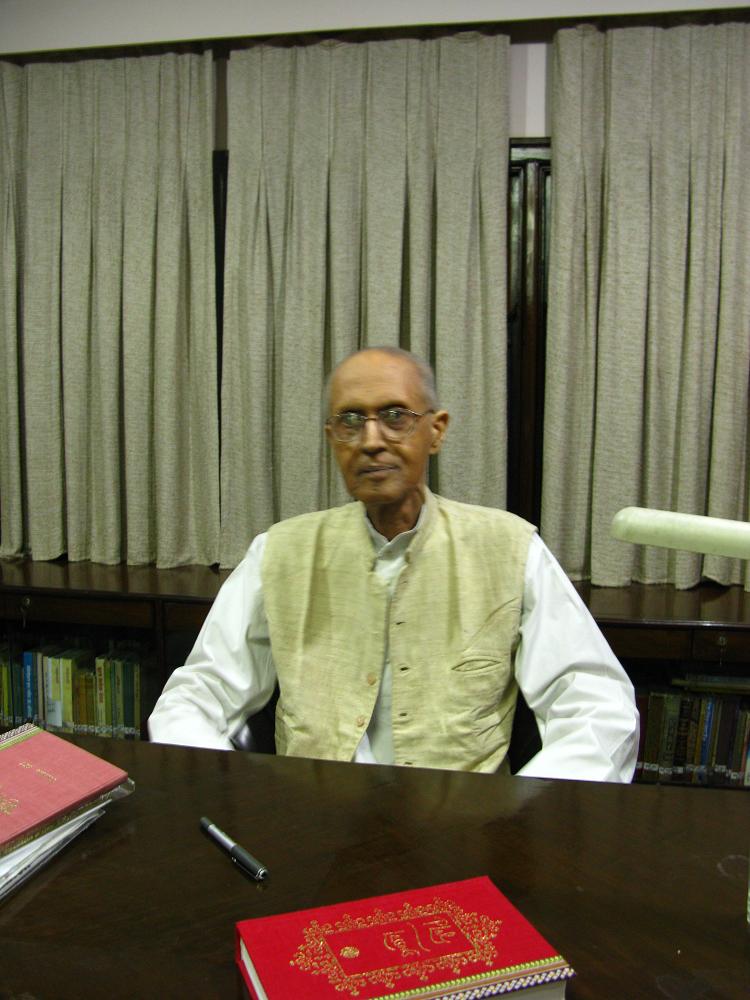
He has maintained this Sunday morning tradition, albeit now in a slightly different format. For 30 years, he has been working on what he calls an English “transcreation” of the 100,000 verse Indian epic the Mahabharata. (The word “transcreation” is a recognition of the fact that he believes this is not translation, but creation into a new “Indian English” language, capable of bringing new light to the epic).

Sunday morning sessions are now dedicated to readings from this effort. I decided to seek him out again for the session in downtown Calcutta.

I arrived slightly late and slipped into a seat near the front, joining about 20 others, most of whom were clearly regulars. Lal was reading from clippings that he had pulled together during the week, pricking the pomposity out of hard-worked journalistic endeavours with rapier thrusts and parries. “Why is it that American writers feel a need to be both learned and hip at the same time. To be both cute and acute? I just don’t understand it…”

The reading itself started. We sat spellbound as he read out passages from Section 50, breaking off occasionally to deliver damning and acerbic analogies to modern-day life, along with comments on the futility of worrying too much.

“This is Obama and the bankers of course. Enough’s enough!” … “They’re all here of course – the politicians, the teachers” … “A mad world it is. So what are you going to do? Get Angry?”

Literary allusions to Eliot’s Wasteland and Ezra Pound’s Cantos peppered the commentary as he switched easily between highlighting the comic brilliance of the epic poem and drawing out the erotic intensity and deep symbolism inherent in some of the original language.

It was a remarkable hour. As it ended, Professor Lal left one final thought.

“You know, in the end, the message of the Mahabharata is really simple. It is ‘Transform yourselves. Go Beyond. Find out your potential.’ That’s all.”

It was a fitting finale to an intriguing and inspiring meeting with a remarkable man.

[You can read more about Professor Lal and his Writer’s Workshop in an article recently published in the Hindu newspaper, available here.]

Leave a comment

Filed under 'mind the gap' journey 08-09, All posts, India '08-'09, North India

Base Camp, Bad Booze, and Bad News

[Continued from the previous post]

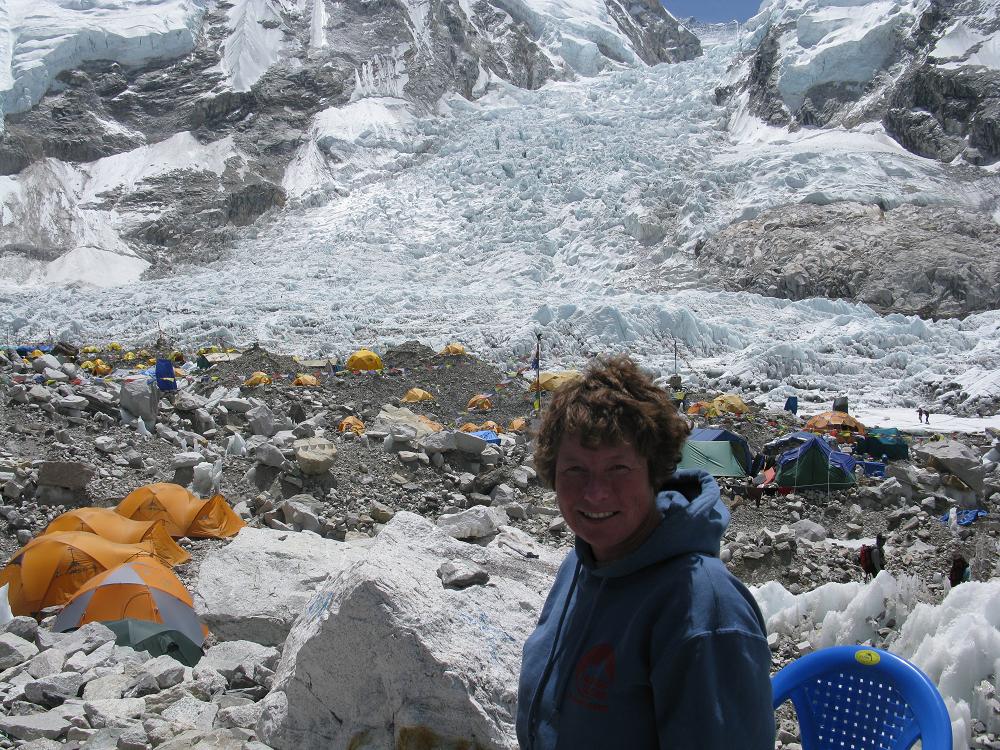
It is a short 90-minute saunter up the side of the glacier to get to Everest Base Camp, the jumble of tents at the bottom of the infamous Khumbu Icefall apparent from some distance.

Given the uncertain nature of glacial terrain, the path doubles back and forth past crevasses before suddenly entering the compact area of tents. This year, it is home for over 600 climbers, supporting sherpas and porters, their tents perched improbably on the ice on stone-built platforms.

The risks are ever-present. A couple of days before my visit, an avalanche had swept down the Khumbu Icefall, killing one Sherpa climber and injuring two others, the snow-dust cloud reaching well into Base Camp itself. The Icefall, which moves about a metre down the hill each day, is always dangerous – and particularly unpredictable this year. The snow piled up on the forbidding slopes to North have made it more treacherous than usual – to the extent that at least one expedition leader has put a time limit on climbers getting through. If you can’t make it in time, tough – you’re back down, no climb.

But I had work to do – 8 days earlier, across a couple of mountain ranges ot the West, I had been given a letter to deliver from a Sherpa whose son was at Base Camp. I started asking around to locate his expedition. “Alpine Ascents?” I enquired. The familiar answer – “Go straight” with a vague wave of the arm in the direction of the main camp – wasn’t particularly helpful.

In fact, somewhat predictably, Alpine Ascents was the furthest possible set of expedition tents right at the top of the temporary village by the foot of the icefall. Knowing that expeditions were not always that keen on the distraction of visitors, I entered gingerly.

“Errrr… I’m the postman – anyone know Nima Nuru Sherpa?” A few shouts and grunts later, and the 19-year-old Nima wandered out, toothbrush in hand.

It was a great moment – in an age of instantaneous communication across continents, there’s something deeply satisfying about delivering a letter by hand over 30 miles and eight days. After he had devoured the letter, I sat quietly drinking tea with Nima for half an hour. He must have offered me more tea about very 30 seconds. I will stay in touch with him.

I spent a further couple of hours at Base camp, chatting with the leader of the Jagged Globe expedition (Adele, pictured in front of the Icefall, with the ominous hanging ice on the slopes to the left/North) and one of the climbers, Doug (Everest will complete the “Seven Summits” for him). I did a climbing course with Jagged Globe in the Alps in 2006. Adele was, amusingly, recovering from a massive party put on my the Kazakhstani Expedition the night before.

I also managed to enjoy the incredible apple pie in the Base Camp Bakery (set up by a climber-Sherpa Steven Dawa Sherpa – all the profits go towards an initiative to remove plastic waste from Base Camp) before eventually dragging myself away from this fascinating human drama.

The challenges of Everest 2009…

As I returned to Gorak Shep, heavy snow started to close in. It would snow for the next three days. Summit attempts this year have already been postponed once (orignally May 10th), and the snows are threatening to do so again. As I write, many expeditions have set off with the aim of summitting on or around the 20th. You can read about their progress here. With so many expeditions, the chances of queues for the top along the final stages is high.

After a quick wander up the 5600m peak Kala Pittar, I reluctantly started heading back down the Khumbu valley. 4 days of sickness (plus the deteriorating weather) put paid to my plans to walk over a third pass to the fifth valley.

As I descended, a series of strange incidences occurred which only made sense later. A Sherpa complaining of severe kidney pain in Gorak Shep; an expedition leader passed me running down from Base Camp to the medical camp at Pheriche and back (2 hours round trip); a higher-than-usual number of helicopters buzzing up and down the valley.

The full story is quite remarkable, and very sad. Essentially a bad batch of moonshine booze from Kathmandu (methanol masquerading as whisky) killed one Sherpa cook and severely injured another. The activity I had witnessed was an amazing (successful) 48-hour battle to save the second Sherpa. It is recorded, by the climber whose cook he was, in a compelling blog here. The doctors had to innovate above and beyond normal practice, eventually (bizarrely) putting him on an alcohol drip, to combat the methanol. Incredible.

Return to Namche and beyond

Within two hard days of walking through the snow, I was back in Namche Bazaar. I returned to the hut that I had started from. I was happily explaining my route to the owner and casually mentioned the Japanese climbers that I had bonded with over the local rice-beer Chang 15 days earlier. I was shocked to hear that 2 of them had been killed in their attempt to climb Kawande, their rope being cut by a falling rock as they ascended a ridge. It was a final reminder of how dangerous proper climbing in this region can be.

I returned, bearded, to Kathmandu for the inevitable night out in Thamel, and reflected on a rewarding, fascinating and sobering 20 days. Taking the path less trodden across the passes) had given me a broader sense of the region and it’s culture than I could have hoped for; and travelling without a guide or a porter (I carried all my own gear) increased the physical challenge, and gave me a very liberating sense of freedom.

Finally, the trek served as Phase 2 of my unintentional weight loss programme (Phase 1 being qualifying as a Yoga Teacher). Getting ill at altitude is a fine way to shed the pounds (though probably not medically recommended). While not quite a rake yet, I definitely am erring on the slender side for the first time in a few years.

I leave for Tibet, overland, on Tuesday; with only a 15-day one-man “group” visa for Tibet, I then have the challenge of entering China via the Lhasa-Qinghai railway, and trying to extend my visa – apparently not as easy as it sounds.

Leave a comment

Filed under 'mind the gap' journey 08-09, All posts, Nepal and Tibet '09

Getting to Everest Base Camp – the long way round

[I got back to Kathmandu yesterday – this is the first of 2 posts about the last 20 days in the Everest region. The second will appear tomorrow]

After spending two days rattling around in the small Sherpa town of Namche Bazaar, I was eager to get going, and to get some real altitude.

From Namche, five glacial valleys spread out like the thumb and fingers of a hand, separated by towering snow-clad peaks. Most people tramp up to Everest Base Camp along the Khumbu valley which stretches like the ring finger to the North-East; given my lack of time constraints (and my relative fitness following Sikkim), my intention was to visit them all over 20 days, travelling West to East across high passes where possible.

A barren landscape (in more ways than one)

The small village of Thame was my first stop, to allow for nosing around the less-explored valleys in the West and starting the slow process of acclimatisation.

As an introduction to just how ingrained climbing is in this region, you can’t beat Thame – it is hard to find a villager who hasn’t summitted Everest. The owner of the small lodge I stayed in, Ang Phurba Sherpa, had summitted a couple of times; Ang Rita Sherpa, who as summitted 10 times without Oxygen, is also from this tiny village.

I shared the lodge with a team of four Japanese climbers who were planning an assault on Kawande, a notoriously difficult peak. Climbing/walking days here tend to start at dawn, and finish by early afternoon, leaving plenty of time for reading, thinking and chatting, so I was glad to have a chunky Dickens novel (Martin Chuzzlewit) to while away the hours. Time somehow also passed more swiftly when my new-found Japanese friends and I discovered a shared taste for the local homebrew “Chang“, which had the added benefit of lowering the language barrier significantly.

I left Thame to walk up the second valley, heading North towards the Nangpa La pass to Tibet, This is truly bleak, barren wilderness – you can get to the Tibetan border in two long days with a tent, but not many pass this way. I walked as far North as I could without a tent, rewarded with spectacular views of the massive Cho Oyo on the Nepalese border. This is also a great place to see the raw grittiness of Sherpa life, and to sense the strength of the Buddhist influence here. You can walk for miles without seeing much sign of cultivation, and then suddenly come across a glacial boulder intricately carved with Mani inscriptions, or a water-powered prayer wheel whirring away.

I stopped in the last hut before Tibet, spending two nights with Pemba Nuru Sherpa. His Chang, brewed in December, was exceptional, and as we chatted in stilted English, it became clear that he had been on Everest 6 times too, with Alpine Ascents International. It became clear that the risks of a life on Everest also had obvious benefits – he had four children at boarding school in Kathmandu.

One evening, when Pemba realised I was eventually heading to Everest Base Camp, he became quite animated. His eldest son, 19, was at Base Camp. Would I carry a letter to him? I said I would be delighted to.

By now I was well-acclimatised; with the letter in my pocket, I headed East over the spectacular 5400m Renjo La pass, a tough six-hour day, dropping down to Gokyo, a village set by one of a series of 6 glacial lakes. Gokyo is relatively popular as a trekking destination due to stunning views of Everest from a 5400m peak nearby.

After 3 days of wonderful solitude, the relative bustle of Gokyo took a little mental adjustment. I started chatting to some of the others in the lodge, and was reminded that the economic landscape away from Nepal was just as bleak as some of the areas I had been walking through. In one hut of twelve people, there were two Spanish girls, a British couple, one American and even one Chinese all made redundant in the last 6 months. In a telling and amusing role reversal, the British couple (both in their fifties) had shocked their children by announcing to their children at Christmas that they were off travelling for half a year.

I spent three fun nights in Gokyo, getting up early to see the sun rise over Everest, and exploring some of the higher lakes. (Everest is, funnily enough, the big one in the photo).


Down and Out in Dzongla and Gorak Shep

I teamed up with four others to cross the glaciered 5450m Tsho La pass over into the Khumbu Valley. We were across the hard stuff by mid-morning and had started to drop down the other side when it started.

Rumble. Rumble. Rumble. Thankfully this was the start of an intestinal avalanche rather than the more dangerous snow-laden type; I made for the first hut I could find in the small summer Yak herding station Dzongla, and hunkered down in a sleeping bag, feeling truly rotten, sickness being accentuated by the altitude of 4800 metres.

In an inevitable twist of fate, this was one of the huts with only an outside toilet. For two nights, I pulled my boots on and off with monotonous regularity to make the 50 yard dash to the rough shed with a hole in the ground that passed for a toilet, the only compensation being the most incredible views of Ama Dablam by moonlight. I even managed to remain compos mentis enough to take a snap in my reduced state.

On the third day I struggled for four hours up to the highest hut in the Khumbu valley, the last village before Base Camp, Gorak Shep at 5140m. This proved to be somewhat premature, and I spent another day laid low and miserable.

With time now marching on, and Base Camp tantalisingly out of reach, I got busy reminding myself that, in the best Buddhist fashion, pain is temporary. Then suddenly two pretty Brazilian girls came to my aid. Apart from lighting up the lodge, they also pushed some of the drug Diamox (for reducing the effects of altitude) my way, which gave my body time to recover from what had been a gut-wrenching bug.

I was slowly returning to some sort of form… as I fell into a drug-induced sleep on my second night at over 5000m, I resolved to get to Base Camp the following day come what may. After all, I had a letter to deliver…

[Click for follow up post: “Base Camp, Bad booze, and Bad news“]

2 Comments

Filed under 'mind the gap' journey 08-09, All posts, Nepal and Tibet '09