
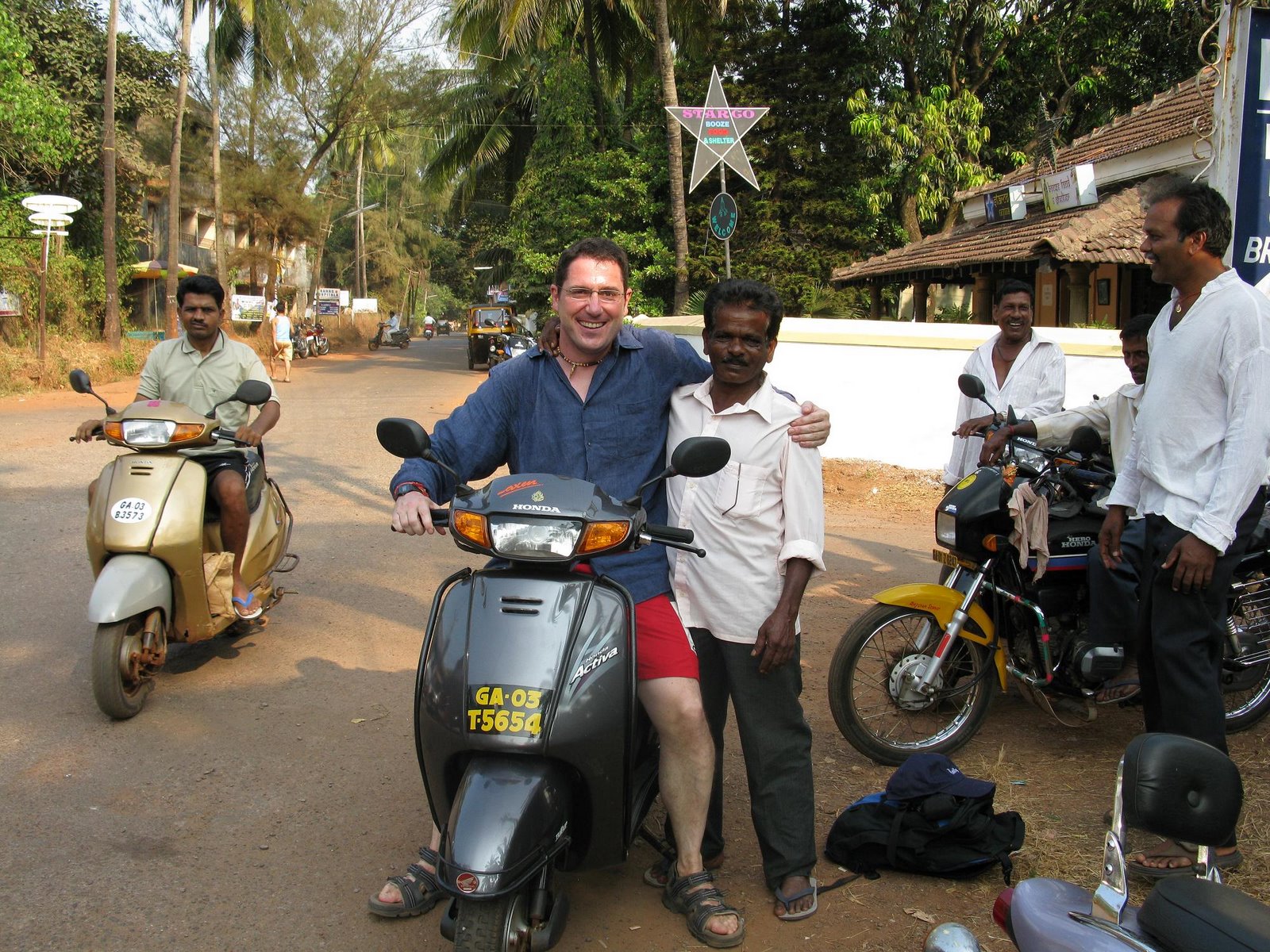
Shastri, my scooter and me


[“You want t-shirt?”
“No.”
“You want nice sarong?”
“No”
“You want nice print sheet – very nice for beach… you want towel?”
“No – thank you.”
“You want nice necklace – you look? Very nice for you…”
“No”
“Looking is free – you look?”
“No”
“You no buy, just look OK?”
“No”
“You very nice man, where you from?”
“No”

Ad infinitum. Enough said.]

So, the scooter. Two wheels is the way to get around in Goa, so I picked an Indian guy with friendly eyes (Shastri), paid the price he asked (400 rupees, about 6 quid for two days) and I was off.

Given that prior experience was not required, and that the lesson consisted of “Key –here, accelerate – here, brake – here, this is very important”, I opted for an afternoon on the quiet roads on day one to break myself in. Mind you, the temptation to open up the throttle and tear around at 60 kph is somewhat curtailed by the potholes, the occasional speed-bump, and the more than occasional cow in the road. (Oh yes, and the elephant. I saw my first elephant today).

Having survived day one, this morning I took the bike (or to be more accurate, the bike took me at times really) into the heart of Goa, away from the coast. Off the beaten track, Goa is quite different – very green, amazing bright painted houses, often kept immaculately, and exceptionally friendly people. Coming from a grumpy London, the constant smiling is almost un-nerving.

The rules of the Indian road are that there are no rules. As a pedestrian, it grates to hear the horn used seemingly on every possible occasion. As a biker (for I am he), the benefits (pleasures) of injudicious use of the horn become abundantly clear – to list but a few of the meanings of that tinny bleep:

– Get out of the way
– I’m about to overtake you
– I know you’re about to overtake me
– Hi
– How’s the wife?
– And the kids?
– What the hell, let’s have a beep party

It’s all very good-natured really – the trucks even have a painted sign on the back saying “Horn – Please – OK!”

I survived a 100 km round trip returning to Anjuna beach as the sun started to fade over the Indian Ocean once more. There was one task left – to return the bike to a nervous Shastri. As I handed over the keys, I realized there was petrol left in the tank. Hmmm, I thought, time for a social experiment. I requested with a straight face that he pay me 50 rupees (about 70p) for the petrol (probably worth 250). I think this might have been a first – it’s not often that the pleading is on the other foot as it were. There was much nervous giggling among his compadres, and Shastri professed to have no money. But with some gentle (smiling) persistence, I think I won the day, and he says he will bring me the money tomorrow. Time will tell.

My next task is to secure tickets for the 4th England-India One-day international in Bangalore. I arrive Saturday, and it takes place Sunday. Here’s hoping. Any hints/tips/high level Indian government contacts greatly appreciated. And if they bat Ravi Bopara down at 8 again, I’ll be the one flinging Samosas on the pitch.

And finally, for technical wizards, RSS should now be enabled – see link at the bottom of the page. If you want to receive email messages with the blog in them, let me know and I will add you to the mailing list.

Leave a comment

Filed under 'mind the gap' journey 08-09, All posts, India '08-'09, South India

Nice Goans and Fat Russians

[Re end of last post – false alarm.]

Hmmm. Goa is a bit of a conundrum. After a day I wanted to leave; in the end I decided to stay for 6 days. I’m glad I did. (If nothing else, to learn how to ride a scooter – more on that tomorrow).

Goa is the smallest province in India by some way. It is without doubt predominantly a tourist resort. At times the worst of British peeks its ugly shaven head from behind the idyllic beaches – a restaurant offering “Sunday roasts”, a Manchester City FC flag flying at the bar on one of the remotest beaches, even a Domino’s Pizza franchise for God’s sake.

But two other nationalities are starting to dominate here. I had been warned in Mumbai that the place was run by Israeli and Russian mafia, but no-one told me they would form a large proportion of the tourists too. The evidence is everywhere – try the “Gagarin” bar for instance, or the adverts for restaurants subtitled “All foods served – Russian, Israeli, Chinese Tandoori”. Or just stand on the beach and look – and listen.

The locals I talked to confirmed this growing trend. Rajan works as a conservationist. For 70p a day, he protects the Olive Ridley turtles that return in dwindling numbers to Morjim Beach in North Goa. “The Russians are buying everywhere” he says, pointing across at the recently built and massively conspicuous Casablanca resort that has cropped up in one of the more remote areas of the coast. “The government loves them and their money, not me” he adds – not great news for the turtles, who aren’t the biggest fans of trance music at 3 in the morning while they are quietly trying to lay their eggs.

On the positive side, Rajan is just one example of the good natured Goans. My hosts in the Arjun Villa, Godfrey and Joan (Christians converted by the Portuguese like 50% of the Goan population) have been welcoming and engaging. They both worked in Oman for 10 years before returning to Goa and gave an interesting explanation as to why so many Goans go overseas.

India’s 27 states have more than 60 languages. Despite the governments efforts to promote Hindi (and latterly to re-promote English), these local languages still predominate. As a result, if an Indian company hires a CEO from Gujarat, he tends to employ people he can understand – Gujarati speakers. When a CEO from Maharashtra province (where Mumbai is) takes over, out go the Gujaratis, in come the Marati speakers. And so on. Goa, being tiny, suffers from having very few “godfathers” in business, so they all go overseas to the Middle East for work. QED.

I’m glad I stayed. It is proving to be really informative, even if by all accounts Goa is an anomaly from the rest of India. The beaches and the sun are stunning, and are definitely a great way to step off the conveyor belt.

And finally… India may be making an impression on me, but I’m making my own impression too. Every time I take out my notebook and start writing, Indians stop and stare with incredulity. They’ve never seen a left-hander writing before. Combine that with my mal-coordinated attempts to eat right-handed, and I am definitely leaving an impression, even if it’s only on the tablecloth laundry bill.

Leave a comment

Filed under 'mind the gap' journey 08-09, All posts, India '08-'09, South India

Trains, buses, and the phoney war

[In the previous post, I also meant to say that Ravi Bopara looked in particularly good nick in the Mumbai nets. For the record, given Bopara’s 54 n.o. and Collingwood’s (predicted) failure, I am willing to make myself officially available as England coach.]

Departure from Mumbai was almost as early in the morning as the arrival. I caught the 06.55 “Mandovi Express”, which wends its way down from Mumbai to Karmali in Goa, moving from the slum outskirts of Bombay, down the Maharashtra province coast, eventually reaching the lush green countryside of Northern Goa in early evening.

Already, Indian trains are proving to be a great experience. Thanks to the advice of Jake in Snow and Rock High Street Kensington, I had the best seat for day-time travel – a side lower bunk seat, along the side of the train giving room for snoozing and reading in equal measure.

The trains are wide, unfeasibly long, and totally packed. As the wide carriages rumble down the track, the blue-shirted porters amble up and down offering various foods, chanting their names in monotone voices “Sa-mos-a”, “Pan-i”, “Bhaj-i Bhaj-i-a”, “Gul-ab Jam-un”. Best of all, with an admirable disregard for Health & Safety, the doors are left wide open, so you can lean out of the doors hanging on to one of the handles as you look up the tracks. 11 hours passed before we arrived a (respectable) 75 minutes late, drawing in to Karmali as the sun disappeared behind the stunning Goa countryside.

After a night and a day in the main town in Goa (Panjim), two 10p buses, each of an hour, took me down to Anjuna beach where I stay for a few days. 10p buses reminded me of the No.26 to Gilmerton. (Obscure reference for former Edinburgh schoolboys).The traveling is all.

A number of kind email enquiries have come in about the state of my digestive system. The truth is that it feels rather like a phoney war – I am fully aware that the monent of truth will arrive; just not sure when. The Australians I met in Mumbai suggested running a book on the time of the reckoning, but that would be inviting disaster… oh… hold on… must dash…

Leave a comment

Filed under 'mind the gap' journey 08-09, All posts, India '08-'09, South India