Category Archives: China ’09

Brnads (sic), Filth, and Ethnicity

A different take on a couple of news stories linked to the growing war of words between the US and China… and brief reflections on five weeks here.

Branding – or Brnaidng?

Walk through any city centre here, and you could be forgiven for thinking that the US brand Nike has a massive presence on the High street.

But look closer… alongside the Nike store, there’s the replica store “Erke” (complete with similar logo). Next door the un-named Li Ning store goes even further – like Nike, they just use a swoosh, distinguished from the Nike logo only by an upturn at one end. (See it here).

To a western eye, these copies are fairly obvious. As are the razors in the store with the logo “Gittelly” (despite the identical font and colour palette), the t-shirt bearing the word “Adaiads”, and the “Pearlfox” store that sits next to “Playboy“.

Imitation brands are so common nowadays that they’re hardly commented on, taking advantage of the lack of familiarity with Roman characters. (From the other side of the language barrier of course, I struggle to read anything in Chinese. Let alone notice if a couple of Chinese characters are swapped around in a word).

The issue’s been around for a while, but whether branding (or brnaiding) comes into play if the mooted “trade war” develops will be worth watching.

Filtering net “filth”

Internet cafes in cities over here are strange affairs.

Endless rows of computers stretch deep into distant murky corners. Hundreds of young Chinese (boys and girls) sit engrossed in high-graphics computer games, slouched in sofa-like leather chairs.

As I walked out of one in an anonymous Chinese city last week, I had to do a double take on one screen. I had not been mistaken – the game was ignored momentarily as a young guy flicked to his messaging screen, deftly downloaded some porn, and switched back without anyone noticing. Internet cafés are clearly providing escapism for young Chinese in more ways than one.

It put a bit of “flesh-tone” on the burgeoning story about the net-filtering software that China wants to put on all new computers here.

To recap, the software will not only filter on words, but will also pick up “flesh-tones”. (The fact that this could block any website with pink on it is considered superfluous to the argument). It’s now led to interruptions to the Google service, statements from the Pentagon, and accusations by Chinese officials that the monstrous Google is deliberately linking to “pornographic and vulgar” websites.

The issue is only set to grow in profile, as this society tries to unravel some tight controls and not others.

Reflecting China

The way you enter a country undoubtedly influences how you perceive it.

Coming in through the “autonomous regions” of Tibet and Xinjiang, for instance, has given me a sense of the genuine diversity of this huge country – but also sight of the difficult relations between the strong centre and it’s far Western outposts. This is most clear in the belaboured “celebration” of China’s ethnic peoples by a strong Central authority torn between managing diversity and promoting homogeneity.

Since Xinjiang, the last couple of weeks getting from one side of China to the other, via one overnight bus, three overnight trains, five cities of 3 million people – and a day with the Terracotta warriors.

In the cities, the sense of self-confidence, general orderliness and rapid growth is palpable. The contrast with the amiable chaos of India and Nepal is striking. Comparisons East-wards with the US are more realistic.

One brief example of the differences though. Yesterday I saw something that screamed “Only in China”. 8.30am outside the main China Postal service office in Xi’An, and 100 employees in 10-row formation are marshalled in stretching exercises to what sounds like a Chinese version of Eye of the Tiger. It was bizarre to watch. I tried in vain to transpose the picture to the GPO in Edinburgh, or the USPS central office in New York. Somehow that just doesn’t work.

And Finally…

I arrived in Beijing this morning. It took a few minutes to work out why I felt slightly discombobulated – this is the first properly global city that I have been in for eight months. (None of the Indian cities have this kind of super-organised rail station, controlled traffic and all the other accoutrements).

It’s all about the big cities for the next 2 weeks – Beijing, then Shanghai, the Hong Kong.

Big, brash, urban China here we come.
Leave a comment

Filed under 'mind the gap' journey 08-09, All posts, China '09

Les Flâneurs en Kashgar

“Do you know the meaning of the term ‘Flâneur’?”

I confessed my ignorance to my travelling companion Martin, as we strolled aimlessly down the streets of Kashgar deciding what to do with the day.

“A ‘flâneur’ is a person who walks the city, without any particular plan, in order to experience it…” advised Martin, indulging me with knowledge gleaned from his recently completed Social and Political science degree. “Why don‘t we indulge in a bit of ‘flânerie’ for the day?”

I had been travelling with Martin and Becky for a few days. As Becky had been struck unexpectedly by the a bug, a spot of ‘flânerie’ seemed like a capital idea. We rapidly dispensed of the ever-present guide-books and set off in a vaguely Western direction through the streets of this fascinating city.

The flâneurial spirit

Our wanderings soon took us past the old Russian consulate, an incongruous late 19th century pile hidden behind a monstrous mid-20th century hotel. As we wandered around peering through locked windows, you could feel the spirit of the Great Game period when the old Imperial powers played out their political shenanigans throughout this region.

We sauntered on reaching the centre of the city, where the signs of China’s growing 21st century affluence lie side-by-side with more traditional emblems of the country’s 20th century history. Well-dressed Chinese hustle and bustle past branded stores with names like “Ben Cool” and “Playfox”, while not more than a few hundred yards away, a massive 24-metre high concrete statue of Chairman Mao waves imperiously down over the concrete mass of Renmin Square.

The real fun started when we left Chairman Mao behind as we ventured North again.

A Uighur adventure

Life visibly slowed down. We were now in the very different Uighur part of town. The saloon cars were replaced by scooters, donkeys and carts. Men in shalwar qameez grilled kebabs in long thin braziers on the side of the road. Women, in chadors, burqas or headscarves walked purposefully through the streets in pairs. Many men just crouched on their heels pensively watching the world go by.

As we turned into one of the side streets, we could have been anywhere in south central Asia. Faces peered out of ornate turquoise and russet red doors lining the sun-dried adobe alleyways, as a couple of children torment a pair of tied-up cows, pelting them with pebbles.

We wandered further. It became clear that this was a deeply Muslim area, where small, well-used mosques provide a visceral reminder of the importance of religion in daily lives here.

We turned another corner, and discovered a young man sitting nervously in his wedding suit with his friends, waiting to be called into his future wife’s home.

Down a nearly alley a cook brewed a huge wedding stew in a metre-diameter wok. As is the custom, he insisted we eat so we perched on a bench hungrily shovelling some delicious rice into our mouths with our hands.

I suddenly noticed the cook staring at my watch. He rubbed his fingers together in the globally recognised commercial gesture. “How much?”

Decision time – this was a prized Casio F91-W, a retro throwback to my schooldays that I had picked up for a few rupees in Calcutta… could I part with it? It was an easy decision – the lessons on possessions from the Ashram kicked in – I handed it over. The rice had been payment enough.

But our man looked puzzled. He pointed to the watch, shrugging his shoulders and producing his mobile phone. He pointed to the time on his phone, 2 hours earlier than that on the watch.

I suddenly clicked. I recalled hearing that, in a gentle gesture of independent spirit, the local Uighur population run their clocks a couple of hours behind the official “Beijing time” (which is the only official zone for the whole of the country despite it‘s immense size). You can read about it here. This in fact makes enormous sense – it gets a bit strange when it’s still dark at 7am on a summer morning – and the evenings go on till midnight.

The watch transfer paid off too. Despite Martin’s Chinese (learnt from teaching English in Hunan), language was proving a serious impediment to communicating with the locals. Phone-calls were made; an English-speaking Uighur appeared from nowhere; and we were whisked into a house for a fascinating four-hour insight into what’s really going on here…

As the light faded, we headed back to the hostel. Our day of flânerie was drawing to a close… or was it?

A final flâneurial flurry

As we ambled back at midnight, past locals defiantly enjoying their 10pm walks, we passed a motorbike-taxi. (For the uninitiated, this is a 6-person trailer pulled by a 125cc bike. Uncomfortable, Unsafe, and Unadvisable.)

High on life by this stage, we both waved cheerily at the middle-aged buxom lady in the back, calling out the familiar Uighur greeting “Yahximusiz!”

Within seconds we had been virtually kidnapped, bundled into the back of the open taxi by the ample arms, if not charms, of Buxom. It seemed only fitting to go with the flow.

It was a bizarre hour. As the driver tired, Martin was asked to drive (which he did). Numbers were exchanged. Frantic phone calls were made. We still had no idea where we were headed.

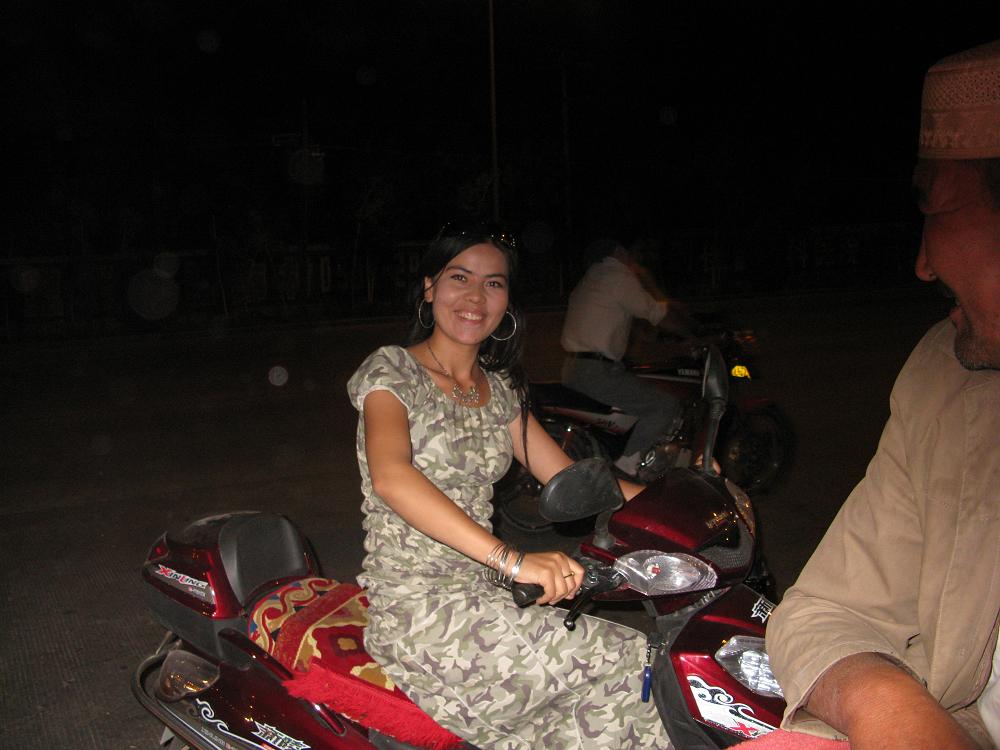
And then, suddenly, it all became clear. We were being taken to meet Buxom’s daughter. When she appeared out of the murky evening light – and turned out to be an astonishing Central Asian beauty (pictured) – it felt like we were being rewarded. (Flâneurially of course).

It had been another remarkable and memorable day. As I mentioned in a previous post, the Uighur Kashgar that provided us with such pleasure may not be around for much longer.

Tomorrow we will set off along the Southern Silk road.

Leave a comment

Filed under 'mind the gap' journey 08-09, All posts, China '09

Chinese Bureaucratics, Kashgar economics and Xinjiang politics

A surprising encounter with the authorities – an insight into the micro-economics of Western China – and a reminder of the politics that dance in the shadows here…

Chinese Bureaucratics

“Ah, Mr Durf, you are still here, good!” said the girl on the desk of the hostel. “You must go PSB! They have called! There is problem with your visa!”

I stopped in my tracks. (You would too if you encountered four exclamation marks in one sentence.) The Chinese PSB (Public Security Bureau) is an organisation that guidebooks advise you to “minimise contact with”. Being beckoned into their hallowed portals is not a terribly good sign.

When I got to the building, I tried my best to stroll nonchalantly up to the counter. I was reminded of a passage in the book I had finished that morning (William Boyd’s Brazzaville Beach), which explained the different types of catastrophe under the science of catastrophe theory. A ‘fold’ catastrophe is conditioned by a single factor and cannot be reversed (like the popping of a balloon); in a ‘cusp’ catastrophe, on the other hand, there is always a chance of recovery (like in an epilectic fit, or even boiling a kettle of water). I prayed that this was merely a cusp catastrophe.

“Errr…. Mr Durf… why you have Group Visa with only one person on it?” This was indeed an excellent question, and one that I had asked myself when it had been issued in Kathmandu. It had made little sense at the time, and made even less so now. I struggled manfully to explain that it hadn’t actually been my choice, and that I had little control over the actions of the Chinese Visa section in Nepal, who wouldn’t let you cross Tibet with an Individual Visa.

“Errr… Mr Durf… then we have problem. I also have no control over Visa section in Kathmandu. They report to Foreign Ministry. I report to Public Security ministry,. They make mistake. I must rectify mistake. Sorry. This will take many days. Even then you may not get visa.” My heart sank.

Despite his being the bearer of bad tidings, I rather liked the cut of this guy’s jib though. It was clear that he was one of the Top Dogs in the building, and yet his blue policeman’s shirt was unbuttoned halfway down his chest in a casually LAPD-kind-of-way. His harsh words were set off against a gentle faintly smiling face. So I pleaded and cajoled my way through the next quarter of an hour – using “yes’ and “and”, avoiding “no” and “but” in an effort to find a constructive solution to his difficult problem. I really fancied I was making progress… but he seemed caught in a loop.

“Errr… Mr Durf… you must understand. I am sorry. It is my duty to report this. Foreign ministry has duty. I have duty. It is problem.” Now I really was ready to give up. If China didn’t want my money, they could stuff it. I’d go elsewhere.

Then suddenly he softened. “Errr… Mr Durf… you wait 20 minutes?” And Bingo. Twenty minutes later, he came back grinning. “Errr… Mr Durf…. Is OK. You can have one month.” I wanted to hug him. I couldn’t help but break out into a grin myself.

In discussions with a few people since, the general consensus has been that this incident is a good pointer to the change that is going on in China. Not only are there a few reasonable guys making it up the greasy pole, but once they get there, they are acting more reasonably, perhaps being given a little more freedom to act. There are still barriers, but they are getting easier to surmount.

Kashgar Economics

Those of you who have had the stamina to follow this blog for a while may remember the Bangalore Economics story associated with the purchase of a ticket for the cricket there.

Kashgar’s economic indicator is slightly different, but equally fascinating. As I got off the 24-hour overnight train from Urumqi to Kashgar, I couldn’t understand why so many people seemed to want to buy my (franked, and therefore redundant) ticket. I enquired of the friendly Hotel bus driver.

It transpired that this was actually an expenses scam. The flight from Urumqi to Kashgar costs 300 Chinese Renimbi (about 30 GBP), 50 renimbi less than the cost of the train ticket. So if someone buys my used ticket for 5 renimbi, they can then sell that ticket to a businessmen who has actually taken the flight for 20 Renimbi; the businessmen can then claim with that used ticket for the extra 50 Renimbi, pocketing 30 Renimbi.

Elegant, I think, is the word.

Xinjiang Politics

A couple of brief examples, without comment, of the way that politics infuses culture and religion here.

On the first panel in the (generally excellent) Xinjiang Museum:

“We have selected a batch of fine works to show the contributions of the peoples of all nationalities in Xinjiang have made for safeguarding the reunification of the motherland’s cultural treasure-house, and to make the masses of audiences receive the education in patriotism.”

At the entrance to the grand mosque here (from where salat prayers can be heard every morning at 6am, reinforcing the Central Asian feel here):

“[This mosque] shows fully that Chinese government always pays special attentions to the another and the historical cultures of the ethnic groups and that all ethnic groups warmly welcome Party’s religious policy. It also shows that different ethnic groups have set up a close relationship of equality, unity, and helps to each other, and freedom of beliefs is protected.”

And finally…

Kashgar is full of interesting travellers. The most interesting/courageous are a couple of likely lads from the US, who have just spent 2 months cycling across Tibet. Given the various obstacles in their way, much of the actual cycling was done at night to take advantage of dozing check post guards. Great stories. They only got arrested once.

Kashgar is also full of surprises – I was a little taken aback to see “Haggis” on the menu in one restaurant. Clearly I had to order it. It is somewhat more rustic than the famous Crombies’ offering; I think I can vouch for the fact that they use a few more parts of the sheep too. Oh, and the coup de grace is that it is served on a bed of sheeps’ lungs. I think I’ll stick to Crombies.

I will spend a few more days here exploring the Chinese side of the Karakoram Highway before heading along the Southern side of the Taklamakan Desert and into central China.

Leave a comment

Filed under 'mind the gap' journey 08-09, All posts, China '09