Category Archives: ‘mind the gap’ journey 08-09

A rubbish dilemma

So here’s an interesting dilemma for you.

You are on a train in India, the only westerner in an 8-person compartment. Despite a lack of more than about 20 common words (14 of which are Hindi), you have made friends with the man sitting next to you. He has bought you a tiny plastic beaker of Masala Chai from the guy going up and down the train, which you are enjoying the dregs of, marvelling on the beauty of travel connections.

As he finishes off his cup, he opens the rusty window a few inches, and casually flings the empty out of the window, smiling broadly at you and inviting you to do the same.

What do you do?

It’s not quite as simple as it sounds.

It would be fair to say that the idea of responsible waste management is not one that has set India alight. In fact any kind of waste management would be a novelty here. Walk along any road in any town or city and you will see all all kinds of rubbish (and I mean ALL kinds) strewn down the side of each and every road. And the cows – well, the cows add their two-penn’orth as well with a good sputter (new word of the day – work it out) at every opportunity.

[I remember being told in New York not to look up all the time – it’s a sure sign you’re a tourist marvelling at the size of the buildings which no self-respecting New Yorker would do. The same could be said about looking down in India.]

The waste is so in-your-face and so alien to anyone from the UK that it was the first thing I discussed with the first guy I met on the second evening I spent in India (in Mumbai) over 3 months ago. By a happy coincidence, Hannu Laaksonen was a manager in the Waste Management department of that cleanest of cities Helsinki.

In response to my moral outrage a the lack of street wastebins, Hannu calmly pointed out that there’s not much point in having bins if you have no-one with a truck to collect the rubbish in the bins, and there’s not much point having anyone with a truck to collect the rubbish in the bins if you have no dumps for the trucks to go for, and there’s not much point having dumps if you have no intention to do anything with the rubbish once it’s been dumped.

Which is a long-winded way of saying that, basically, there’s not many people here who really worry about the rubbish. It’s not a priority for government at any level (or presumably for voters). The street is the waste-bin.

So back to the dilemma. I didn’t fling my cup out of the window onto the street, and earned a puzzled look as a result. Instead I put it under my seat. Where someone would later find it. And fling it out on the street. Hmmm…

I am now in Jodhpur. The experiences keep coming thick and fast. In the past 48 hours I have had to rescue my flat-cap from being torn to shreds by stray dogs, have witnessed a Shakespeare play in the Fort here (bizarre but brilliant), and attended two impromptu wedding celebrations. More tomorrow.

Leave a comment

Filed under 'mind the gap' journey 08-09, All posts, India '08-'09, North India

A Yogi’s Tale (an Ashram story in 3 parts). Part 3 – “Soul”

[Click here for Part 1]
[Click here for Part 2]

Ashrams, by their nature, attract people on a search for something. As the Swami frequently delighted in pointing out “you all decided to come here for a reason”.

I wasn’t really sure what my reason was (doing it “for a laugh” didn’t really cut the mustard), so I resolved to retain an open mind for the four weeks.

There were times when this was a bit of a struggle – such as when I got involved (as a bystander) in a conversation over tea about the merits or otherwise of astral traveling (leaving your physical body for a short vacation and visiting somewhere else under the auspices of your “astral” body). At times like these I’m afraid my mind closed faster than a clamshell on speed, and I found myself wanting to distribute copies of Francis Wheen’s book “How Mumbo-Jumbo conquered the world”.

It was, however, fascinating to see that the search for the soul takes many forms. Some took it all very seriously, others were clearly here to learn how to teach the stretchy stuff and head home.

The most obvious navigational device for soul-searching was meditation. This was always going to be a challenge for me – sitting still has never been my strong point, and with hips which stubbornly refused to open more than 45 degrees, crossing my legs could be seriously painful.

Still, it was a unique opportunity to meditate for 20 minutes twice a day, and I gave it my best shot.

Distractions during meditation were, unfortunately, a fact of life with over 200 people trying to practice silence together. The 6am sessions also had the dubious pleasure of the sound of rutting lions as a backdrop – the safari park across the lake held eight of them, and they definitely had a “daily routine”.

On one particular 8pm evening session, I was sitting at the back of the hall as usual, trying hard to avoid furrowing my eyebrows with the effort involved in controlling my mind and moving into the spiritual realm.

All of a sudden a noise emanated from the top corner of the hall near the raised stage. I cautiously opened one eye to peer into the gloom, relieved to see others do the same. We were all thinking one thing – “That wasn’t a… It couldn’t have been… could it?”

The second sound put things well beyond doubt. It was unmistakeably the sound of unintended flatulence. Suppressed, guilty laughter spread through the hall. Unfortunately, the acting Swami didn’t share our amusement. “You people are amazing you know…You’re like children. No
self control. Grow up.” I’m not sure that she understood how much we needed moments of humour like these to keep going.

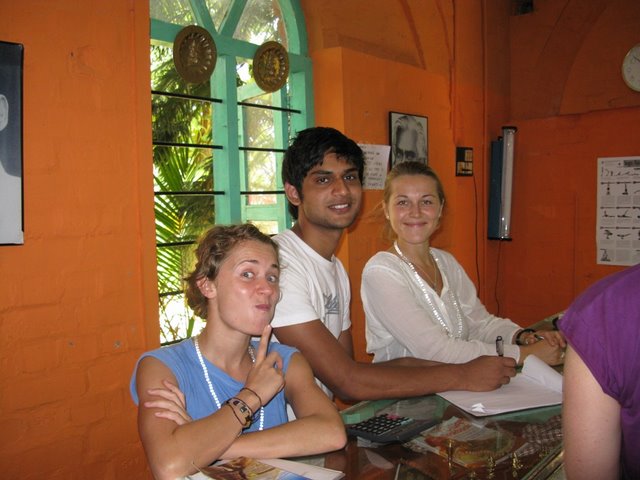
I was also lucky that my daily hour of Karma Yoga provided a daily break from the routine. I spent the month reorganising the bookstore with Amy, Abi and Laura (pictured in the boutique) in a job that was manna from heaven for a bibliophile like me. It left me contemplating whether it was OK to enjoy Karma Yoga. (It was. I asked.)

Sometimes the lessons for the soul were most unexpected. Twice I got a wake-up call to be less attached to my possessions. One of these was when my shoes got nicked from outside the hall. I spent a good few days obsessing over the loss. (As Mel Brooks so acutely pointed out “Comedy is when YOU fall down a manhole. Tragedy is when I prick my finger.”) The lesson came when another Ashramee gave me trekking sandals he no longer needed. A lesson in Karma indeed.

With nearly 200 young(ish) international Ashramees, there was also plenty of opportunity to connect with other souls. The variety was endless – on any given evening you could find yourself speaking with yoga teachers, Indian Government civil servants, healers, lawyers, MIT PHD students, first class air hostesses, even an Arab Sheikh. The conversations were fascinating. I probably got more from these interactions than anything else.

As the course came to an end with exams and a graduation ceremony (see previous post), everyone was left to reflect on what they’d found out about themselves. Seeing forlorn faces heading back to full-time jobs, I felt exceptionally lucky that I had the time and the space to reflect on the course in the days and weeks that follow. It was clear that some had found their lives changed; others simply got what they came for. For everyone it had been a compressed and challenging month.

Myself? I definitely got more than I came for. I even walked away with a spiritual name, Gajananam (the fact that this is another name for the elephant-headed Hindu God, Ganesha, is somewhat offset by the fact that he is the deity invoked by writers).

The decision a month earlier – to follow my heart – had been the right one.

Leave a comment

Filed under 'mind the gap' journey 08-09, All posts, India '08-'09, South India

A Yogi’s Tale (an Ashram story in 3 parts). Part 2 – “Mind”

[Click here for Part 1]

“Errr… you do know that there are philosophy lessons don’t you?”

Every former Yoga Teacher Trainee I had spoken to had mentioned the philosophy lessons with a look in their eyes that made me slightly nervous. And when student after student rose at the “Initiation” ceremony to talk of “learning more about the spiritual side of Yoga”, it became clear that that some had come with more in mind than just the stretchy stuff.

Still, forewarned is forearmed, and I was definitely better prepared than some. I’m not sure anyone, however, was prepared for the length, depth and sweeping magisterial breadth of what was to follow.

Our lecturer for the month was Swami Mahadevananda (also the director of the course) a powerful Italian, and one of the leading lights in the Sivananda movement alive today, his imposing physical presence backed up by a booming voice and a strangely piercing glare.

Philosophy lessons were scheduled for 2pm daily, and from the word go he established his trademark no-nonsense style. The lesson was blunt and to the point, clearly based on the principle that Eastern Philosophy is so alien to the western mind that it can only be communicated with a bang not a whimper.

The message was suitably mystical. (For the sake of brevity, I paraphrase 100 minutes into 30 seconds). “Om. Forget everything you know. Time doesn’t exist. Space doesn’t exist. In fact nothing that you think of as real exists. God is the only thing that’s real, but your stupid little minds and your gigantic egos mean you’ll probably never really understand that either. Om.”

A few tentative questions were brushed away nonchalantly, and the class dispersed to ponder what would come next.

2pm on Day Two. As the chatter of 175 newly-met students echoed round the hall, the Swami sat imperiously on his cane chair.

He drew attention to his presence. “I’M HEYEEERE” he bellowed loudly, in an opening gambit was to become all too familiar over the coming weeks. It reminded me of Jack Nicholson’s “Heeeeeeyere’s JOHNNY!” in the film The Shining.

If Day One’s message had been hard to digest, Day Two was equally uncompromising. (I paraphrase again). “You think you’re free? You think the West’s free? You must be crazy. The 20th century was a disaster for the world; you’re trapped and frankly there’s not much hope of a way out. None of you know what real freedom, spiritual freedom, is anyway.”

Gulp. Looking round the tired faces in my dorm that night, it felt like any type of freedom would do. It wasn’t just the challenge of the philosophy classes – more that the combination of lack of sleep, tough Asana practice, a down-shift to two meals a day, and twice daily chanting left little time to digest food let alone spiritual manna. Drastic measures were required. In Vishnu dorm we prepared a wall chart was hastily prepared with a 26-day countdown to liberation, whatever form that might take.

But there was no let-up – over the next couple of days, the barrage continued as the Swami outlined the basic tenets of Vedantic Philosophy and Hindu belief. There was something majestic about the way he stuck to his guns. He was here to give a message, and that was what he would do. He served big, booming metaphysical statements straight down the middle of the court with the power of Nadal; questions were swatted away with the consummate ease of Sampras at the net; and lessons were drawn out more painfully than the longest Henman Wimbledon thriller.

We were informed that science, frankly, was bunkum, and that no Western research had ever started to understand the mind. (As Swiss doctor commented to me later “There goes Freud…”). Although lessons rarely finished on time, some of us couldn’t help but ask floundering questions, eating into a valuable scheduled 30 minutes of free time in our packed schedule.

An underground movement sprung up among some frustrated students. Books and articles on neuroscience were surreptitiously put into circulation; names of philosophers were swapped around, particularly by frustrated Buddhist practitioners.

But still the Swami continued with vigour. His energy (he’s 70) and his belief were unquestionable. He raced through an exploration of the Vedas, explained how to tell your Brahma from your Brahman, took us up and down the Chakras, moved from Physical to Astral and Causal bodies with ease, and warned of the power of Kundalini – all the while interspersing his languid speech with intriguing personal stories. Slowly the jigsaw pieces of the belief system behind Hindu Culture were assembled.

For a Westerner like me, with little to no knowledge of Hindu Culture prior to the course, it was an eye-opener. The amount of information communicated in a short period of time was substantial. The core message – that you can only reach God by getting beyond your mind and controlling your ego – is a powerful one, and brought meditation to life. And understanding Karma (properly) as well as the concept of reincarnation is no bad thing when it underpins the beliefs of rather a lot of people in the world.

Most importantly, I got a first-hand experience of the concept of unquestioning devotion that is at the heart of the Guru (Gu-ru = “Remover of – Darkness”) system. For Westerners used to seeing critical analysis as the only real way to progress in life, this comes as a bit of a shock. But when you realize that in some ways unquestioning devotion is an organising principle in India, it starts to explain some of the fundamental differences in the approach to society here – both advantages and disadvantages.

Over time, I also came to realize that his didactic and sometimes aggressive style was, in some ways, the only option he had. (Taking a quick 40 winks in one of his classes (or, worse, not turning up in uniform) was to risk being singled out with a booming “HELLOOOO”). Time was limited, and he had an awful lot to say.

I walked away with a much greater understanding of one of the great faiths. There were many things which bothered me, but that’s no bad thing. (I will mention only one – there seemed to be a deliberate attempt to conflate religious/spiritual belief and science, giving the former the ascendant position and assigning it with ownership of the concept of “truth”, while denigrating the value of the latter. This seems pointless to me. If there’s one thing we know, it is that if a belief is proved as objective truth, humans will move on and find the next thing to believe in. Valuing belief for what it is – above and beyond objective truth – seems more, um, logical).

But maybe the real lesson is this: Don’t think too much.

So. Mani was arming me with an understanding of how to control my body. The Swami was driving home the message of the importance of getting beyond my mind to reach the self/soul.

Meditation, we were told, was the key to connecting the two… but could I keep my legs crossed for long enough?

[Click here for Part 3 – “Soul”]

Leave a comment

Filed under 'mind the gap' journey 08-09, All posts, India '08-'09, South India