Indian Railways: getting on the right side of the tracks

“Indian Railways” is, by any account, a remarkable organization. Various sources claim that:

a) it is either the largest or second largest (after the Chinese Army) employer in the world
b) the network carries the equivalent of the population of Australia every day
c) it has one of the most complex revenue collection systems in the world

The daily reality is equally astonishing.
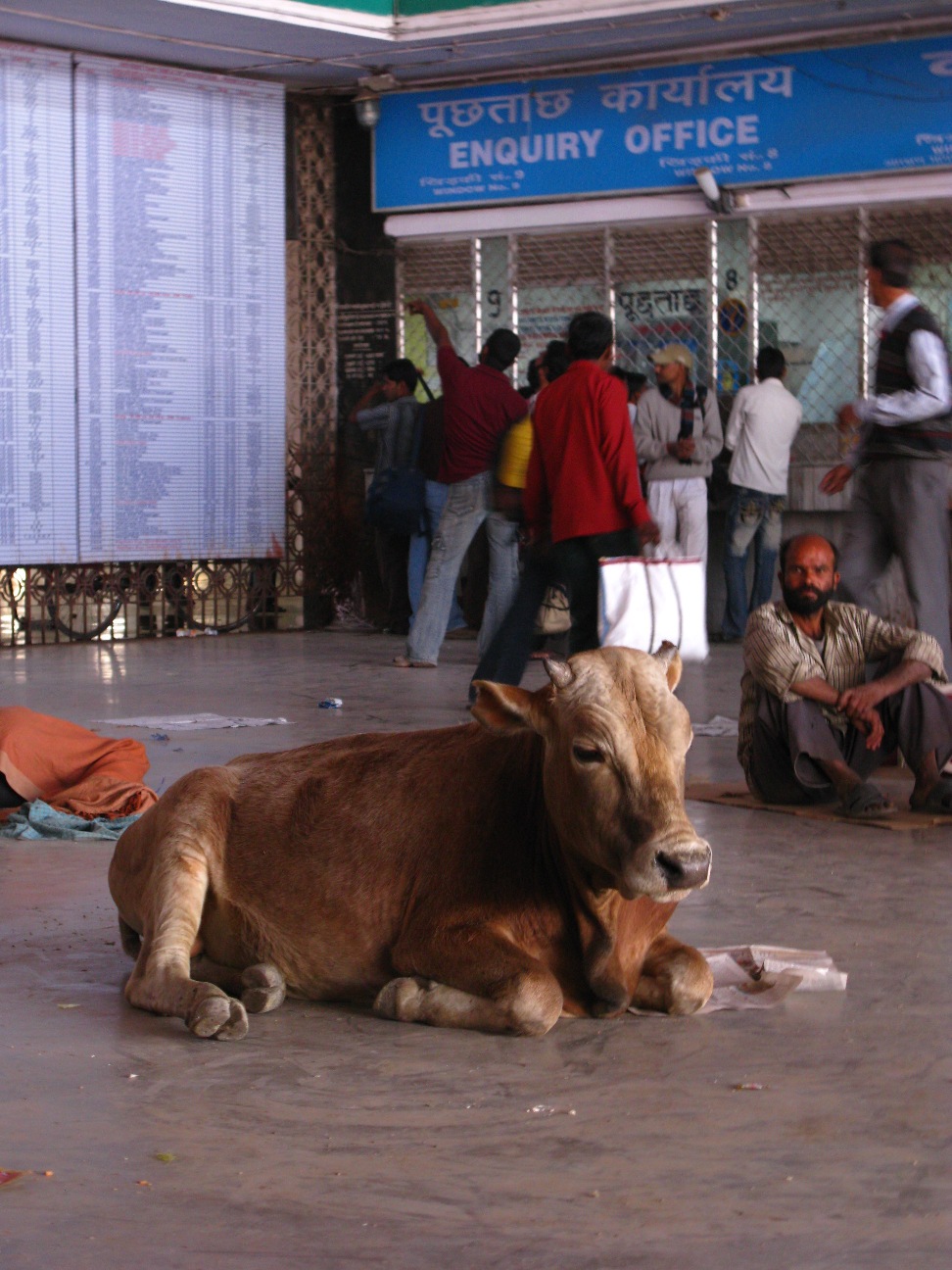

We arrived at Mughal Sarai station (just outside Varanasi) at 8.30am, greeted by a cow who had clearly got bored of queueing up for the ever-chaotic Enquiry Office. Although it would be unfair to say this is a frequent sight, you get so used to randomness here that it took a second to register just what a strange picture this was.

Leaving Ermentrude behind, we walked through the upright scanner that most Indian stations now have for these security-conscious times. The operation of these is just as random as the queue for enquiries however – the sound of the beeper alarm is no guarantee that you will be stopped, and if your bag is too big to squeeze through these flimsy structures, doing a quick side-step round the side is usually tolerated by generally bored looking officials.

The train was delayed. I was quite happy to draw on my ever-increasing well of patience. I decided to have a look around.

A couple of young official-looking boys with flimsy fluorescent yellow waistcoats (so loved by officials the world over) walked past. They came over. The usual pleasantries were exchanged, involving interrogation as to our country of origin (more on that in another post). It turned out that they were riding on the trains in a joint WHO/Rotary International programme, administering polio drops to children under five. Given the Australia statistic above, this seemed like a deeply practical initiative.

As the boys walked off to continue their walk, I looked up the platform. There was something wrong. The platform was not just clean, it was close to spotless. I looked up to see a sign:

“REVOLUTION HAS JUST BEGUN FOR COACH CLEANING
Clean n Carewel Services CTS MUGHAL SARAI”
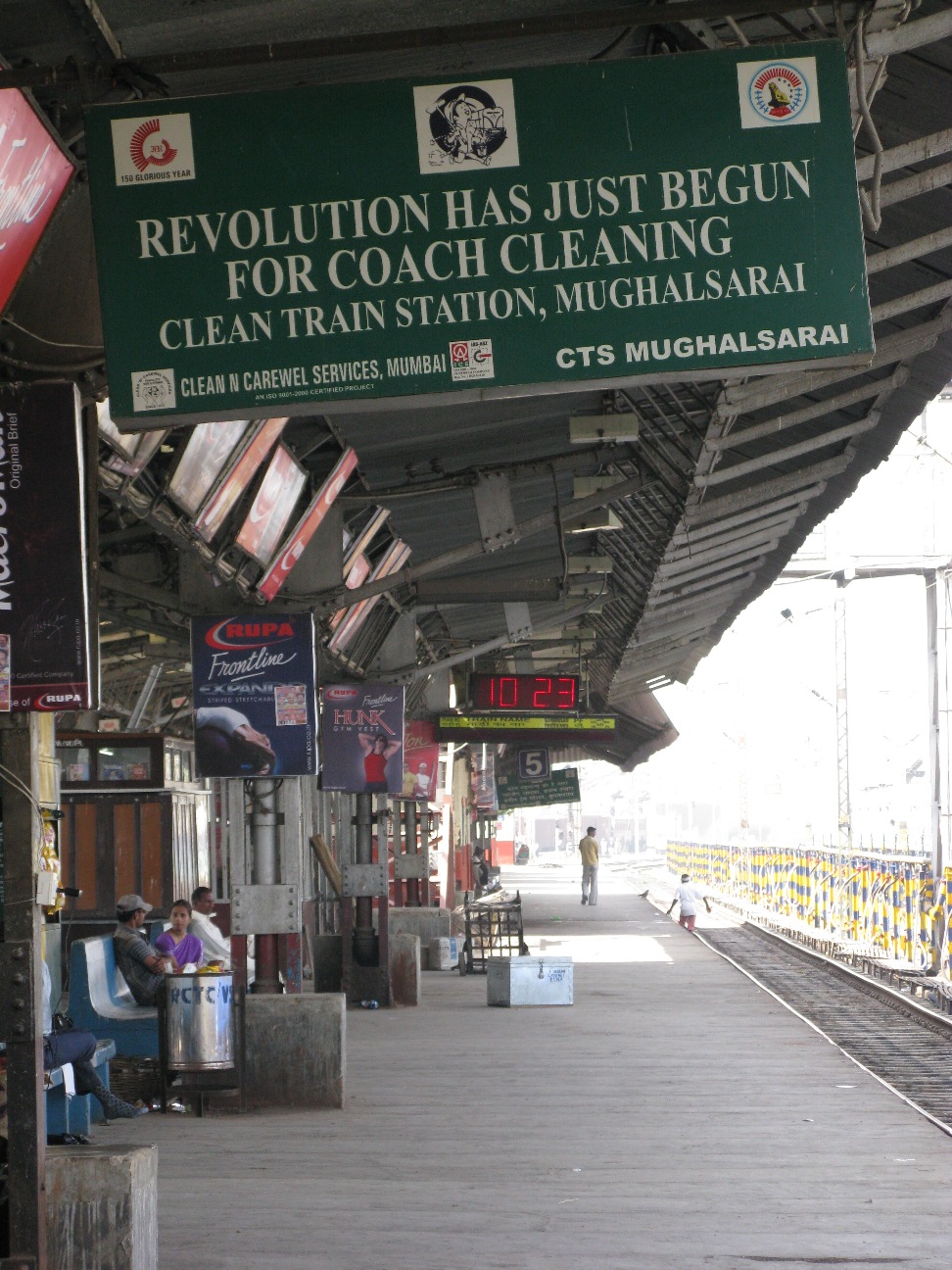
It seemed remarkable. As the Western world privatizes its banking system, could private contracts for railway station maintenance really be establishing a foothold in India?

The train arrived, a mere 90 minutes late, which is actually not bad for a train that had been on the tracks for 10 hours and had at least another 12 to go. (We were joining the Sealdah-Jaipur Express, which cuts a swathe through the Gangetic Plain from Bengal to Rajasthan – click here for route).

Within a few kilometres we were headed into the interminable expanses of countryside, so uniform across the entire country that, as John Keay points out in his History of India, “the traveller – even the Indian traveller – may have difficulty in identifying his whereabouts”.

Despite this uniformity, there is always endless fascination and plenty of food for thought. Within a single minute you pass seemingly random piles of concrete pillars (actually railway sleepers); village settlements with haystacks and flimsy homes with roofs made from plastic sacks; railway crossings with a surprisingly large number of assorted cars, cycles, rickshaws, pigs, cows, monkeys, and foot passengers waiting patiently to cross; a concrete town settlement looking strangely cubist with it’s concrete box housing; school children immaculately dressed on their way to their lessons.

But these are interruptions to the hours spent staring out of the windows at vast tracts of cultivated land as the train trundles on. (It was in Karnataka when the full scale of what these tracts mean first dawned on me – with little to no mechanization in many parts of the country, the crops still have to be harvested. By hand).

We pulled into Allahabad station, where the Ganges and the Yamuna rivers converge. Two men in smart green jump-suits climbed on – one walked purposely through the carriage spraying pungent air freshener everywhere, while another brought on what looked like a steam vacuum cleaner and started cleaning the floors. Someone, somewhere, had spotted the opportunity of these private cleaning contracts. “Clean n Carewel” were clearly a successful outfit.

The opportunity to chat to fellow passengers is one that I rarely turn down (even at the risk of occasionally being sucked into a vortex of interminable conversation). On this journey, my favourite was the Sikh who sniffily picked up the history I was reading, turned straight to the Index and announced loudly that it couldn’t be any good because it only had a dozen pages or so worth of references to Sikhs. I tried to point out that a) the book was 500 pages, b) it endeavoured to cover 5000 years, and c) Sikhism (though an essential part of the mix) hasn’t exactly dominated Indian society since its founding in the late 15th century. But he was not convinced.

We finally pulled into Agra Fort station in the evening, emerging back into the chaos of the streets from the relative tranquility of the journey.

There is a whiff of change in the Indian Railway system. It almost feels like things have even improved while I have been here (although admittedly the sample is rather low and restricted to passenger trains – 70% of Indian Railways revenue comes from shifting freight).

Lalu Prasad Yadav is the man in charge, a bruiser of a politician from the wrong side of the tracks, with a background that is colourful even by Indian political standards. It is he that is credited by some with making the difference, and in a tactic employed the world over in the run-up to elections, he is also promising massive investment.

He is a toughie, from the toughest of the tough lands in India, Bihar. But then as one of my fellow passengers said, the Biharis may be the only ones tough enough to keep up with the pace of change here.

I am in Agra and the surrounding area for a few days.
Leave a comment

Filed under 'mind the gap' journey 08-09, All posts, India '08-'09, North India

Varanasi: Shining Oscars, burning bodies, grasping politicians

I arrived in Varanasi (a.k.a. Benares, Kashi etc) on Wednesday morning, from Delhi. There are many stories to tell from 2 days of random meetings in Delhi, but since then I have had two intriguing and contrasting days in the City of Light.

Grasping the Golden Lady

We were travelling on a cycle rickshaw in the University area when I saw the sign out of the corner of my eye.

Smile Pinki
Felicitations to the Smile Pinki Oscar Winners
Today 5 March. 4pm”

It was 4.15pm. Despite not knowing anything about “Smile Pinki” (other than that it was the other Indian Oscar winner – a documentary), the temptation to follow our noses was too great. We pulled over and joined the crowds heading for the University’s Medical Department Auditorium.

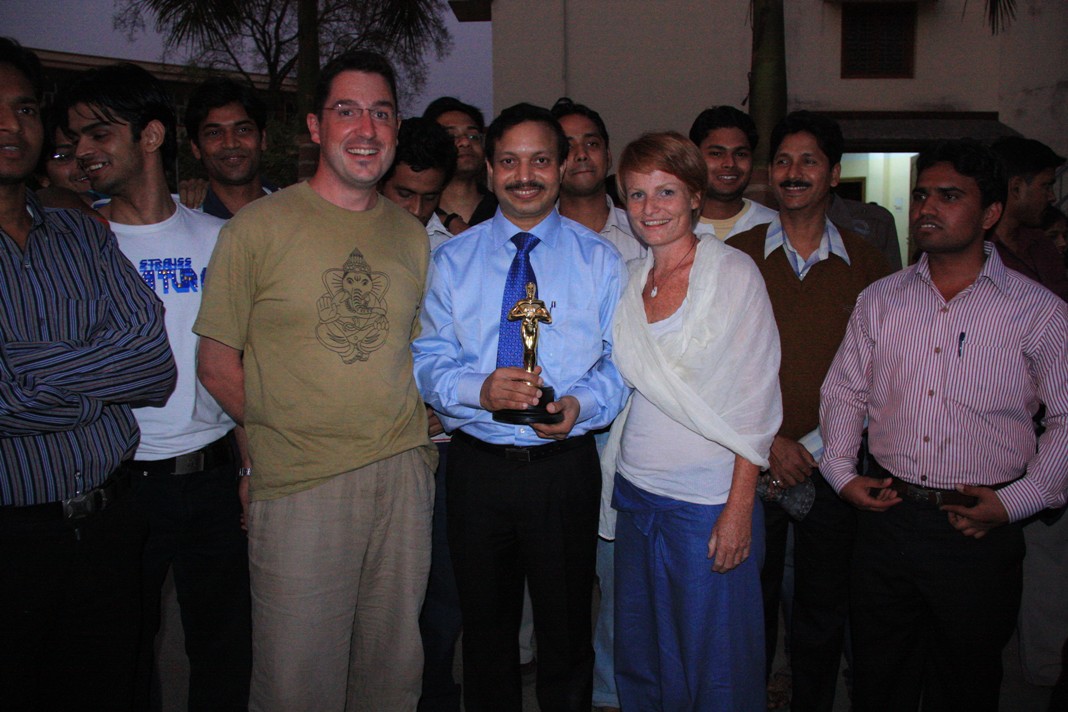
At the front of the stage, 1 Indian woman and 6 Indian men, one of them with a small Golden Oscar statuette in front of him, sat behind tables.

The 300 seats were taken. We found space and perched in an aisle. In no time, there were about 400 in the hall, crammed into every spare space.

We were still unaware of what we had stumbled upon. But as we listened to numerous laborious speeches, it dawned on us that we were witnessing the homecoming of the two main stars of the documentary, a surgeon Dr Subodh Kumar Singh and an anesthetist Dr AN Singh, fresh from their remarkable success at the Academy Awards.

The documentary deals with the Cleft Palate problem (more prevalent in India than most over countries in the world) and a remarkable project to deal with this at Benares University Hospital.

In rural areas of India, children born with Cleft Palate are seen as a curse on the mother, who will blame something like an Eclipse during pregnancy for the deformity. The children often end up ostracized by their communities, and even by their families.

The documentary follows the amazing work of the Smile Train Team at Benares University, as they go out into the surrounding rural areas to convince people that their children are not “monsters” and perform the operation on many children in one of their regular sessions. One of the real insights from the documentary was the practical reason behind the ostracising – prospects of marriages for Cleft Palate children hovered belween slim and nil.

Dr Subodh Kumar Singh was the last to take to the stage. He looked admiringly at the statuette in his hands.

“I feel privileged to be among the few in the world to grasp the Golden Lady!” he said with obvious emotion. “As a doctor, I never thought I would get a chance to walk on the Red Carpet!”No-one could begrudge him his pride. He gave thanks to every member of the teaching staff, auditorium staff, auditorium cleaning staff, family members, ancestors etc. It was a speech worthy of the famously emotional, if lengthy, Oscar monologues.

After an hour of speeches, the crowd were getting restless. When the compere suggested refreshments before the film started, a full-blown revolt seemed possible. The compere wisely took to the stage. “OK, we have heard you. The film starts now!” The 39-minute film (from a mere 100 hours of filming) did not disappoint. After an impassioned rendition of the Indian National Anthem, the famous Varanasi Ghats came into view. There were proud gasps from the crowd. It is a remarkable documentary with no narrated voice-over and no major production work. If you get a chance to see it, do so.

Despite the fact that we were clearly gatecrashers, we managed to wangle our way into the post-film refreshments, and meet the stars themselves. It was all, once again, most bizarre – but then I am starting to realize that is the norm in this country, and certainly for this trip.

Swimming with the Ashes

The contrast with the previous day was stark. I had arrived off a night train, and after a restorative Puri Masala, we headed down to the Ghats, which are the 88 separate series of wide steps leading down to the sacred river Ganges.

Hindus believe that if you die in Varanasi, you achieve instant Moksha (enlightenment). Most are cremated, with their ashes scattered on the river. Pregnant women and children are dumped directly into the river.

We sat by one of the Ghats where bodies are cremated by the side of the river in stacked piles of wood. An interminable stream of bodies were brought to the river wrapped in cloth, dipped in the Ganges, placed on the pyres, and set alight, while others were rowed out to the centre of the river for the final passage. The whole place is suffused with a strange combination of gentleness, spirituality, and matter-of-fact practicality in the face of death. When you believe that we are all spiritual beings merely on a human journey, death becomes a mere passage. There is no need for weeping or wailing – these are solemn, but not unhappy, occasions.

Look around and you notice the dogs defecating nearby, the children urinating in the street, the cows munching on the unidentified flotsam and jetsam at the edge of the river, the half burnt legs and arms being raked back into the pyres, even 21st century intrusions as mobile phones are answered at the side of cremations. It is also challenging to see people bathing in the same river where dead bodies and half-burnt body-parts are floating – the Hindus believe that bathing in the Ganges remits your sins. Strangely, none of this takes away from the essential spirituality of the place.

As a major Hindu religious site, the temples in Varanasi are patrolled by endless bored-looking policemen in the run up to the General Election. Uttar Pradesh will be a fascinating battle-state, and attracts colourful politicians like Mayawati and Mulayam Yadav, both promising endless money for investment in Varanasi and making impassioned denunciations of the other in a rivalry that stretches back more than 20 years.

But with a spiritual tradition that stretches back longer than any city in the world by some accounts, you get the feeling that the people of Varanasi can’t be bought. Somehow, Varanasi’s Oscar award, for a project imbued with such generosity of spirit, says so much more about this city and its potential future.

We head towards Agra tomorrow.

Leave a comment

Filed under 'mind the gap' journey 08-09, All posts, India '08-'09, North India

Getting lost in the Delhi Triangle

I have been staying with ex-pat friends in Delhi’s “Defence Colony”, the plush suburb that marks the break between the heritage of both Old and New Delhi in the North, and the sprawling middle class housing projects expanding ever further south.

To misquote Obama, change is coming to Delhi. Things are on the move here – the Commonwealth Games will take place in Delhi in 2010; a massive underground metro is being built (work will continue until 2021); and a Municipal government (led by the unfortunately-named Sheila Dikshit) has just been elected for a third four-year term.

With eight (some say fifteen) different cities built over the centuries, it would take more than the dozen or so days that I am spending here to understand the complexities of Delhi.

Nevertheless, I have had three very distinct impressions of this rapidly evolving city that is destined to play a major role in the 21st century.

A sense of the suburbs

After my slightly bizarre cinema experience in Jaipur, I headed out last night into the deep suburbs to South Delhi to catch Slumdog Millionaire. As my auto-rickshaw jostled for position in the road amid the Toyota, Audi and Suzuki saloons, it was clear that I was entering true aspirant middle-class Delhi.

The Saket PVR cinema complex could be anywhere in the world. The multiplex cinema, surrounded by a McDonalds, a Pizza Hut, a Subway sandwich bar and a few emerging drinking holes; young couples strolling around, while families struggled with errant children, and groups of teenagers congregated on concrete benches; Popcorn, Pepsi and pre-fab Hot Dogs on sale by the box office.

I wandered into the McDonalds before the film. Despite the odd subtle change (the “Big Mac” became the “Chicken Maharaja” – even Ronnie M has worked out that beef don’t sell in India), the similarities were more evident than the differences. The same fixed grin on the servers faces, the obligatory “Have a nice day” with your meal, the tall stainless steel dispensing units shielding the frenetic fast food preparation activity from prying eyes. As I took my Maharaja Meal upstairs, I realised that the only discernible difference was the people –you get a better class of customer in a Delhi Maccy Ds.

If it hadn’t been for the much higher standard of behavior (probably due to the lack of alcohol), the whole thing could have been transplanted into Surbiton. This very average scene is an essential part of the whole Delhi picture.

The film itself seemed to leave a few people uneasy. Moral agonising (in the way that we love in the West) still isn’t the norm in films over here. Bollywood has a tendency to keep things simpler. While the reaction that I had heard in Jaipur was probably at the extreme end, I got the feeling that there were bits of the film that did touch nerves. Which is probably no bad thing.

Remains of the Raj

In the 1930s, the British laid down New Delhi with (as William Dalrymple points out in “City of Djinns” ) more than a whiff of the arrogance and hubris of Nuremberg. The resulting “imperial mass of masonry” still holds the political centre of India, as well as wide boulevards and green spaces which recall the European cities it was built to ape.

For four weeks each year in February and March, the Mughal Gardens (actually created in the 1930s as well) of the Presidential Palace (formerly the Viceroy’s House) are opened to the public. A journalist told me that visiting these is something of a rite of passage for a Delhi-ite, so Mel and I set off on Friday to see what all the fuss is about.

As we passed the laborious security checks and entered the gardens, we both suspected that we were in for another disappointment. A slightly tatty herb garden and a Path-From-Which-You-Must-Not-Stray did not augur well.

Then, as we turned the corner into the Rectangular Garden, we were confronted by a riot of colour that was almost overpowering. The formal layout of the garden is offset by blooming flowers in hues of red, blue, yellow, pink, orange and greens of all kinds. With over 100 types of rose, all beautifully labeled, there were some great names: the “Kiss of Fire”, “Rhapsodie in Blue”, “Doris Trysterman”, “Dr B.P.Lal” (who he? Ed), and my favourite name “Just Joey”. With cameras banned from the Gardens, it was refreshing to be able to simply suck up the atmosphere without the very 21st century obsession with capturing everything digitally (more often than not only to be deleted later).

As we left the Gardens and drove along “Church Lane” past the Cathedral Church of Redemption, I felt privileged to have seen at least one fine legacy of the pre-Independence era.

Making a mess of the Mughals

Walking through the streets of “Old Delhi” (the 17th century Mughal bit) is a bit like being on one of the streets in the futuristic film Bladerunner, only without the cars flying about: the confused jumble of signage, some of it illuminated; the bundles of electrical wires hanging and occasionally crackling and fizzing; the mix of Eurasian and Asian facial types all competing for attention; the occasional hint of a glorious past in patches of architecture peeping out from down a back alley.

In many ways this part of the city is the biggest challenge for the city planners and administrators in Delhi. Even if it feels disorientating and out-of-control for many westerners, the narrow streets and alleys are packed with life, commerce, and people’s livelihoods. Change will not be easy.

At the apex of the Old city is the Red Fort, which was a stronghold for the Mughals, the British and the young Independent India.

Six years ago, the fort was granted UNESCO status on the condition that it got rid of its military garrison. As a result, things have started to look up for what could be an interesting monument with a bit of TLC, though clearly it will take time.

Our guide told us that restoration work on some of the delicate wall-paintings has been halted for 5 years, after an (Indian) NGO sued the Archaeological Survey of India, alleging that the restoration was not faithful to the original and that cleaning practices were damaging the original materials. The case is still being heard in the courts.

—–

Delhi is fascinating. An article in today’s Hindu Times noted (admittedly with a touch of melodrama) that India is now facing potential failed states on three of its six land borders (Pakistan, Nepal and Bangladesh were what they had in mind – the others being Bhutan, Burma and China). Delhi is at the heart of that particular triangle. And the religious mix here certainly continues to hold a degree of repressed tension.

With such a diverse and rich historical background and such a potentially important future role, this is a city to watch.

I leave on Tuesday heading for the Gangetic Plains.

Leave a comment

Filed under 'mind the gap' journey 08-09, All posts, India '08-'09, North India