[Click here for Part 1]
[Click here for Part 2]
Ashrams, by their nature, attract people on a search for something. As the Swami frequently delighted in pointing out “you all decided to come here for a reason”.
I wasn’t really sure what my reason was (doing it “for a laugh” didn’t really cut the mustard), so I resolved to retain an open mind for the four weeks.
There were times when this was a bit of a struggle – such as when I got involved (as a bystander) in a conversation over tea about the merits or otherwise of astral traveling (leaving your physical body for a short vacation and visiting somewhere else under the auspices of your “astral” body). At times like these I’m afraid my mind closed faster than a clamshell on speed, and I found myself wanting to distribute copies of Francis Wheen’s book “How Mumbo-Jumbo conquered the world”.
It was, however, fascinating to see that the search for the soul takes many forms. Some took it all very seriously, others were clearly here to learn how to teach the stretchy stuff and head home.
The most obvious navigational device for soul-searching was meditation. This was always going to be a challenge for me – sitting still has never been my strong point, and with hips which stubbornly refused to open more than 45 degrees, crossing my legs could be seriously painful.
Still, it was a unique opportunity to meditate for 20 minutes twice a day, and I gave it my best shot.
Distractions during meditation were, unfortunately, a fact of life with over 200 people trying to practice silence together. The 6am sessions also had the dubious pleasure of the sound of rutting lions as a backdrop – the safari park across the lake held eight of them, and they definitely had a “daily routine”.
On one particular 8pm evening session, I was sitting at the back of the hall as usual, trying hard to avoid furrowing my eyebrows with the effort involved in controlling my mind and moving into the spiritual realm.
All of a sudden a noise emanated from the top corner of the hall near the raised stage. I cautiously opened one eye to peer into the gloom, relieved to see others do the same. We were all thinking one thing – “That wasn’t a… It couldn’t have been… could it?”
The second sound put things well beyond doubt. It was unmistakeably the sound of unintended flatulence. Suppressed, guilty laughter spread through the hall. Unfortunately, the acting Swami didn’t share our amusement. “You people are amazing you know…You’re like children. No
self control. Grow up.” I’m not sure that she understood how much we needed moments of humour like these to keep going.
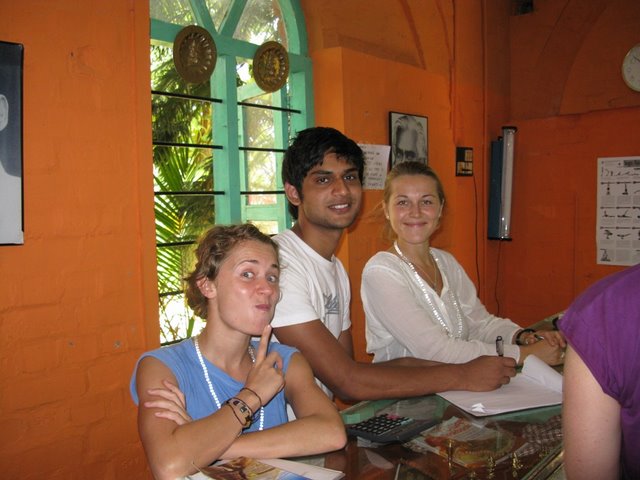
 I was also lucky that my daily hour of Karma Yoga provided a daily break from the routine. I spent the month reorganising the bookstore with Amy, Abi and Laura (pictured in the boutique) in a job that was manna from heaven for a bibliophile like me. It left me contemplating whether it was OK to enjoy Karma Yoga. (It was. I asked.)
Sometimes the lessons for the soul were most unexpected. Twice I got a wake-up call to be less attached to my possessions. One of these was when my shoes got nicked from outside the hall. I spent a good few days obsessing over the loss. (As Mel Brooks so acutely pointed out “Comedy is when YOU fall down a manhole. Tragedy is when I prick my finger.”) The lesson came when another Ashramee gave me trekking sandals he no longer needed. A lesson in Karma indeed.
With nearly 200 young(ish) international Ashramees, there was also plenty of opportunity to connect with other souls. The variety was endless – on any given evening you could find yourself speaking with yoga teachers, Indian Government civil servants, healers, lawyers, MIT PHD students, first class air hostesses, even an Arab Sheikh. The conversations were fascinating. I probably got more from these interactions than anything else.
As the course came to an end with exams and a graduation ceremony (see previous post), everyone was left to reflect on what they’d found out about themselves. Seeing forlorn faces heading back to full-time jobs, I felt exceptionally lucky that I had the time and the space to reflect on the course in the days and weeks that follow. It was clear that some had found their lives changed; others simply got what they came for. For everyone it had been a compressed and challenging month.
Myself? I definitely got more than I came for. I even walked away with a spiritual name, Gajananam (the fact that this is another name for the elephant-headed Hindu God, Ganesha, is somewhat offset by the fact that he is the deity invoked by writers).
The decision a month earlier – to follow my heart – had been the right one.




 Andrew Duff