
A Yogi’s Tale (an Ashram story in 3 parts). Part 2 – “Mind”

[Click here for Part 1]

“Errr… you do know that there are philosophy lessons don’t you?”

Every former Yoga Teacher Trainee I had spoken to had mentioned the philosophy lessons with a look in their eyes that made me slightly nervous. And when student after student rose at the “Initiation” ceremony to talk of “learning more about the spiritual side of Yoga”, it became clear that that some had come with more in mind than just the stretchy stuff.

Still, forewarned is forearmed, and I was definitely better prepared than some. I’m not sure anyone, however, was prepared for the length, depth and sweeping magisterial breadth of what was to follow.

Our lecturer for the month was Swami Mahadevananda (also the director of the course) a powerful Italian, and one of the leading lights in the Sivananda movement alive today, his imposing physical presence backed up by a booming voice and a strangely piercing glare.

Philosophy lessons were scheduled for 2pm daily, and from the word go he established his trademark no-nonsense style. The lesson was blunt and to the point, clearly based on the principle that Eastern Philosophy is so alien to the western mind that it can only be communicated with a bang not a whimper.

The message was suitably mystical. (For the sake of brevity, I paraphrase 100 minutes into 30 seconds). “Om. Forget everything you know. Time doesn’t exist. Space doesn’t exist. In fact nothing that you think of as real exists. God is the only thing that’s real, but your stupid little minds and your gigantic egos mean you’ll probably never really understand that either. Om.”

A few tentative questions were brushed away nonchalantly, and the class dispersed to ponder what would come next.

2pm on Day Two. As the chatter of 175 newly-met students echoed round the hall, the Swami sat imperiously on his cane chair.

He drew attention to his presence. “I’M HEYEEERE” he bellowed loudly, in an opening gambit was to become all too familiar over the coming weeks. It reminded me of Jack Nicholson’s “Heeeeeeyere’s JOHNNY!” in the film The Shining.

If Day One’s message had been hard to digest, Day Two was equally uncompromising. (I paraphrase again). “You think you’re free? You think the West’s free? You must be crazy. The 20th century was a disaster for the world; you’re trapped and frankly there’s not much hope of a way out. None of you know what real freedom, spiritual freedom, is anyway.”

Gulp. Looking round the tired faces in my dorm that night, it felt like any type of freedom would do. It wasn’t just the challenge of the philosophy classes – more that the combination of lack of sleep, tough Asana practice, a down-shift to two meals a day, and twice daily chanting left little time to digest food let alone spiritual manna. Drastic measures were required. In Vishnu dorm we prepared a wall chart was hastily prepared with a 26-day countdown to liberation, whatever form that might take.

But there was no let-up – over the next couple of days, the barrage continued as the Swami outlined the basic tenets of Vedantic Philosophy and Hindu belief. There was something majestic about the way he stuck to his guns. He was here to give a message, and that was what he would do. He served big, booming metaphysical statements straight down the middle of the court with the power of Nadal; questions were swatted away with the consummate ease of Sampras at the net; and lessons were drawn out more painfully than the longest Henman Wimbledon thriller.

We were informed that science, frankly, was bunkum, and that no Western research had ever started to understand the mind. (As Swiss doctor commented to me later “There goes Freud…”). Although lessons rarely finished on time, some of us couldn’t help but ask floundering questions, eating into a valuable scheduled 30 minutes of free time in our packed schedule.

An underground movement sprung up among some frustrated students. Books and articles on neuroscience were surreptitiously put into circulation; names of philosophers were swapped around, particularly by frustrated Buddhist practitioners.

But still the Swami continued with vigour. His energy (he’s 70) and his belief were unquestionable. He raced through an exploration of the Vedas, explained how to tell your Brahma from your Brahman, took us up and down the Chakras, moved from Physical to Astral and Causal bodies with ease, and warned of the power of Kundalini – all the while interspersing his languid speech with intriguing personal stories. Slowly the jigsaw pieces of the belief system behind Hindu Culture were assembled.

For a Westerner like me, with little to no knowledge of Hindu Culture prior to the course, it was an eye-opener. The amount of information communicated in a short period of time was substantial. The core message – that you can only reach God by getting beyond your mind and controlling your ego – is a powerful one, and brought meditation to life. And understanding Karma (properly) as well as the concept of reincarnation is no bad thing when it underpins the beliefs of rather a lot of people in the world.

Most importantly, I got a first-hand experience of the concept of unquestioning devotion that is at the heart of the Guru (Gu-ru = “Remover of – Darkness”) system. For Westerners used to seeing critical analysis as the only real way to progress in life, this comes as a bit of a shock. But when you realize that in some ways unquestioning devotion is an organising principle in India, it starts to explain some of the fundamental differences in the approach to society here – both advantages and disadvantages.

Over time, I also came to realize that his didactic and sometimes aggressive style was, in some ways, the only option he had. (Taking a quick 40 winks in one of his classes (or, worse, not turning up in uniform) was to risk being singled out with a booming “HELLOOOO”). Time was limited, and he had an awful lot to say.

I walked away with a much greater understanding of one of the great faiths. There were many things which bothered me, but that’s no bad thing. (I will mention only one – there seemed to be a deliberate attempt to conflate religious/spiritual belief and science, giving the former the ascendant position and assigning it with ownership of the concept of “truth”, while denigrating the value of the latter. This seems pointless to me. If there’s one thing we know, it is that if a belief is proved as objective truth, humans will move on and find the next thing to believe in. Valuing belief for what it is – above and beyond objective truth – seems more, um, logical).

But maybe the real lesson is this: Don’t think too much.

So. Mani was arming me with an understanding of how to control my body. The Swami was driving home the message of the importance of getting beyond my mind to reach the self/soul.

Meditation, we were told, was the key to connecting the two… but could I keep my legs crossed for long enough?
[Click here for Part 3 – “Soul”]

Leave a comment

Filed under 'mind the gap' journey 08-09, All posts, India '08-'09, South India

A Yogi’s Tale (an Ashram story in 3 parts). Part 1: ”Body”

The decision

“No, seriously, I think I might do the Teacher Training Course – for a laugh.”

It was Boxing Day. I had been doing Yoga for six days. The idea of becoming a Yoga Teacher was preposterous really, and I uttered these words more as a provocation to the world than anything else.

On the other hand… granted there were many more accomplished Yogis than me on the “Christmas Yoga Vacation”, but hell, I was enjoying the challenge, the physical exercise was doing me good, and the Sivananda Yoga website clearly started no experience required for Teacher Training. So why not, I thought? What a laugh!

But as the sun rose on 2009 a week later, and I found myself by the beach in Varkala having left the Ashram for a few days, I was definitely having second thoughts.

The attractions of the sun, sea and sand determinedly gnawed away at my cocky “Why not?” A timid little voice crept inside my head – “Errrrmmm… hold on… why?” I was genuinely flummoxed. I canvassed opinion from other vacationers on the beach. Their reactions, which varied from incredulity (for obvious reasons) to downright disgust (that I could think such a thing would be funny) didn’t particularly help. What to do?

Left to my own devices as the other vacationers slipped away leaving me alone with my (in)decision, I tried to listen to myself. Heart said yes, head said not sure. If this journey’s about anything I told myself, it’s about following your heart. No contest. It was on.

Part 1 – Body

The prospect of four weeks of intensive Yoga Asanas (the physical bit which we did for 3-4 hours a day) filled me with both excitement and trepidation. The excitement came from the thought that I might at last convert my weary body from a creaking liability to a semi-useful tool for life; the trepidation stemmed from a concern that it all might prove to be a bit beyond me. Both proved to be true.

It was clear from the first class that our teacher was going to be popular. Mani Chaitanya, already in charge of the Delhi Centre in his mid-30s, had a strong presence and marshaled his team of assistant teachers with remarkable control.

During the initial classes, the two weeks of credit from the Yoga Vacation I had just completed stood me in good stead. I was just about able to hide away my inability to touch my toes as Mani expertly drilled 175 students in the clearly defined Sivananda Yoga format, developed around the belief that Asanas should balance relaxation, breathing control, and exercise in equal measure.

The problems started towards the end of the first week with the introduction of Sirshasana, the headstand. I became a little concerned. How would I ever be able to complete such a ridiculous posture? Still, I was consoled in the knowledge that I was not alone, as fully 25% of the class struggled to complete this “King of Asanas” at first attempt. “Practice, practice, practice” we were told. “But how? But how? But how?” said my stubborn mind.

As if to compound the pressure, Mani gently started introducing what he mischievously termed “Variations” in Week 2. The headstand was nothing on some of these moves. As feet started disappearing behind necks, arms were linked around ankles, and legs started protruding at awkward angles into mid-air, I became seriously conspicuous. My muscles and joints started to protest more loudly.

The queue for questions at the end of each class started to grow. I joined it. “Errm… my neck’s hurting a bit and my knees playing up – any ideas?” I asked tentatively. The response was brutally simple. “Good. Your body is opening up. Next please.”

This brutal disregard for personal discomfort, while slightly concerning for a hypochondriac Westerner used to (at least on the surface) sympathetic NHS doctors, was strangely motivational. I was reminded of something I had heard a drill sergeant in the French Foreign Legion say on TV once – “Pain is God’s way of telling you that you need to try harder”.

And the truth was, my body was opening up. I attended daily the additional coaching classes, and set myself goals for getting the headstand right. I decided to at least try everything once, even if it was plainly light years beyond me. And most important of all, I concentrated on my own development, doing my best to ignore the incredibly contortions of lithe young girls in their 20s who had been doing this for years. Comparisons, as they say, are deeply odious.

By the beginning of the third week, the energy highs and energy lows were coming thick and fast. Mani called us on it. “You look tired. What you want to do?”

“Swim in the lake!” came the unanimous response. Our leader looked slightly disappointed. When he had asked the same question of the previous Teacher Training Course, they had responded “108 Sun Salutations!” – the heart-pumping series of dynamic movements used as a warm up, normally in no more than groups of 10.

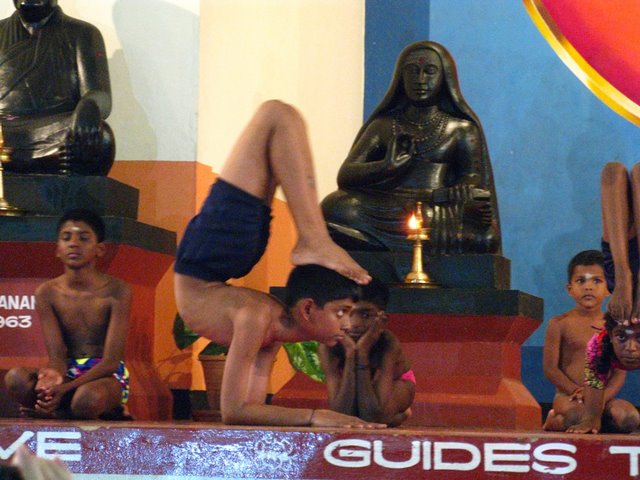
During the final week we were yet again taken into new territory. We completed the cleansing Kriyas (see previous post), and survived Mani’s version of the “BBC” (Back-Breaking Classes). We did our class of 108 Sun Salutations. We were introduced to Advanced breathing techniques (including the “Anal Lock” the details of which I will spare you of), and taught to teach Pregnant Mothers, Children and Golden Oldies. We were even given a show from the 8-year old Under-10 Yoga Champion of All India demonstrating some mind-boggling poses.

It was all far more enjoyable than I expected, and a lesson in how the mind can overcome most obstacles. In the final “meditative yoga” class (see previous post), I even managed to hold the headstand for over three minutes, unthinkable only 10 days previously.

And then suddenly it was over. I had survived – more than that, I had benefited enormously.

At the end of the course I was left to reflect on what I had achieved. Six months previously I had been worrying over results of an MRI scan on my neck in Harley Street consultation rooms. Now, over the past six weeks, I had done 3-4 hours of yoga on all but 7 days, and gained a Yoga Teaching Qualification (even if that is somewhat theoretical without better personal practice). Not many people get the opportunity to do that.

Physically, I couldn’t really have asked for more. But the physical bit was only half the story.

[Click here for Part 2”]

Leave a comment

Filed under 'mind the gap' journey 08-09, All posts, India '08-'09, South India

The belly of Delhi and Andy of Jaisalmer

[Re last post – the mercenary troops Captain Imodium and Lieutenant Rehydration-Salts have been called into action on my behalf, and we have a ceasefire. Let’s hope it’s not just temporary. It is tempting to think that my 48 hour stop-over in India’s capital was the cause of a dose of the Delhi-belly rumblings, but I think that would be stretching a point.]

Having arrived in Delhi last Wednesday night, one of my first tastes of the city was on the following morning – through the eyes of a street-kid. Mel who I was staying with, had arranged a tour with The Salaam Baalak Trust, a charity set up in 1988 by film-maker Meera Nyal (Monsoon Wedding, and the upcoming Shantaram film version).

For myriad reasons, thousands of children flee their hometowns across North India and end up living as street-kids in Delhi. Inevitably many get co-opted into various unsavoury lines of work along the way. Salaam Baalak employs a “pull” rather than “push” approach to helping them, setting up “contact points” near the areas of greatest population. These provide above all an initial place for kids to come and mess about together. Basic education and health support is on offer in huts in some places, with the option to get off the streets when the time is right.

Our guide had fled his Bihar Province home at 8 when he was abused by his uncle; he was on and running drugs by 12; did a few things I am sure we weren’t told about; and ended up with Salaam Balaak over the last 5 years. He is now one of 3 guides running these innovative tours. (To avoid the accusation of “slum pornography”, Salaam Balaak concentrates on visiting their own contact points and telling stories of those that have been helped rather than slavering over deprivation).

Towards the end of the tour, we walked down a back-alley less than 200 yards form the Delhi Railway police station. Cheek-by-jowl with a store offering to “unlock your i-Phone”, two heavily-creased men smoked heroin off tinfoil in the middle of the alleyway. In the next door shop an elderly man was making terracotta piggy-banks. The tour was a brief but fascinating insight into a city of contrasts.

I stayed with Mel (of 5-legged elephant fame) and her husband Jason, who are living as ex-pats in one of the smarter areas of Delhi, Defence Colony. It was wonderful to have a hot shower for the first time for 6 weeks, and to lie on a sofa was heaven. Daily ex-pat life here is clearly not easy though – things that seem amusing when they happen once clearly get tiresome with daily repetition.

To lighten the mood, Mel and I found time for a session of “Laughing Yoga” in one of the parks on the Friday morning. With out 4 new-found laughing friends, we practiced belly laughing (quite simple really -“1…2….3…. hahaha”) and silent laughing (even simpler (1…2…3……[ ]). Both were surprisingly effective.

The three of us escaped that evening by train heading for the Jaisalmer Desert Festival. The cheap seats in the 1740 from Old Delhi are clearly a favourite with local daily migrants – my seat (designed, sensibly, for one) quickly became a haven for me and 4 new-found temporary Indian friends, all of whom I became more intimate with than I ever intended. We beat the record from an earlier journey, getting 27 into an 8-person compartment this time.

As the train slowly spewed forth these returning commuters into suburb towns, my Indian fellow travelers (i.e. those that had actually booked seats) started to get out their books. One of the wonderful things about bookshops in India is the random assortment of English language titles available to a middle-class with a passion for reading, and this was reflected in the compartment – an old 1960s copy of Anna Karenina, A PG Wodehouse “Jeeves” title, and Douglas Adams Hitch-hikers’ Guide to the Galaxy. I felt rather boring as I took out my copy of the Booker Prize winning title White Tiger.

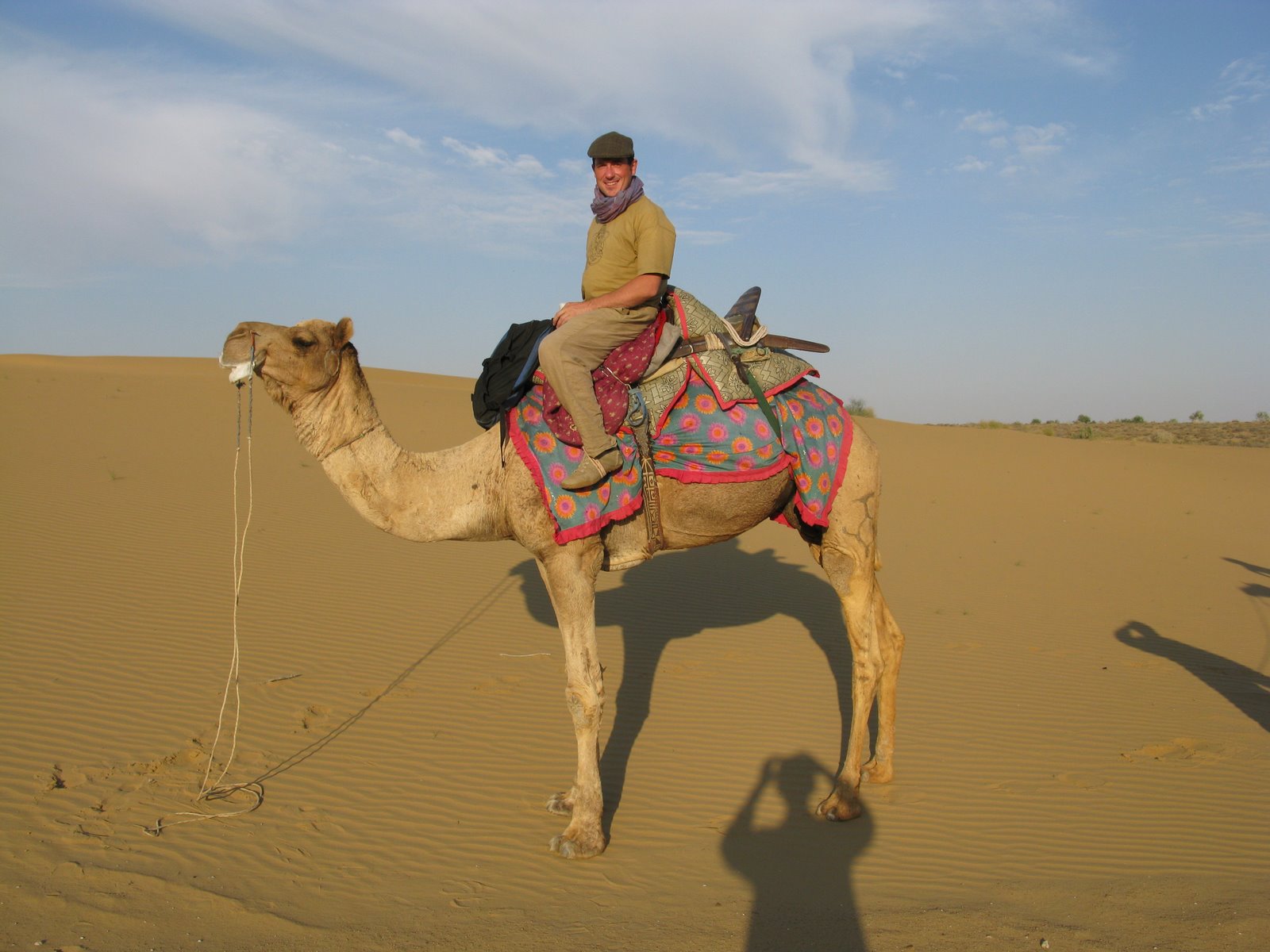
The festival itself was a little disappointing – although the ride into the desert on a camel did present me with my first opportunity to don the flat cap and earn the epithet “Andy of Jaisalmer”.

Inevitably, now that the tourists have gone Jaisalmer is much more pleasant. I will spend a couple more days here to rest and plan what’s next.

Leave a comment

Filed under 'mind the gap' journey 08-09, All posts, India '08-'09, North India