Category Archives: ‘mind the gap’ journey 08-09

You can’t change the plan unless you have a plan…

One of the great things about independent traveling is that you can change your mind at a whim. So that’s what I’ve done.

Some background…

A couple of years after coming to India, my grandfather and three of his friends all in their early 20s, took a trip up to Darjeeling. Being adventurous types, the four of them then embarked on an 80-mile trek through South-West Sikkim on foot. (Darjeeling is the gateway to the Indian state of Sikkim, formerly an ancient Buddhist kingdom, which is perched precariusly between Nepal, Bhutan and China).

My grandfather wrote the trek up in 10 fascinating type-written sheets entitled “A Ten-day tour of Sikkim, October 1922”. It has details of the route which covered 80 miles through the villages of the area, estimated distances covered each day, information on where they stayed (old style “hill bungalows”), and is accompanied by about 20 well-preserved photos.

The best-laid plans…

Naturally, on leaving London I had been excited about the possibility of following the same route. But when I arrived in Darjeeling a week ago, all the guides I spoke to in Darjeeling explained one-by-one that this trip wasn’t really practical now. “Things have changed…” they said. “There won’t be anywhere to stay…” they added. “And anyway how about this nice high-altitide trek?”

It was disappointing, but slowly I was persuaded that redoing the “Ten-day tour” was just a pipe-dream. I reluctantly convinced myself that a different trek would be just as fun.

So I hired the best guide I could find, Shradha Gissing, and made an alternative plan. Shradha (who also happens to be the only female guide in Darjeeling) would take me to her village in West Bengal for a couple of days; we would then take a jeep to a couple of the places mentioned by my grandfather. She would pass me to another guide for the popular 10-day Goecha La trek (a high altitude trip to 5000m to gaze up at Kanchenjunga) in a group with a few others.

That was the trip I proudly announced a couple of days ago.

Make-a-your-mind-up!

But when we got to the beautiful village, something was still gnawing away at me. Why couldn’t the trip from 1922 be done? Surely it couldn’t be that hard?

As we sat eating by an earthenware stove, I shared my frustration with Shradha. I told her I wanted to have one more go at working out the 1922 trip. I asked for a couple of hours to think.

I went to my room, and pulled together everything I had – a 1982 Government of India map bought in Calcutta; my “Rough Guide to India” (with patchy details of the area); the photocopied pages of my grandfather’s route; and finally a book that Shradha’s father had treasured for years and that she had lent to me, entitled “Darjeeling District since 1835”. (Published in 1916, this book later proved to have valuable details of some of the villages on the route).

A couple of hours later, Shradha knocked on my door. I shared what I had found. As we worked through the details into the evening, we both started to realise that it really might be possible. Inevitably there would be a cost to cancelling the high altitude trek, but we reckoned we could still stay within the same budget. I slept on it.

By the next morning, it was so obvious to me that this was the right thing to do. So I am now back in Darjeeling, where we have spent the last couple of days excitedly planning everything. Barring one bridge which no longer exists, we should be able to follow the trek fairly faithfully. Some of the other (previously nay-saying) guides have already been sniffing around for details of how it will be done.

One last thing for amusement. In my grandfather’s type-written notes, there is a section entitled “Kit”. I reproduce it in full. It says:

“KIT. As little as possible is a good maxim. A valise with two blankets and a razai (or quilt) to lie on is all that is required up to 7000 feet. One suit case should carry all other requirements. For dress, stout boots well-dubbined are good, also serge shorts, a thick grey flannel shirt, putties (not always necessary) and a good thick topee as the sun is strong during the day. Thick socks are practically an essential, while lux and darning wool are also useful. Plenty of reading material and paper for writing should be taken. A good sharp knife and a rope are handy. As regards medicines, iodine and Eno’s are the most necessary. A sweater should be carried during the day, and put on at night, when it gets much colder. Candles are always useful as the bungalow lamps were not always in working order. It might be advisable to take a good lamp as well as the hurricane “buttis”. A kettle should be carried for mid-day tea; other useful items in the tiffin equipment are “jharrans” or dish towels, a ground sheet, and papier mache napkins, while of course cups, plates, and cutlery are required. Some small change is necessary but a small amount will suffice.”

Clearly “as little as possible” meant something different when you had a train of 10 porters, cooks, sirdars – and a couple of ponies.

We set off tomorrow morning. With a rucksack each. I will be back on 18 April.
Leave a comment

Filed under 'mind the gap' journey 08-09, All posts, India '08-'09, North India

Getting high in North India

I am heading for the hills of Sikkim for a couple of weeks, so this will be the last post until 18th April.

Darjeeling is currently wet. Very wet. There has been an interesting cast of characters to keep me amused though, the most entertaining of which has been Barbara, a 50-year-old Glaswegian member of the British Communist Party. Tales of being on the barricades with Tommy Sheridan have been relayed with a fine ferocity over a couple of breakfasts. She is here teaching the poorest of the poor. She claims that there is a warrant out for her arrest in the UK.

Since Kanchenjunga has peaked through the rain-clouds only once, I have decided that getting high is the only answer. Judging by the dazed looks on some faces, I am not alone. My particular method involves altitude. I am trekking into Goecha La at 4940m.

Au revoir.

Leave a comment

Filed under 'mind the gap' journey 08-09, All posts, India '08-'09, North India

Clubbable Calcutta and Coal-fired comforts

East-west rivalries exist in many places – New York vs. LA; Sydney vs. Perth, and of course in Scotland, Edinburgh vs. Glasgow. In Scotland the differences were highlighted in the 80s when Glasgow adopted a burly double-entendre of a slogan designed to muscle it‘s way towards the top as Scotland‘s premier city (“Glasgow’s Miles Better”/”Glasgow Smiles Better“). Edinburgh’s pithy response was “Och yes, but Edinburgh’s slightly superior…””

There’s something of that going on between Calcutta and Delhi. The latter is a city on the make (see previous post) and definitely wants you to know it. There’s a sense of pushiness about the way the city portrays itself and acts.

Calcutta, on the other hand, doesn’t feel the need to push it’s case. It has a more languid feel to it with a rich Bengali cultural tradition, a coterie of important families still with some vestiges of power and influence, and some of the elitist Raj institutions having segwayed silkily into the hands of upper Bengali society.

I managed to sneak into one of those institutions, the Bengal Club, during my week there. No-one seemed the least bit fazed as I wandered through in cargo pants and a t-shirt asking for directions to the Reynolds Room on the first floor.
(I sat there for 30 minutes reading my book under the watchful eye of the fortune-teller in Reynolds‘ famous painting, completely undisturbed. Although the waiter was a little bemused).

As I left, I took a look at the notice board. Alongside an admonition form the President (apparently members have been giving tips staff, which is a strict no-no), there was a list of the latest additions to the reading material of the club. Blow the fiction list (Jack Higgins’ and John Grisham‘s latest, Sophie Kinsella’s Shopaholic & Baby, and Vikas Swarup’s Slumdog Millionaire) was the non-fiction list, which made quite interesting reading:

RED HAMMER OVER CALCUTTA UNIVERSITY – Santosh Bhattacharya
BARACK OBAMA – THE NEW FACE OF AMERICAN POLITICS – Martin Dupuis
GABRIEL GARCIA MARQUEZ: A LIFE – Gerald Martin
DREAMS FROM MY FATHER – Barack Obama
THE RISE, DECLINE AND FUTURE OF THE BRITISH COMMONWEALTH – Krishnan Srivanasan

Each says something interesting about the concerns and interests of Club members. In particular, items 2 and 4 reminded me of the daily front-page drama in the newspapers here when I first arrived in November. The question of when Obama would call the Indian Prime Minister verged on a national obsession.

I enjoyed Calcutta immensely for many reasons, but the rising heat (and my consequent increasingly sweat-sodden state) made the siren-call of the “Queen of hill-stations” Darjeeling easy to cave in to.

My 16th Indian train journey brought me to the flats of West Bengal. From there, the famous Darjeeling toy-train creeps up 80km in distance and 6000 feet in height over 6 long hours, with some engineering contortions that are all the more spectacular for having been constructed in the 1921.

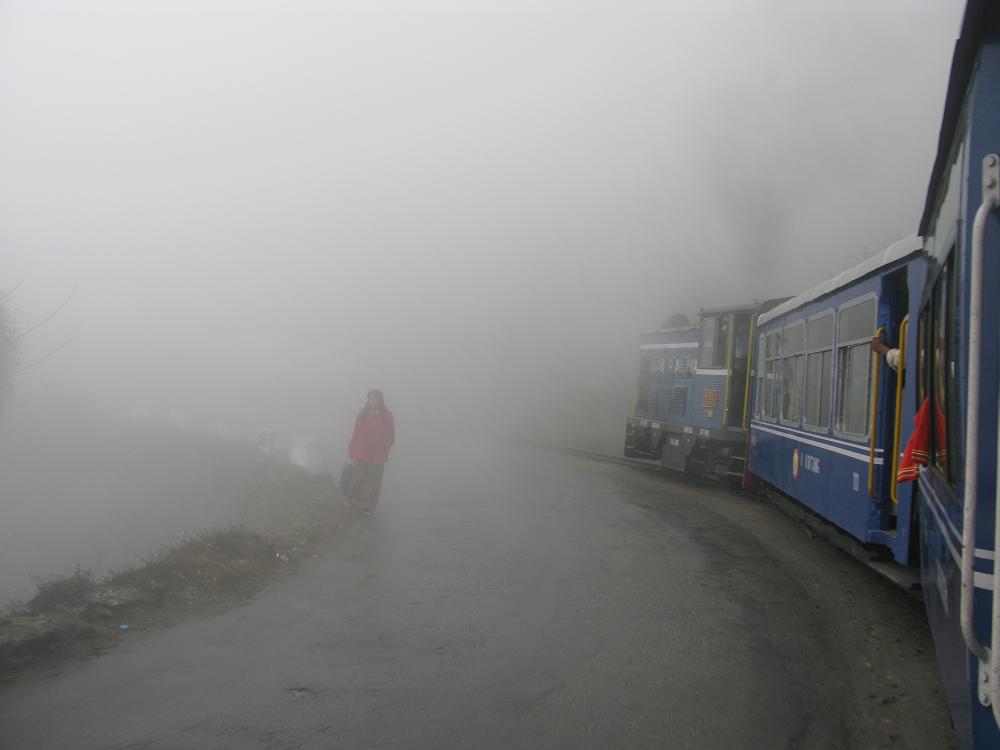
Slowly, everything morphs. Faces become more Nepalese/Tibetan in look; predominantly western clothing betrays both the shift towards a more Buddhist culture and the wealth that has come from tourism; and the weather, well, the weather becomes more… Scottish. The only thing that definitely didn’t change was the injudicious use of the horn. As the railway and the road vie with each other for space on precarious hill-side cuttings, our driver had no hesitation in honking for India.

As we reached the height of Ben Nevis, we were suddenly hit by a thick pea-souper that would put the Bengal Club’s Mulligatawny to shame. With visibility down to a matter of yards, I was suddenly glad of that horn-use. The disappointment of missing out on the normally magnificent views was offset by the beauty of the drops of condensation clinging to the rhododendrons and pine trees along the route.

As the train pulled into Darjeeling station, the rain started to fall heavily. I recalled something in one of the guidebooks about rooms with coal fires. It was too good to pass up.

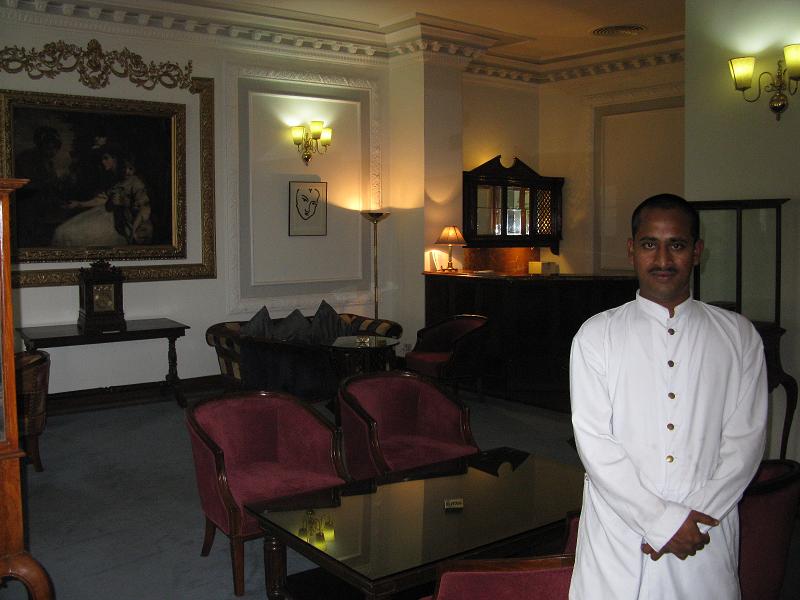
I therefore now write this from a room on the Planter’s Club of Darjeeling (room rate plus 50 rupees temporary membership, plus 120 rupees per bucket of coal), on my handy (tiny) new net-book computer, with a roaring fire in front of me. “Aye. No bad, pal…” as we say in Scotland.

There’s more to write about Calcutta in due course, including a meeting with a remarkable 80-year-old professor in Calcutta. You can read about him here. I was lucky enough to be given a tip that he might be an interesting interviewee, and so it proved.

Sikkim next.

Leave a comment

Filed under 'mind the gap' journey 08-09, All posts, India '08-'09, North India